Saturday, 16 June 2018
The Post-Revolutionary Society has to be built Now
Why is the world suffering from the machinations of the global capitalist mafia? What has happened to us that has allowed these inhuman monsters to gain such power over our lives? It seems that not many years ago, although intrigue was afoot, the world at large was for all practical purposes immune to the drive towards the global gulag. So what happened to weaken our natural immunity? Why did we let our mortal enemies get the upper hand?
This is indeed a tricky question to answer. It could be suggested that the reason our hidden masters have such power is that we perceive them to have this power. What has changed is that we now have a mass media which presents a false image of the world to us, and by owning that media, our enemies have convinced us that we are powerless to halt their 'progress', and that we really shouldn't waste our time trying to.
The printed word, which offered the opportunity for a great spreading of knowledge, has become a medium for the spreading of ignorance and falsehood. To an even deeper extent, audio, and visual media, have become a source of power for those who seek to control us. This is because the human brain works in sounds and pictures and absorbs more information if presented in a manner which mimics natural interaction and experience. Thus the advent of Hollywood and television has proven to be highly significant in influencing how the world is perceived and how this perception is reflected in how people behave in reality.
Our enemies control the media. They own every major outlet, either directly, or directly by being hold the purse strings through advertising. Thereby, they are the editorial power - deciding exactly which issues will be discussed, and in which manner, and which will be ignored. People who speak of revolution are deluding themselves - the media as it exists is in the hands of the globalists, and so long as they have financial power, that is where it will rest.
'Money', in the form we have come to know it, is an illusion. It is produced at the strike of a key on a computer, and from that moment on exists as a generator of debt. We cannot compete with the globalists by trying to become financially more powerful in the conventional sense, as they control the money supply and can create currency at will. What we have to do is look beyond the playing field that has been concocted for our enslavement, and work in reality, rather than in illusion, refusing to play their game and support their agenda.
How do we escape the web which has been spun for us? The media constantly tell us that we cannot. Well, we can. A key step in our struggle for freedom is to stop listening to the lies which are used to imprison us. How many people watch television from the moment they get home, to the moment they go to bed? Some may convince themselves they are 'selectively' viewing and that by filtering out what they consider the most harmful programmes, music, films etc, they are safe from the influence of the mind controllers. This is rubbish! The powers-that-be are far from stupid. They have created levels of control - some obvious, some subtle - but all designed to manipulate the viewer/listener. The obvious mind control is deliberately obvious, so as to allow the participant of the media circus to consider him or herself to have discovered the game and dodged it. 'I don't watch the soaps, I only watch history documentaries' etc - if this is you speaking, you haven't escaped the mind programming, you have actually embraced it more than those who watch all the drivel on the TV, as you believe what you watch to be fair and unbiased. the solution? Turn the machine off, put it in a cupboard, and when the withdrawal symptoms have worn off (It is an addiction - you will experience withdrawal), bin it!
Freeing your mind from the media is but one step in the march to freedom. It is, however, the most important step. Once you are 'clean' of the media poison, you will come to realise that the media are really powerless. they gain control over us because we invite their toxic propaganda into our minds. Once we no longer partake of their lies, they have no power at all. 'But what will I do if I don't have a TV?' you may ask. Think about that question - what will you do, other than stare at a box in the corner of your room? For a start you will NOT stare at a box in the corner of your room! You will Not be programmed to be a servant to the machine - eating your meals at certain times so you can watch the programmes you just MUST see! You will be free to leave your home and live in the real world. You will be free to talk to your loved ones - about things which really matter. You will be free to explore your desires, to explore the world and to enjoy your imagination. In short, you will be free to begin living in a manner of your choosing, not in the manner designed by those who seek to control you.
This is but the first step. Once you have made yourself aware that the media control is a lie, you will begin to see concrete ways to live outside the wider control of the ruling elite - and then we will take back our power from the minority who rule us, and take back our freedom. Their power is the power we give them. We have to take it back!
As Revolutionary Patriotic Socialists forging the path of Economic and Social Liberation, we have to change ourselves from victims of the system, into combatants who stand outside the system - not combatants in the stereotypical guerilla warrior style, but combatants in the manner of people who have freed ourselves from the control of the enemy. Fighting in chains is futile. We must first of all break those chains.
The chains of forced labour can be broken by engaging in cooperative labour with like-minded people, self-employment, or other forms of labour which are not part of the trap of exploitative wage-slavery.
The chains of staring at the tv can be broken by using the tv as a monitor only, and only watching that which is not a part of the controlled media propaganda.
The chains of neediness can be broken by learning and practicing self-reliance in all areas where we can do things for ourselves - as individuals and as groups of people united in comradeship and friendship supporting and helping each other.
The first step on the road to freedom comes in freeing ourselves. This is the beginning of Revolution. As we free ourselves, we become better able to help others onto the path to freedom, and in this way we build the resistance and create a network that exists outside the control of the liberal tyranny. We need to build the Socialist Republic now, so that when the capitalist system implodes, we already have a better way in embryo, which will be the foundation of the future. And of course, from the strength and security of that network, we can do all we can to hasten the collapse of the hated system of exploitation.
Friday, 15 June 2018
Home Education or Liberal Indoctrination - an obvious choice
The UK and Ireland share in common a dire education system in which all that is taught is obedience to the anti-values of liberalism. People who are able to keep their children out of the clutches of the liberal mafia will find that although their children tend to outperform those in the system. They will constantly notice discomfort on the behalf of the individuals asking about their child's school, when they are told that he/she doesn't go to a conventional school, but is schooled at home.
Such is the impact of the liberal education system, that the majority of people in the UK, consider it unhealthy, un-natural, and just plain wrong for a child to be educated by anyone other than an accredited teacher. There are even those who don't accept that homeschooling has any validity, and argue that it shouldn't be allowed. In some countries, homeschooling is illegal, and there are those in the UK who would like to see it proscribed here as well.
Why is there hostility to homeschooling? Why do people sincerely doubt the ability of parents to raise and educate their own children? Scare stories in the media and decades of propaganda about the dangers of not being 'normal' members of society, have taken their toll. By 'normal', the propagandists of course mean conformist. Those who dictate behind the façade of democracy, are wary of anyone who does not accept their rule, and use every means at their disposal to enlist the ordinary people into fighting against any threats to their control. Hostility to homeschooling is a result of a refusal to accept that liberalism isn't magnanimous; it is an expression of defence of the prison state for fear of the consequences of freedom, such as responsibility, self-reliance, and having to think, act and feel for oneself.
In the UK, to become a teacher, one has to undergo a one year post-graduate course. Yes, one year! The course deals with how to control a class of 30 or more children, and how to implement government social-engineering lessons. The knowledge of the teacher from his or her chosen university degree course may, or may not, be useful in teaching, dependent upon which subject or subjects he or she is to teach.
When one begins homeschooling, it really doesn't matter if one is educated to degree level. Understanding the complexities of Statistical Analytical Procedure, or the different strands of thought involved in the Sociological study of Gender Identity Issues (or other such piffle), really does not help when it comes to teaching a child to read and write, to grasp the fundamentals of mathematics, or to do art and crafts.
Education is a vital part of a child's development, but the regimentation of education is un-necessary, and indeed injurious to the child. Regimented education prepares the child for his or her place in the class system. For those who are educated in the State sector, the strict conformity to the bell/buzzer, and the absolute insistence that the Teacher is always right, prepares the child for a subservient role in the economy. For those educated in the fee-paying sector (the bizarrely named Public Schools), the emphasis is on preparation for a managerial role, and the more expensive the school, the higher the level of management and of power in adult life. Thus, the Institutional School System, ensures the continuation of the Class System, and of Materialism as the be-all and end-all of life.
In official schools, the emphasis is clearly placed on conformity and obedience. Freedom of thought is forbidden, and where it raises its head, it is punished. In History lessons, children are taught that the British are basically evil due to their involvement in the African Slave Trade. Woe betide any child who dares to mention the fact that it was the Ruling Class who created the Slave Trade, and that Working Class Britons were enslaved by the Ruling Class and their collaborators before the same tragedy was inflicted upon Africans. Anyone who dares to question the official fantasy version of history risks punishment which could include prosecution for thought crimes. Schools exists to disseminate propaganda, not to impart knowledge.
Homeschooling is time consuming, and it is not without costs. Teaching materials, pens, paper, and all the paraphernalia associated with education, have to be bought. There is no refund of taxes for not using the Establishment system, thus homeschooling effectively means paying for one's child's education twice over. However, monetary considerations should not be paramount. Yes, homeschooling requires sacrifice, but having children requires sacrifices.
A misunderstanding of homeschooling is that the education a child receives at school is superior to that it can receive elsewhere. This is nonsense. A child learning at home has the complete attention of the teacher, and even where there is more than one child present, the ratio of child to teacher cannot be as high as that in an external school. It is argued that discipline suffers when a child is at home; those who argue this may be referring to their own inability to discipline their children, but that doesn't mean that all parents are lazy or incompetent in looking after their own.
Home-schooled children tend to work harder than other children, and have fewer long holidays. They certainly do not have the chance to avoid doing work set for them, and if they ever utter the words 'my dog ate my homework', the chances are it will be true!
The State actively encourages parents to hand their children over to nurseries and pre-schools before giving them to more strangers in the school system itself. It is not uncommon for a child as young as one year-old to be given into the care of non-family members. If parents are willing to abrogate their parental responsibility in order to gain material wealth, then they do not deserve to have children at all. Such parents reduce themselves to breeders of the next generation of producer-consumers; victims of the anti-human State.
Do you want your children to be indoctrinated with globalist propaganda? Do you want them to be taught that there are more than two genders, and that feelings are more important than facts? Do you want your children to grow up supporting NATO's wars against humanity; to have no love for anything but materialism; to have no culture; to have no spiritual or intellectual goals? Or do you want them to be free, feeling, thinking, intelligent, articulate, questioning human beings?
Homeschooling is more important than ever now that there are more failing schools than ever, increased class sizes and easier exams. Also the very fact that the liberal dogma effectively means that bright kids are ignored in the class room so that more time can be spent on thick and/or disruptive kids means that a decent education in a state school is very unlikely.
Children can get all the socialising they need from clubs and extracurricular activities. The socialising in schools is unnatural and bullying, peer pressure and pecking orders always establish themselves.
Unless you are happy for the liberals, capitalists, globalists and trotskyites to destroy your children and any hope of them achieving a future of moral, cultural and spiritual worth, then you will do all you can to keep them out of the School System. The citizens of many countries are legally barred from home educating their children. In the UK we are still allowed to raise our own children as we see fit. If we do not make the fullest use of this opportunity, then we are collaborators with the destruction of society, and deserve the evils which our enemies are striving to make our reality. The prison door is closing. We have the chance to put a foot in the door and empower the next generation with the tools to restore freedom. This is a chance we cannot afford to miss.
SMPBI members and supporters are encouraged to do all they can to limit the influence of the liberal indoctrination system on children they are responsible for. If you can home school, you should. In the coming Republic, education will be the responsibility of the community, with all teachers and children knowing one another, and no strangers involved. The education that we would give our own children now, is the education we want for the nation when we sweep away the decadent parasitic system of today. Our children deserve our fullest commitment; nothing less will do.
Thursday, 14 June 2018
Sajid Javid: Zionist Tory Banking Tyrant; Enemy of the NHS and the Working Class Worldwide
The Home Secretary Sajid Javid, will tomorrow lift all restrictions on non-EU people working in the NHS. He will effectively open the borders to anyone from anywhere in the world (except the EU), as long as they claim to have a background in healthcare.
Who is this Sajid Javid who is playing loose and fast with our sovereignty? Javid was born in Rochdale to Pakistani immigrants. In 1995 he began working for Chase Manhattan Bank in New York and South America, followed by Deutsche Bank in London and Singapore, having a working lifetime in the heart of the Globalist Capitalist Banking Criminal Network for 14 years. He progressed to Managing Directorship level. He has Global roots, Global experience and is committed to furthering the cause of Globalisation.
Javid left Banking to go straight into a safe seat for the Tory party, becoming an MP in 2010.
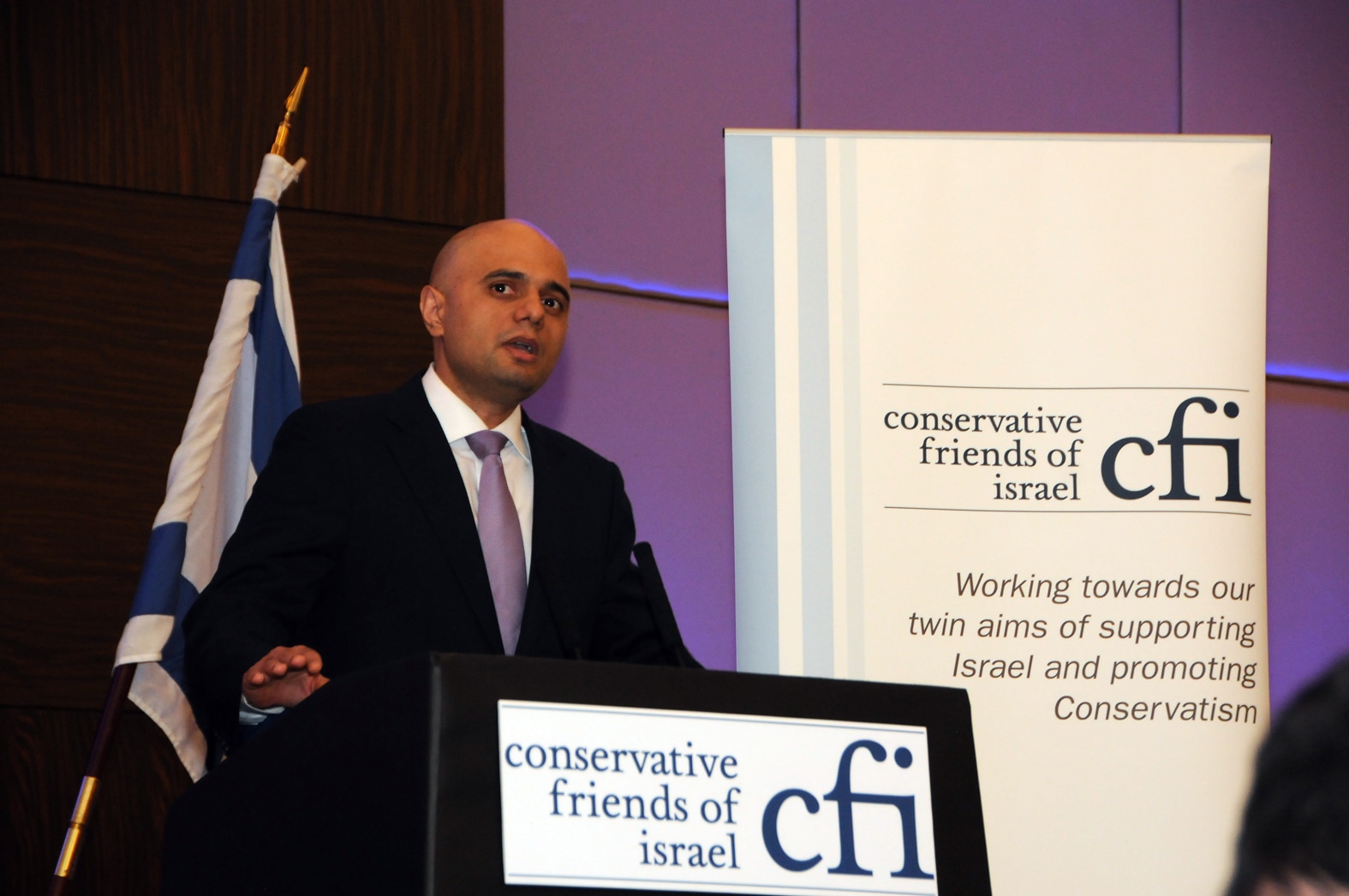
As well as a career in Banking, Javid is a confirmed Zionist, who has stated that should he be offered the chance to live in the Middle East, the only country he would want to live in is Israel. He used his position as Communities Secretary to attack councils who supported the BDS movement and in this way increased the power of the Zionist stranglehold in British politics. He is - of course - a member of the Conservative Friends of Israel, aka the Conservative Enemies of Palestine and Freedom Anywhere.
In 8 short years as an MP, Javid has advanced at a rate which is even surprising for the corrupt Tory party, to now hold the position of Home Secretary. Clearly being an ex-Banker, a Globalist and active Zionist, is the key to success in the Tory ranks.
His announcement that the NHS should be filled to the rafters with non-EU workers, is an affront to the people who voted for Brexit. We voted to secure our borders, not kick them wide open. But more than this, it is an attack on the Working Class in Britain, who will be denied work, as cheaper imported labour will once again be used in place of training the unemployed.
The NHS does need more skilled staff. Importing skilled staff from other countries - especially underdeveloped ones - is a drain on those countries. It is a form of racism, to attack countries economically - as Javid's banking colleagues do - then to steal the best workers from those impoverished countries to staff the NHS. Every country needs its best people to help it develop. Stealing the best from other nations is to cause a brain drain and to cause skills shortages in those countries, which will of course, further impoverish them. SMPBI is outraged at this racist attack on poorer nations, which will become poorer still as a result. Javid is a Banker at heart, and does not care that it is the likes of the World Bank and IMF which are destroying the underdeveloped world. He is a Globalist who has no respect for Borders and National Integrity.
SMPBI calls for British Jobs for British Workers. Our People must come first. If there are skills shortages, there must be free training for the Working Class to fill those shortages. We call for an end to the disgusting abuse of foreign countries which comes in the form of draining them of their best workers rather than train our own citizens.
Sajid Javid is an absolute disgrace. His identification with the Zionist menace is a clue to his character. He respects Israel and attacks those who oppose the brutalisation of the people of occupied Palestine. Javid is living proof that it isn't only the liberal globalists who are a danger to freedom, but all globalists. If the countries destroyed by Bankers like Javid were free from the capitalist sickness, they could have their own NHS's, and their own people could help to raise the standards of those countries. If the British Isles were free from these political and corporate parasites, we too could have an NHS staffed with our own Workers, with Class and National Loyalty making our lands better places in which to live.
Javid personally gained by accepting payments from the Fracking Industry to overturn the democratic decision of Lancashire County Council to ban Fracking in Lancashire. The man who claims to care about the NHS, took payments to bring in unsafe practices which are linked to decline in health in people living in affected areas. Lancashire is 120 miles from where Javid is an MP, and much further from where he sits in London. The Tories will sell off the NHS at the first opportunity. Javid has as much respect for the NHS as he has for the People of Lancashire who he sold out so his corporate friends could make a killing in an industry which has very serious questions as to its safety. He is corrupt to the core - a perfect Tory!
Javid has to go, and so does the entire corrupt Globalist Zionist system.
Save our NHS. Train our People. Stop the Exploitation of other lands. Close the Borders and Stop the Parasitic Skills Drain, which in turn impoverishes not only the lands of the immigrants, but also our own.
Wednesday, 13 June 2018
Uniting Hegel, Husserl and Heidegger - Wilberg on Wednesday
MIKE KOSOK CA. 1981
(1927 – 2015)
The Dialectical Phenomenology of Michael Kosok
Biographical Preface
The larger-than-life man to whom this essay is dedicated and without whose genius and inspiration it could not possibly have been written, is in all likelihood long dead. I first encountered Michael Kosok in 1975, when he was still professor of physics and mathematics at Fairleigh Dickinson University, New Jersey. For over two decades now he has disappeared from trace, his extraordinary writings on philosophy and science now seemingly consigned to oblivion – never published save for a few articles in the journal Telos. From him comes the term ‘dialectical phenomenology’ which is the subject of this work — a homage to his genius and a belated recognition of the immense influence he exerted on my own life and thought. Mike himself favoured another term for his own philosophy – the Life and Science of Paradox – a life he lived through his appreciation of energy as dynamic relationality, and his unsurpassed grasp of the “Dialectics of Nature” – the circular and paradoxical dimension of relationality in all domains and at all levels, from the sub-atomic to the social. With this essay a circle in my relationship to Mike is also completed, one that began in my last year as an undergraduate at Oxford with the discovery of his seminal article entitled “The Formalisation of Hegel’s Dialectical Logic”. Thirty years later (2004), I find myself having come full circle from this beginning in my own writings on phenomenological medicine and psychotherapy, and the dialectical phenomenology of the human organism. The completion of a circle is not a closure but an opening, for the circle is no less defined by what it rings and bounds as it is by the unbounded field that opens up around it and the infinite possibilities of inward expansion that this field opens up. The same I believe is true of the circle of life that we see beginning at birth and ending at death. I am sure that Mike is even more fully aware of this now than he was when I knew him. Though I cannot locate his body in space and time, the ‘non-localised field of awareness’ that constituted his being and brought life to it is anything but dead.
Introduction
Physical science is based on a belief in miracles — the miraculous emergence of awareness itself from an otherwise non-aware universe of matter and energy – a universe we couldn’t even know about without our awareness of it. It seeks to explain our capacity for conscious awareness through studying particular phenomena within our own field of awareness — for example the physical body or brain. The terms ‘physical’ and ‘physics’ derive from the Greek verb phuein – to ‘emerge’, ‘arise’ or ‘manifest’. Physics offers explanations of how things emerge or arise but does not begin by recognising them as phenomena emerging or arising within a field of awareness. From a phenomenological point of view, however, the known universe is not merely a universe we are aware of – it is the universe of our present human awareness. The focus of phenomenological science is not preconceived ‘things’, but the nature of those things as phenomena manifesting in a field of awareness. Dialectical Phenomenology is concerned with the physical dynamics of phenomena in the root sense of this term – the process by which phenomena emerge or arise, not as objects for a localised or ‘punctual’ subject, but events arising from and within a non-localised field of awareness – indeed as the self-manifestation of that field. Dialectical Phenomenology belongs to the very essence of Marxism as a “human science of nature and a natural science of man”, distinct in principle from both the Hegelian dialectic and Husserlian phenomenology. Hegelian dialectics lacks a full phenomenological basis. Husserlian phenomenology lacks a full dialectical understanding of the field character of subjectivity and its field dynamics – the dynamics of inter-subjectivity and relationality. For Husserl, consciousness was always conscious of something. For Michael Kosok there are no ‘things’ to be conscious of in the first place. The world is not a step-by-step linear ‘construction’ or ‘evolution’ of complex wholes from separate, pre-given elements which enter into relation with one another — or with a perceiving subject. Instead all elements are, to begin with, not elements in relation but elements of a dynamic relation, constantly defining themselves through that relation and constantly being transformed by it. We live, according to Mike, not in a world of things but a world of ‘-ing’. Ultimately ‘being’ as such is a verb (‘be-ing’), but a verb without a pre-given subject, an activity without a pre-given agent. Subject and object, self and other, are distinct but inseparable dimensions of a singular boundary state of dynamic relationality or interactivity, one which defines itself and all ‘selves’ or ‘subjects’ through its dynamic process of self-manifestation and self-differentiation – of ‘selving’. Husserl was right in one sense: our awareness of ourselves is always an awareness of ourselves in relation to something or someone other-than-self. But that relation is itself a circular one – one in which self and other define themselves in and through their mutual relation, as distinct but inseparable aspects of a dynamic field of interrelatedness whose self-expression is what they both essentially are.
BRIEF DEFINITION OF DIALECTICAL PHENOMENOLOGY
A unified field theory of awareness: awareness being understood as a non-localised, field of relatedness and inter-subjectivity which is the condition of appearance of any localised objects for a localised subject.
THE PRINCIPLES OF DIALECTICAL PHENOMENOLOGY
1. The basic phenomenological principle
All phenomena are localised self-manifestations of a non-localised field of awareness.
2. The basic dialectical principle
Any phenomenon manifesting within a field of awareness as a bounded entity (a posited presence or ‘thesis’) is co-defined by its immediate context of appearance (its ‘antithesis’). Examples of thesis and antithesis are figure and background, organism and environment, particle and energy field.
“Neither exists as an already well-defined entity outside of their mutual boundary relation…the so-called synthesis or unity of opposites is not a construction of opposites but rather the opposites are nothing but inseparable sides of a singular boundary state…” (Michael Kosok)
3. The principles of dialectical ontology
All fields of awareness, and the phenomena that manifest within them are the expression of a universal ground state of awareness which we call Being. The ground state of awareness is not awareness of anything. It is the being of awareness – itself inseparable from the awareness of being. The being of awareness is ‘no-thing’. Nor is it nothing. It is the field condition for our awareness of ‘any-thing’. The awareness of being is awareness of no-thing. It is the condition of awareness of any-thing. The ground state of awareness is both formless and the source of infinite formative potentials. Formlessness and form, potentiality and actuality, non-being and being, no-thingness and thingness, are inseparable aspects of a singular boundary state of ‘becoming’ – or ‘be-ing’. The ground state of awareness or “Being” is a state of dynamic actualisation or Be-ing, constantly giving form to its own formative potentials, and constantly transformed by them.
4. The Gestalt principle (dialectic of figure and ground)
All phenomena are forms or figurations (‘Gestalts’) arising from the universal ground state of awareness.
All figures that emerge from this universal ground state of awareness (Being) are also particular figurations of awareness (beings).
As a figuration of awareness, every figure that emerges from the ground state of awareness configures its own field of awareness.
A being is no more or less than a particular pattern, figuration or ‘Gestalt’ of awareness: one which configures its own awareness of other beings – the way it perceives them as phenomena within its own field of awareness.
The universal ground state of awareness (Being) is a source both of infinite fields of awareness (beings) and the infinite phenomena manifesting within those fields.
An example of the figure/ground dialectic:
A fish is a part of the oceanic ‘field’ in which it lives and at the same time an individualised self-expression of that field — a fishly form of the ocean as a whole. The fish is also distinct from the oceanic environment around it and from the other fishes within it. All oceanic life forms perceive both the ocean as a whole and other organisms within it in their own unique way, for their own unique organising field-patterns of awareness each create a uniquely patterned field of sensory-perceptual awareness – their ‘ocean’. Sharks, for example, perceive electrical fields of other organisms and experience the ocean itself as an electrical field and not merely a tactile, visual or auditory one. The ocean, in this analogy, can be compared to the universal ground state of awareness or Being which gives rise to a multiplicity of foreground ‘figures’ in the shape of fish and other life forms. Yet each of these figures in turn shapes its own ‘background’ field – constitutes its own patterned environment field of awareness or ‘ocean’. The ocean as such, as a ground state of awareness, is not reducible to a singular environmental or ‘background’ field common to all the life forms that ‘figure’ within it, but is a field of fields or ocean of oceans. What the ocean as such or any other oceanic life form within it essentially is, cannot be reduced to the way it is perceived as foreground figure or background field by other life forms – each of which perceives both the ocean as a whole and all the life forms within it in a way configured by their own organising field-patterns of awareness. If Being is a ground state of awareness then the relation of Being and ‘beings’ can be compared to the ocean’s awareness of itself as ocean, and its awareness of itself in the individualised form of each of the life-forms that it gives rise to. The self-awareness of these life forms is their awareness of themselves and each other as a part of the ocean as a whole and as self-expressions of it - both distinct but inseparable from it. Only a fish with a human-like ego awareness would experience itself as a being separate and apart from the ocean as a whole and other life forms within it, and regard its own uniquely patterned perception of the ocean and its life forms as more ‘real’ or ‘objective’ than those of a fish or shark.
5. The principle of irreducibility (dialectical asymmetry)
Being cannot be reduced to beings.
The universal ground state of awareness cannot be reduced to any particular figurations and fields of awareness it gives rise to.
A given field of awareness cannot be reduced to or explained by any phenomenon manifesting within that field.
Examples:
A nightmare cannot be reduced to or explained by any event experienced within it.
A text cannot be reduced to or explained by a single word, sentence or paragraph within it.
Similarly, the awareness we possess as human beings cannot be reduced to or explained by any phenomenon manifesting within our field of awareness: for example the human body or brain as we perceive it within that field.
6. The holarchic principle (dialectic of whole and part)
The universal ground state of awareness is not just a whole that is more than the sum of its parts: a ‘holistic’ field of awareness in which particular figures manifest. Since every figure emerging from the ground state of awareness configures its own field of awareness, the universal ground state of awareness is a holarchic field – a whole of wholes or a field of fields.
Every part is a self-manifestation of the whole, one which in turn transforms the whole.
Every phenomenon manifesting within a field of awareness is a self-manifestation of that field, one which in turn transforms that field.
Every patterned field of awareness emerging from and within the ground state of awareness or Being, is a self-manifestation or ‘selving’ of that ground state – thus assuming the character of a self or being.
Being, as the sum of all that is, is not just an absolute or infinite whole made up of finite parts — beings. Nor is any whole – even an absolute whole - merely the unity of its parts. For each part is also the unity of all the wholes of which it forms a part – up to and including any absolute or infinite whole. Each part being the unity of all the wholes or fields of which it forms a part - and a self-manifestation of any absolute or infinite whole or field - beings are themselves absolute, infinite or holistic units – ‘holons’.
7. The principle of form (dialectic of foreground and background)
Every phenomenon that manifests within a field of awareness appears as a foreground figure which co-defines its own background field. Foreground figure and background field are distinct but inseparable aspects of a singular unitary or ‘holisitic’ field of awareness within which they arise or emerge, a field which includes both. A prominent object in a still-life painting appears as foreground figure against a background field. The holistic field – the painting as a whole, includes both the object and its background.
Foreground figure and background field (for example a black object against a white background) are also inseparable mutually-defining elements of a singular boundary state – the form of the figure as such. What we see as a ‘black’ circle surrounded by a white background could just as well be seen as a ‘white’ circle with a black interior. The circle as such – the form or figure — is not black or white. It is both and neither. Similarly, what we perceive as spherical bubbles of gas in a fluid medium could just as well be described as bubbles or spheres of fluid containing gas. Just as the circle as such is neither black or white so is the sphere as such neither fluid nor gaseous. A form is reducible neither to a foreground figure or text nor to a background field or context. It is a dynamic boundary of distinct but inseparable elements. Any ‘body’ is essentially a bounded form or figure – defined not simply by what it surrounds and contains but also by all that surrounds and contains it. The principle of form offers a new understanding of biological forms and of bodyhood as such - not as something intrinsically bounded but as a dynamic boundary between the inner and outer fields of a form or figure.
8. The principle of relationality (dialectical logic)
A field is not composed of separate elements placed in a certain formal relation to one another. The elements are themselves elements of their formal relation, distinct but inseparable sides of a singular boundary state of determination, like two sides of a coin or the inside and outside of a circle or sphere. All elements of any field are circularly self-referential, defining themselves through their relation to other elements in the field — as an organism, for example, defines itself through its relation to its environment and to the other organisms within it. From the simple antithesis of seemingly separate entities – organism and environment — the dialectical principle of relationality allows us to understand the reciprocal relation of organism and environment as a relation internal to both. For the environment of an organism is itself an environment of organisms — an ‘eco-system’. Conversely, each organism constitutes its own sensory-perceptual environment. In the case of human beings, the dynamic relation of the human organism to its environment becomes one element in an internal relation of the organism to itself – the capacity of the human mind to create an internal mental environment to which the human body itself responds physiologically in the same way that simpler organisms respond to their physical environment.
So-called ‘formal’ logics are based on the idea of elements which are not only distinct but separate – whose own form and identity is independent of their formal relation.
Dialectical logic is based on the idea of elements which are distinct but inseparable, formed and transformed by their mutual relation.
No relation (<>) between two elements, A and B is merely an external relation of separate identities. It is also an internal relation of identity – a relation between the A-aspect of B and the B-aspect of A.
A <> B ‡ A[B] <> B[A]
Example:
Wholes (A) and parts (B) are not separate things, but defined by their mutual relation.
The internal relation of whole and part has to do with the partness of wholes and the wholeness of parts.
The whole is a whole of parts and the parts are parts of a whole.
Any whole is part of a larger whole. Any part is a whole with its own parts.
A whole is composed of its parts and of their sub-parts (like a large circle with multiple smaller circles and circles within those circles).
Conversely however, a part is a constituent of all the larger wholes of which it is a part (like a circle which is one of multiple circles within larger circles and circles of circles).
A whole is a unity of the parts which are a part of it. Conversely however, a part is also a unity of all the wholes of which it forms a part.
9. The principle of field-subjectivity (dialectical epistemology)
Dialectical epistemology does not begin with the idea of a punctual subject confronting an independent world of objects but with the understanding of the field character of subjectivity. It understands both ‘subject’ and ‘object’ as part of a unitary field of awareness.
The unitary field of awareness embraces not only the individual’s experience of the world but their experience of themselves as part of that world.
It embraces not only their experience of ‘objective’ things but their ‘subjective’ experience of the thoughts they have about those things.
It embraces not only their perception of external objects as bodies in space but their internal ‘subjective’ perception or proprioception of their own bodies and their spatiality.
It embraces not only external or ‘objective’ objects but internal or ‘subjective’ objects such as feelings and sensations. These are distinct but inseparable aspects of a singular field of awareness.
Our self-experience and our experience of the world and other people, in other words, are distinct but inseparable aspects of a singular field of awareness. Concepts and thoughts are not merely subjective representations of percepts or things in the ‘real’ world. Both concepts and percepts, thoughts and things are an expression of the same reality, phenomena manifesting within a field, and self-manifestations of that field.
This is not to say that a dualistic epistemology based on the idea of a localised subject confronting an independent world of objects is ‘false’. It is one culturally-conditioned way of experiencing our relationship to the world, one culturally-conditioned mode of self-experience reflected in philosophy, one configuration of the larger non-localised field of awareness within which we give form to both our self-experience and our experience of others and otherness. This non-localised field-subjectivity is not enclosed by our skins, located in our brains or bounded by our skulls. Our very experience of ourselves as perceiving subjects separate from the objects of our perception implies a relation to those objects. The question is whether subject and object are elements in relation or mutually defining elements of that relation, and of the field of interrelatedness of which it forms a part.
Dialectical epistemology is phenomenological epistemology but not ‘phenomenalism’, ‘solipsism’ or ‘subjectivism’. For it includes a dialectical understanding of the intrinsically relational dimension of subjectivity or awareness, and the inter-subjective character of awareness fields. The world is indeed the world as we are ‘subjectively’ aware of it. But that does not mean that awareness is the property of a solipsistic ‘subject’ or ‘ego’, for whom the existence of ‘other minds’ or other ‘subjects’ is doubtable.
We do not just experience things and people in the light of our ‘own’ awareness of them. We also experience ourselves in the light of the things and people around us. Standing next to a tall skyscraper, we are not merely aware of its height. We feel small in relation to it. Awareness has the character of mutuality or inter-subjectivity comparable to a mutual gaze. Other people, for example are not just part of our own field of awareness – we are also a part of theirs. How we manifest or appear to one another within our respective fields of awareness has to do with the intrinsically relational or inter-subjective character of those fields themselves. The look on a person’s face or in their eyes is no mere object for a perceiving subject. It reveals their way of looking out at the world and experiencing it subjectively. In the mutual gaze, what we see in their look is their way of looking at and seeing us — and also what they see in us. Inter-subjectivity, seeing and being seen manifest objectively in the looks perceived in the face of the other, but if our focus is entirely on the objective features of a person’s eyes, we cease to gaze upon the human being, and nor do we experience our own being in the light of their gaze.
10. The principle of figurative perception (dialectical aspectivism)
An idea too, is a way of looking at things. The word ‘idea’ is derived from the Greek eidos - the look of something or its ‘aspect’, and the verb ‘idein’ – ‘to see’. The word ‘aspect’ in turn refers to both an ‘objective’ face or facet of something we perceive and to the ‘subjective’ angle of perception from which we perceive it – our way of looking at it. The perceived look or aspect of a thing or person is never something purely ‘subjective’ or ‘objective’. Perception is always aspectual, and aspects are always ‘as-pects’, a perception of something ‘as’ this or ‘as’ that.
Examples:
We perceive something as a rose or tree.
We recognise a voice on the answerphone as that of person X or person Y.
We perceive a look on someone’s face as a look of anger or delight.
For Plato, the treeness of a tree or the tableness of a table was not in itself anything substantial, but rather its eidos – translated both as ‘idea’ and as ‘form’. Dialectical aspectivism is not a relativistic perspectivism or constructivism which reduces objective perception to a subjective construct. Instead it understands aspects as something that transcends the subject-object dichotomy. In perceiving the table as a table we perceive one aspect or ‘as-spect’ of what it is — its tableness. Plato’s intuition was that the perceived form of a thing, its eidos or aspect, is both something ideal and immaterial and something no less real for that. The aspectual character of experience is not just its formal character but also its figurative or ‘metaphorical’ character in the broadest sense. We do not only conceive or mentally represent things ‘as’ this or that — we also perceive them as such. What Hegel called the ‘subjective idea’ of a thing can be understood as our mental representation of it as this or that. What he called the ‘objective idea’ can be understood as the aspect of the thing itself that our perception of it reveals. The Hegelian dialectic understood nature itself as an unfoldment of the ‘objective idea’ and the progressive emergence of its latent forms or aspects at ever higher and more complex levels of dialectical interrelatedness. The ‘absolute idea’ was reached through the completed self-expression of the entire process of dialectical unfoldment in the ‘subjective idea’ ie. human thought itself.
11. The principle of logical method (dialectics of phenomenon and noumenon)
Logical method was central to Hegel’s thinking, and he defined dialectical logic as “consciousness of the form taken by the inner spontaneous movement of its content.” This inner spontaneous movement took the form of a dialectical process which led from ‘thesis’ and ‘antithesis’ to a synthesis which in turn posited a new and higher level thesis. Hegel himself understood his method as a phenomenological one and was phenomenological in as much as it was based on a distinction between consciousness and its content. Unlike previous philosophers, Hegel did not merely think about the world of our conscious experience and then construct a grand theoretical edifice of concepts. His edifice was built on his experience of thinking as such, and his consciousness of the dialectical form taken by the process of thinking — the “inner spontaneous movement” of thought from one concept to another.
The theory of dialectical phenomenology also rests on a fundamental distinction between consciousness and its contents, understood as a distinction between phenomena as we perceive or conceive them and the field of awareness in which these percepts and concepts take shape. The relation between phenomenon and field is conceived as a dynamic and dialectical relation between figure and ground, beings and Being, the aspects of a thing and its essence of beingness. In its method, however, it is nevertheless distinct from that of Hegel. Both phenomenologically and dialectically, it is never enough to make a merely conceptual distinction between awareness fields and phenomenon that manifest within them, between consciousness and its contents, between reality as we experience it and reality as we represent it in thought. To properly conceptualise the relation between thought and experience we must, to begin with, experience this relation.
The method of dialectical phenomenology is based on a distinction between:
pre-conceptual experience
conceptualised experience
experiencing of the process of conceptualisation
conceptualisation of the process of experiencing
This conceptual distinction between these four dimensions of experience must itself become an experiential distinction for the phenomenologist. He or she must develop the capacity to experience distinctions at a pre-conceptual or pre-reflective level before reflecting on and conceptualising them, and at the same time be able to experience the process by which conceptual distinctions arise from and give form to pre-conceptual and pre-reflective experience. Without being in touch with our pre-conceptual experience, conceptual distinctions, far from reflecting or representing experiential distinctions, tend to abolish, supersede or superimpose themselves on the latter. Experience is ‘unconsciously’ pre-conceived and foreclosed by concepts which are not themselves experienced as phenomena in our field of awareness. Concepts as products of experience and thought replace and restrict the ongoing process of thought – the experiential process generating concepts from (pre-conceptual) experience. As a result we cannot reach the stage of being able to conceptualise the process of experiencing itself – what Hegel called “consciousness of the form taken by the inner spontaneous movement of its content”.
The distinction between pre-conceptual and conceptual experience is one dimension of the distinction between noumenal and phenomenal experience. Noumenal experience is our direct experience or ‘felt sense’ (Gendlin) of the pre-phenomenal, field of awareness from and within which all experiential phenomena emerge (phuein) into manifestation — whether these phenomena be things or thoughts, percepts or concepts. The phenomenological method is based on experiencing this process of emergence or phusis and then conceptualising it. Only then will the concepts formed give expression not just to the ‘things’ we experience but to our experience of those things as localised phenomena emerging from the realm of the noumenal – from non-local fields of awareness.
Examples:
· The transformation of pre-reflective awareness into reflective awareness.
· The transformation of perceptual into conceptual awareness.
· The transformation of non-localised moods into localised emotional feelings.
· The transformation of directly felt meaning into verbally formulated meanings.
What these examples are all examples of is the transformation of ‘noumenal’ into ‘phenomenal’ awareness. The ‘noumenal’ is the field of pre-phenomenal awareness. Pre-phenomenal awareness consists of those field-states of awareness (pre-physical, pre-perceptual, pre-reflective and pre-conceptual) which are the condition for the emergence (phusis) of any phenomena we are aware of - and can therefore reflect on and conceptualise. They are also examples of the transformation of feeling awareness and feeling cognition – the essence of subjective field awareness – into ‘objective’ sensory, perceptual and conceptual modes of cognition.
12. The pragmatic principle (dialogical ethics)
Awareness is intrinsically relational – an awareness of ourselves in relation to something or someone. Consequently, our understanding of the relationships between things and between people is conditioned by our relationship to those things or people. What I call the ‘pragmatic’ principle of Dialectical Phenomenology is the recognition that changes in our comprehension of the relationships between things and between people can come about through changes in our active relationship to them – whether this change takes the form of new ways of using them, scientific experiments performed on them, or changes in our inner bearing towards them. Conversely, a new way of seeing something or seeing someone is in and of itself a change in our relationship to that thing or person.
This pragmatic principle is also an ethical principle: knowledge is not neutral, but always the expression of an active mode of relatedness. Marx’s dialectical analysis of social relationships showed how capitalism transformed relationships between human beings into relationships between things – commodities – rather than understanding all relationships between things, natural and man-made, as the expression of relationships between beings. The Jewish social philosopher, Martin Buber, distinguished two primary modes of relatedness, the “I-It” and the “I-Thou” mode. The I-It mode reduces things and people to passive objects for the ego or “I” – whether objects of knowledge or contemplation, thought or emotion, use or exploitation – and in which this “I” remains untouched and unaltered by its relationship to “It”. The I-Thou mode, on the other hand, is one in which the relationship itself is directly experienced as an intersubjective one, a relationship between beings which turns the “It” into a Thou and allows the “I” to be transformed by its relationship to it. The experience of the ‘beingness’ of things is not an esoteric experience. It belongs to the essence of relationality itself as a state of inter-subjective resonance between two beings — two self-expressions of the universal ground state of awareness from which all fields and all phenomena spring.
Postscript: the Heideggerian Gnosis and Dialectical Phenomenology
Heidegger was attuned in a most poetic and profound way to the essence of phenomenology and able to experience and do what Husserl effectively only conceptualised and talked ‘about’ - ground his language and conceptual distinctions in his deep pre-conceptual awareness of those distinctions – in immediate feeling cognition or gnosis. And whilst he affected a scorn of ‘dialectics’, there is perhaps no more pithy distillation of the dialectical character of knowledge or gnosis, understood phenomenologically, than in the following words of Heidegger himself:
“…what is knowable and what is known are each determined in their essence in a unified way from the same essential ground. We may not separate either one, nor will we encounter them separately. Knowing is not a bridge that somehow subsequently connects two existent banks of a stream, but is itself a stream that in its flow first creates the banks and turns them towards each other in a more primordial way than a bridge ever could.”
From Dialectics of Nature by Michael Kosok
Subjectivity as a non-localised field of presence is nothing but concrete immediacy, i.e. experience as an on-going process, in which the events or event-complexes present are any objects, products or structures appearing out of the field and thus co-existing with it, be they symbolic systems, physical objects or ego.
Intersubjectivity…cannot be understood as a simple ego-ego activity of two self-centred individuals somehow ‘relating’. It must include within its domain nature and the body-body physics of interacting energy as the mutual content of genuine relation.
…a dialectics of man implies a dialectics of nature and vice versa.
All event-complexes appearing objectively – be they so-called given matter in the form of photons, atoms or stars; living matter in the form of plants or animals; thinking matter in the form of humans; or culture in the form of expressed ideas – are dynamic expressions of non-linear field activity capable of resonant response with man.
The difference in the intersubjective component lies in the scope and depth of the “I and Thou” resonance that can be established in the non-linear state of affecting and being affected or seeing and being seen.
The so-called problem of the “other” or “other minds” only appears if you really think (Laing notwithstanding) that experience is private and in need of being communicated i.e. that experience can be owned like a commodity. Emotional reactions, thoughts and object modifications are not examples of experience but rather products of experience, and qua products, they are indeed distinctions giving uniqueness.
Growth and genuine transcendence come only when one can re-grasp the relationship that exists between the process of experience and its products, realising that products and results are neither ends (positive or posited goals), nor something to be denied (negative goals) but are rather the vehicles and means through which experience can enrich its self-mediated state of concrete immediacy and express itself in visible forms.
Degeneracy, however, sets in when the reverse takes place and man defines and delimits experience…in terms of its products and results. Such is the paradoxical challenge of existence – not to be ‘done in’ by the very products of its process!
So-called ‘false’ or ‘inauthentic’ consciousness is simply the product of ‘true’ or ‘authentic’ consciousness, instead of being the process.
Mere factual or formal knowledge always appears in the form of an object that becomes known, while wisdom is the realisation that a full knowledge of awareness reveals relations and thus perceives all objects and structures in a state of mutual, reciprocal determination.
Wisdom only comes through recognising the dialectic of mutual limitation between any focused form and its codetermining context. If no integrated experience exists within which the immediate mutuality of subject and object is felt directly, then the alienation of subject from object hardens and the subject-object paradox becomes a contradiction.
In capitalist societies…this hardening takes the form of the institutionalised separation of the subject as producer from his object of production, reducing both to commodities in an external exchange relation in which price (externalised value) replaces value (intrinsic worth).
In philosophy, the hardening first takes the form of an opposition between objective ‘scientism’ (positivism, behaviourism) and subjective existentialism. In both of these positions, subject and object stand as intrinsically ‘other’ to each other. There is no dialectic interdependency manifesting itself through a transformation in which each becomes a function of the other and each a function of itself through the other.
References: Michael Kosok, Dialectics of Nature, from Proceedings of the First International Telos Conference Ed. Grahl and Piccone, Telos Press 1970
Recommended site: THE NEW DIALECTICS The Dialectical Phenomenology of Michael Kosok
Tuesday, 12 June 2018
The DPRK is safe - For now.
The US and the DPRK have reached an agreement which transforms the ceasefire of 1953 into Peace. Today's Summit is a historic occasion in which the aggressors of the USA have finally recognised the right of the Democratic People's Republic of Korea to be a sovereign nation.
The key points of the summit declaration statement are as follows:
- The United States and the DPRK commit to establish new U.S.–DPRK relations in accordance with the desire of the peoples of the two countries for peace and prosperity.
- The United States and the DPRK will join their efforts to build a lasting and stable peace regime on the Korean Peninsula.
- Reaffirming the April 27, 2018 Panmunjom Declaration, the DPRK commits to work toward complete denuclearising of the Korean Peninsula.
- The United States and the DPRK commit to recovering POW/MIA remains, including the immediate repatriation of those already identified.
SMPBI cautiously welcomes the outcome of the Summit. However, there are worrying parallels to be drawn with other countries which have effectively disarmed themselves in the pursuit of peace with the USA.
Iraq and Libya are key example of nations which were threatened by the USA. In both cases, following the destruction of their defensive capabilities, they were invaded and destroyed, They sought peace, and to prove their sincerity made themselves vulnerable. The US criminals took full advantage, and now Iraq is an occupied country, and Libya is in ruins.
If the US modus operandi follows as it always has, then Kim Jong Un (just as Saddam Hussein and Muammar al Gaddafi before him), may well have just signed his own death warrant, and opened the path for his country to be wrecked by a fake 'colour revolution' and/or a military attack.
The DPRK has started down a dangerous path. Creeping economic liberalisation threatens to let the Capitalist parasites back into the country. The existence of a McDonalds in Pyongyang is an illustration of the backwards steps away from the Juche idea.
Has Kim Jong Un saved his country from destruction by the USA, or opened the path for just that? We hope that this summit is the path to peace. Ideally this could be the starting point for reunification of Korea under the ideals of Juche, not the barbarism of Capitalism. We will probably not have too long to wait to see if this was a superb piece of diplomacy, or the leadership of the DPRK walking into a trap.
Sunday, 10 June 2018
Socialist Quotes for Sunday Reflection pt 14
It is not the working class, but the capitalist class that undertakes the organisation of industry and the control of the market for profitmaking. This is no accusative statement. It is the claim boastfully and triumphantly made on behalf of employers and capitalists generally, by themselves and their political apologists. And surely no more discreditable admission of their personal incompetence, or the unserviceableness of their functions could be desired, than this of their cwn, that they are unable to conduct the production and exchange of the country, with even such bare efficiency as will allow of their paying the paltry wages demanded by their workers, or of their obtaining for themselves the no more than petty profits which they allege their businesses afford. What object can there be in producing commodities at all, if neither those who make them, nor those who Organise those who make them, nor those even who sell them, can get a “living wage” out of the undertaking?
And if neither the workers can get wages, nor the employers profit, to whom does the enormous sum of our industrial profits go – a sum admittedly sufficient, even with our present recklessly wasteful methods of production, to richly supply all our material needs as a nation, and of which at present the workers, some four-fifths of the nation, only obtain one-third? Who are the clever knaves, and how do they get their greedy fingers in. who contrive so successfully to deplete the workers of the reward of their labour, and the astute employers of their tender percentages? And why don’t the employers, the “captains of industry,” the “statesmen of commerce,” as they have, with prodigious flattery, been designated, seize hold of these wicked thieves and have them publicly arraigned for their crimes? Truly, if matters stand as said “captains” and “statesmen” protest upon all occasions of dispute with their workmen, they must either be imbeciles, and fit only to be confined in lunatic asylums, or themselves be the knaves, or the abettors of the knaves, in which case they should be stripped of their “captains’” uniforms, and deprived of their “statesmen’s” seals, and sent to the places which they have prepared for their less dangerous, but more unfortunate professional brethren.
And if we inquire we shall find that our worst suspicions of the capitalists are confirmed at every turn. Their everyday actions, their mode of life, their places of abode, the company which they keep, and even their antecedents, all track them down as men of evil principles and unrighteous deeds.
J Bruce Glasier, Socialism and Strikes, 1920
.....................
“This time when people are excited about Socialism, and when many who know nothing about it think themselves Socialists, is the time of all others to put forward the simple principles of Socialism regardless of the policy of the passing hour. I say for us to make Socialists is the business at present, and at present I do not think we can have any other useful business. Those who are not really Socialists—who are Trade Unionists, disturbance-breeders, or what no—will do what they are impelled to do, and we cannot help it. At the worst there will be some good in what they do; but we need not and cannot heartily work with them, when we know that their methods are beside the right way. Our business, I repeat, is the making of Socialists, i.e. convincing people that Socialism is good for them and is possible. When we have enough people of that way of thinking, they will find out what action is necessary for putting their principles into practice. Until we have that mass of opinion, action for a general change that will benefit the whole people is impossible. Have we that body of opinion? Surely not. . .Therefore, I say, make Socialists. We Socialists can do nothing else that is useful, and preaching and teaching is not out of date for that purpose; but rather for those who, like myself, do not believe in State Socialism, it is the only rational means of attaining to the new Order of Things” (Commonweal 15th November 1890)
“Fellow Citizens, We come before you as a body advocating the principles of Revolutionary International Socialism; that is, we seek a change in the basis of Society—a change which would destroy the distinctions of classes and nationalities. As the civilised world is at present constituted, there are two classes of Society—the one possessing wealth and the instruments of production, the other producing wealth by means of those instruments but only by leave and for the use of the possessing classes. These two classes are necessarily in antagonism to one another.” (Socialist League Manifesto)
“No better solution would be that State Socialism, by whatever name it may be called, whose aim it would be to make concessions to the working class while leaving the present system of capital and wages still in operation: no number of merely administrative changes, until the workers are in possession of all political power, would make any real approach to Socialism.” (ibid)
“To the realisation of this change the Socialist League addresses itself with all earnestness. As a means thereto it will do all in its power towards the education of the people in the principles of this great cause, and will strive to organise those who will accept this education, so that when the crisis comes, which the march of events is preparing there may be a body of men ready to step into their due places and deal with and direct the irresistible movement.” (ibid)
"Our business, I repeat, is the making of Socialists, i.e., convincing people that Socialism is good for them and is possible. When we have enough people of that way of thinking, they will find out what action is necessary for putting their principles into practice. Until we have that mass of opinion, action for a general change that will benefit the whole people is impossible" ('Where Are We Now?', 1890, p. 226).
"Intelligence enough to conceive, courage enough to will, power enough to compel. If our ideas of a new Society are anything more than a dream, these three qualities must animate the due effective majority of the working people; and then, I say, the thing will be done" ('Communism', 1893, p. 229).
William Morris
......................
"Technology also replaces the familiar connection of parts to wholes; everything is just an exchangeable piece. For example, while a deer or a tree or a wine jug may “stand on its own” and have its own presence, an automobile does not: it is challenged “for a further conducting along, which itself sets in place the promotion of commerce.” Machines and other pieces of inventory are not parts of self-standing wholes, but arrive piece by piece. These pieces do share themselves with others in a sort of unity, but they are isolated, “shattered,” and confined to a “circuit of orderability.” The isolated pieces, moreover, are uniform and exchangeable. We can replace one piece of standing reserve with another. By contrast, “My hand ... is not a piece of me. I myself am entirely in each gesture of the hand, every single time.”
Human beings too are now exchangeable pieces. A forester “is today positioned by the lumber industry. Whether he knows it or not, he is in his own way a piece of inventory in the cellulose stock” delivered to newspapers and magazines. These in turn, as Heidegger puts it in “The Question Concerning Technology,” “set public opinion to swallowing what is printed, so that a set configuration of opinion becomes available on demand.” Similarly, radio and its employees belong to the standing reserve of the public sphere; everything in the public sphere is ordered “for anyone and everyone without distinction.” Even the radio listener, whom we are nowadays accustomed to thinking of as a free consumer of mass media — after all, he “is entirely free to turn the device on and off” — is actually still confined in the technological system of producing public opinion. “Indeed, he is only free in the sense that each time he must free himself from the coercive insistence of the public sphere that nevertheless ineluctably persists.”
But the essence of technology does not just affect things and people. It “attacks everything that is: Nature and history, humans, and divinities.” When theologians on occasion cite the beauty of atomic physics or the subtleties of quantum mechanics as evidence for the existence of God, they have, Heidegger says, placed God “into the realm of the orderable.” God becomes technologized. (Heidegger’s word for the essence of technology is Gestell. While the translator of the Bremen lectures, Andrew Mitchell, renders it as “positionality,” William Lovitt, the translator of “The Question Concerning Technology” in 1977 chose the term “enframing.” It almost goes without saying that neither term can bring out all the nuances that Heidegger has in mind.)
The heart of the matter for Heidegger is thus not in any particular machine, process, or resource, but rather in the “challenging”: the way the essence of technology operates on our understanding of all matters and on the presence of those matters themselves — the all-pervasive way we confront (and are confronted by) the technological world. Everything encountered technologically is exploited for some technical use. It is important to note, as suggested earlier, that when Heidegger speaks of technology’s essence in terms of challenging or positionality, he speaks of modern technology, and excludes traditional arts and tools that we might in some sense consider technological. For instance, the people who cross the Rhine by walking over a simple bridge might also seem to be using the bridge to challenge the river, making it a piece in an endless chain of use. But Heidegger argues that the bridge in fact allows the river to be itself, to stand within its own flow and form. By contrast, a hydroelectric plant and its dams and structures transform the river into just one more element in an energy-producing sequence. Similarly, the traditional activities of peasants do not “challenge the farmland.” Rather, they protect the crops, leaving them “to the discretion of the growing forces,” whereas “agriculture is now a mechanized food industry.”
Modern machines are therefore not merely more developed, or self-propelled, versions of old tools such as water or spinning wheels. Technology’s essence “has already from the outset abolished all those places where the spinning wheel and water mill previously stood.” Heidegger is not concerned with the elusive question of precisely dating the origin of modern technology, a question that some think important in order to understand it. But he does claim that well before the rise of industrial mechanization in the eighteenth century, technology’s essence was already in place. “It first of all lit up the region within which the invention of something like power-producing machines could at all be sought out and attempted.” We cannot capture the essence of technology by describing the makeup of a machine, for “every construction of every machine already moves within the essential space of technology.”
Even if the essence of technology does not originate in the rise of mechanization, can we at least show how it follows from the way we apprehend nature? After all, Heidegger says, the essence of technology “begins its reign” when modern natural science is born in the early seventeenth century. But in fact we cannot show this because in Heidegger’s view the relationship between science and technology is the reverse of how we usually think it to be; natural forces and materials belong to technology, rather than the other way around. It was technological thinking that first understood nature in such a way that nature could be challenged to unlock its forces and energy. The challenge preceded the unlocking; the essence of technology is thus prior to natural science. “Modern technology is not applied natural science, far more is modern natural science the application of the essence of technology.” Nature is therefore “the fundamental piece of inventory of the technological standing reserve — and nothing else.”
Given this view of technology, it follows that any scientific account obscures the essential being of many things, including their nearness. So when Heidegger discusses technology and nearness, he assures us that he is not simply repeating the cliché that technology makes the world smaller. “What is decisive,” he writes, “is not that the distances are diminishing with the help of technology, but rather that nearness remains outstanding.” In order to experience nearness, we must encounter things in their truth. And no matter how much we believe that science will let us “encounter the actual in its actuality,” science only offers us representations of things. It “only ever encounters that which its manner of representation has previously admitted as a possible object for itself.”
An example from the second lecture illustrates what Heidegger means. Scientifically speaking, the distance between a house and the tree in front of it can be measured neutrally: it is thirty feet. But in our everyday lives, that distance is not as neutral, not as abstract. Instead, the distance is an aspect of our concern with the tree and the house: the experience of walking, of seeing the tree’s shape grow larger as I come closer, and of the growing separation from the home as I walk away from it. In the scientific account, “distance appears to be first achieved in an opposition” between viewer and object. By becoming indifferent to things as they concern us, by representing both the distance and the object as simple but useful mathematical entities or philosophical ideas, we lose our truest experience of nearness and distance."
Mark Blitz: Understanding Heidegger on Technology
Saturday, 9 June 2018
The queen's birthday should be a private affair. Time for the Republic
Today is the monarch's birthday - well, one of them anyway. The media have been waxing lyrical about one of the Guardsmen in the Trooping of the Colour, wearing a Turban rather than a Bearskin Hat. As Republicans, it is hilarious to see the liberals falling over one another to celebrate the queen's birthday, and the way in which the ceremony has become more multicultural, and increasingly removed from its traditions. We want the monarchy gone, so we see nothing positive about appeal of the Ruling Class spreading further. We want a Republic to sweep away the parasites of the Ruling Class. As for the Trooping of the Colour, that ceremony celebrating our oppressors is an anachronism, and the types of hats worn have no significance whatsoever.
Elizabeth Windsor, the so-called Queen, is an utter disgrace. The woman has overseen the destruction of the United Kingdom, with its complete take-over by financiers and global capitalist corporations. For the ordinary people, her years of misrule have seen a proud land impoverished. The Working Class population is denied decent employment, liveable welfare and healthcare and a decent standard of living. Yet still flag-waving imbeciles continue to sing 'God Save the Queen' and to spout absolute drivel about "what a good job" the parasite does for the country!
Elizabeth Windsor is a despicable fraud. She is not, nor ever could be, the rightful ruler of the UK. She has her position simply because she is a member of a family, which has done more than any other to advance the causes of Global Capitalist Tyranny. Every policy wish has passed through parliament has had to have Royal Assent before becoming law. Thankfully, as the incumbent of the Throne has no legitimacy, then nor do any of the laws which have passed during her time.
As if to emphasise her disdain of the British people, the 'queen' gives out 'honours' on her birthday to all manner of scum. To be honoured by a despot is to have no honour at all, so anyone who accepts an honour from the Windsors, publicly identifies him or herself as a stooge of the Ruling Class and enemy of the people. In recent years, the queen has honoured the likes of Rolf Harris, Jimmy Savile and Shimon Peres. These are just a few of many decadent and degenerate creatures who have done nothing to help the peoples of Britain. It is indicative of the Ruling Class and Bourgeois collaborators that absolute scum are honoured by them. You can judge a man by the company he keeps - and in the case of the royals, that is very true.
Shimon Peres
Shimon Peres was awarded the title of Knight of the Order of Saint Michael and Saint George.
So what did Shimon Peres contribute to the world, and to Britain in particular? What had he done to merit an award from the queen?
Shimon Peres was implicated in the murder of Yitzhak Rabin. Rabin's crime was to call for peace with the Palestinians and an end to the ethnic cleansing of Palestinian land in Greater Israel. Rabin did not advocate the dismantling of the bandit state, merely a reduced level of occupation in the West Bank and Gaza. This was so offensive to the elite of Zionism, that Rabin was murdered. Immediately following the murder of Prime Minister Rabin, Peres took the helm. One of his first acts was to invade the sovereign nation of the Lebanon, forcing 400,000 people to flee from their homes, and an unknown number to be murdered. The butchering of Rabin and the Lebanese by Israeli and Zionist forces under Peres' command was rewarded by the queen.
When visiting fellow Zionist state, Turkey, he stated that the massacre of 1,500,000 Armenians by the Turks in the Great War could not be called genocide and should not be considered to be of equal worth to the suffering of the Jews in the Second World War. In a sense, he was correct. The massacre of the people of Armenia is a historical fact, and therefore should not be compared with the Zionist propaganda of the Holocaust.
The knighting of Peres followed in the footsteps of the knighting of mass murderer and accomplice to the New York World Trade Centre massacre, Rudolph Giuliani. Knighthoods are allegedly meant to acknowledge deeds which have benefited the Crown of Great Britain. Certainly the WTC bombings aided the British invasion of the Middle East and Central Asia and helped secure the goal of a Global Zionist Empire. Obviously the millions of murdered Asians are of no consequence to our beloved Queenie.
There are still people who tug their forelocks and proclaim 'God save the Queen'. They argue that the Monarchy have served the British people and deserve our respect. They are wrong.
Jimmy Savile
Jimmy Savile was a child procurer to the rich and famous. The story we are supposed to believe is that Sir James (OBE) wandered into Children's Homes and Hospitals and abused children whilst no-one was looking. This would of course be horrendous in itself, but it isn't true. For those from outside the UK, the term Children's Homes, is used alongside the equally sick euphemism, 'Care' to disguise a system of brutal cruelty in which children are stolen from their parents by the State using an army of Social Workers, backed up by the Police, and place in what would be better described as concentration camps for the innocent victims of the depots in authority.
The illusion of Sir James Savile going into places where he could abuse children using his fame as a television personality and charity organiser, is a smoke-screen. The picture we have of this foul man is of a child catcher, such as the one in Chitty Chitty Bang Bang. There is an ironic truth in this, as in that film, the child catcher was working for the Ruling Class (as indeed Savile was). The controlled media (working for their owners) have twisted the Savile story to make him appear to have been acting more-or-less alone and for his own perverse gratification. In truth, Savile was but a gofer, working with the police and social services to procure victims to be raped by his high powered clients. Rather than using imagery of the Child catcher, we would be better using imagery of a man studying a menu and buying what is on it based on a shopping list given to him by others.
The Windsor scum, Westminster politicians, top civil servants, heads of police forces and assorted celebrities, used Savile and others like him as go-betweens. Savile's role in the child rape scandal was as a front man who would visit his clients in positions of power, take down orders for what particular children they would like to rape, torture and murder, then go to his contacts in the police, social services and the outrageous Family Court Service (secret courts which rubber stamp the break-up of families and which accept no defence against their actions) to ensure that children who fitted the bill would be taken from their families, placed in the child prison system (so-called Care) and made ready for their abusers.
Savile is now dead, and according to the controlled media, he was one of a kind and so we can all now breathe happily in the knowledge that our children are safe. This is preposterous. The people who gave Savile orders are still in place (some have died, but they have been replaced). The people who filled his orders and got the children for his clients to destroy are still in place (or likewise have been replaced by willing monsters who serve the State and have no qualms about ruining the lives of ordinary people.) The army of Social Workers, Policemen, Court officials, Media cover-up teams etc is still in place. And of course, Savile's death changed nothing. He was not a lone wolf - he was a member of staff, with many, many colleagues working alongside him to the same end.
The Savile scandal briefly gave us an opportunity to wreck the system which sees us as cattle, but then the majority of the people went back to sleep, swallowing the lies of the media, and focusing upon the next bit of fake news to be pushed into the public domain. There will be people reading this who will ask, why write about this now as it is old news? That is exactly why it has to be written now. Our children are still being destroyed and we are simply swallowing more media lies and letting it happen.
Savile was awarded the OBE, and made a Knight Bachelor by the queen for services rendered. He also was awarded a KCSG by Pope John Paul II. After Savile's peaceful death, his victims were further dishonoured when neither nor the monarchy nor the papacy would revoke his honours. Such is the calibre of the queen and the quality of the Honours List.
Republic Now
We seek an end to the monarchy, the aristocracy and the entire honours system. A free Socialist Republic will have no place for class distinction and no place for privilege, wealth and power due to birth. We do not wish the monarchy any ill, but nor do we wish that they continue as the Ruling Class. Let them celebrate their birthdays in private, and at their own expense. Their day is over, ours is coming.
Subscribe to:
Posts (Atom)
UNRWA are terrorists
The SMPBI has been campaigning since the 7th October Massacre in Israel for the paliarstinan terrorists to be exposed for the murdering filt...
-
English Revolution was created in response to the need for a left-wing engagement with a rising English sense of national identity and to ...
-
by Wat Tyler The Socialist Workers Party are the product of the British education system and the media. Their obsession with the trials and ...
-
There has been much speculation over the past view days as to the nature of the SWPE. As links have been posted on various sites which will...