Showing posts with label Marx. Show all posts

Thursday, 30 June 2022

Imperialism, Nation and Class Struggle


National-Revolutionaries - "Red Nazis", "Bolsheviks in disguise", "Nazi-Maoists", "Stalinists of the Right" or "Conservatives of the Left"? Our political opponents have been confused since the post-war national revolutionary movement came into being. Ideological pigeonholes and old dogmas no longer hold true and the old taboos of the traditional political camps are shaken when confronted with national revolutionary positions. There are nationalists who make no secret of their nationalist radicalism, but at the same time have elevated the class struggle against the capitalists to the highest principle. How is this possible? How can a nationalist stand for the class struggle against the capitalists? A revolutionary socialist class struggle for the nation? "They are controlled by the East!" cries the so-called "nationalist" right, for whom the protection of private property over the means of production has always taken precedence over the freedom of the nation. They have always seen the class struggle as a tool of an enemy foreign power, intended to destroy the so-called unity of the people. "They are Nazis in a new guise!" cry both the Marxists and the liberals, for whom people and nation have at best a tactical meaning and whose dream goal is the levelled "one world", free of ethnic and cultural differentiations, without independent nations. However, new problems require new questions and new questions require new answers. The fronts of the 19th century (which on closer inspection were also different from what school historians would have us believe), are no longer the fronts of today. The world of the last twenty years of the 21st century is at a point where these new fronts are becoming increasingly clear. Classes, ideologies, social forces, they are all in turmoil.


The New "One World" Imperialism


Today, when we speak of the nation, when we fight for its liberation, when we see nationalism as a progressive, emancipatory force, our opponent is different from the one who confronted the nationalists of the 19th century. It is no longer a question of freeing the merchant and the industrial citizen from the shackles of feudal restrictions; it is no longer even primarily a question of freeing some "small" nation from the rule of a "large" one. Even the concept of imperialism as the antithesis of national liberation can no longer be defined exclusively in terms of individual states.


Certainly, there is American imperialism, the imperialist neo-colonialism of England and France, there are also imperialist elements in German politics. However, all these phenomena, which the socialists of the 1960s were still railing against, are today becoming more and more evident for what they really are: different aspects or facets of one and the same multinational globalist corporate imperialism that penetrates into the very ends of the globe!


The capitalism of the 19th century was the grandfather of this corporate imperialism. It began as the competitive capitalism of individual entrepreneurs. Family fortunes were invested, increased, strengthened by bank loans, and factories were built that in the Netherlands are associated with names like Philips, Unilever, Shell, and so on. The origin, development and inner regularity of this were excellently described by Karl Marx in his economic works. This stage of capitalist development had already been completed for several decades when Lenin wrote his book "Imperialism as the highest stage of capitalism" in 1916. In it he accurately described what Marx had already foreseen: the course of capital concentration in the industrialised countries, which at the end of the 19th century gradually began to replace competitive capitalism. This was caused by the concentration of the economy under conditions of free competition, as Marx had described in his work "Das Kapital". The imperialist phase of capitalism was characterised by the concentration of productive forces as a result of ruinous competition, which led to the formation of cartels, trusts and monopolies, as well as the increasing incorporation of bank capital and industrial capital and thus the complete placing of national state apparatuses at the service of the capitalist classes. While competitive capitalism was still characterised by the export of goods, imperialism was characterised by the export of capital: investments were made in so-called "backward" countries; wages, land and raw materials were cheap here, new markets could be developed locally.


The imperialist states, which primarily included England, France, Germany and the US, secured these interests through military aggression ("gunboat policy") and the colonial conquest of entire continents. In this period, for example, British and French colonial rights were extended to large parts of North and Central Africa, parts of Africa and Oceania were colonised by the German Empire, and the third-ranking former colonial power Spain was crushed by the US, with the establishment of US colonies on former Spanish colonial soil (Philippines, Puerto Rico, etc.). Conflicts of interest between these national imperialisms and their national capital groups then led to the First World War; a thoroughly imperialist war, for which the blame must be laid not on one nation (e.g. Germany), but on the interests of conflicting national capitals.


The period from 1914 to 1945 can be seen as a time of great upheaval, as a transition phase to the nocturnal phase of capitalism. Lenin was mistaken when he considered the imperialism of his time, represented by individual states, to be the highest and final stage of capitalism. On the contrary, the human mill was turned further, the bulldozer was driven even more brutally over tribes, peoples and nations, even more nature and raw materials, people, material, soldiers and citizens, workers and peasants were sacrificed to the Moloch of capitalist industrial development. The revolutionary-socialist hope of Lenin and the Bolsheviks for the end of times proved to be false.


At the end of the Second World War, the USA had become the dominant power in the imperialist camp, the former European competitors had torn each other apart and eaten each other up. However, European capital was still there, in the colonies, in the production units, stocks and real estate that had remained intact, in the money that had been invested in neutral countries. Thus, although the US took over the political and military leadership of the Western world and was certainly the most powerful economically, the US capitalists could not easily absorb European capital. On the contrary, after a phase of increasing export of US capital to Europe, a phase of increasing reciprocity in the export of capital began, the creation of joint subsidiaries (not only in the Third World) and the amalgamation of the largest banking and industrial groups around the world through a thousandfold network of holdings and cooperatives. After competitive capitalism and old imperialism, the third stage of the capitalist system has been reached, multinational imperialism, or globalism!


"One World" of Dead Souls


This new type of imperialism created globalist instruments to coordinate its activities and gain complete control over all the peoples of the world. These instruments include:


- NATO and friendly/allied pacts such as SEATO, ANZUS, etc. as military instruments of domination.


- The World Bank and the infamous "International Monetary Fund" (IMF) as the central levers of global economic control, which have brought almost all the nations of the world into dependence through their lending policies and all manner of financial manipulations.


- Associations such as the "Trilateral Commission", "World Economic Forum" and the "Bilderberg Conference" as consultative bodies of important state, economic and trade leaders, media representatives etc. from the Western industrialised countries.


The goal, the "One World" controlled by inscrutable multinational globalist bodies is now within their grasp! It is not the result of an ominous "world conspiracy", but results from the development logic of capital (which was never understood by the right-wing parties; the reason why they had to resort to mystifications of conspiracies to explain simple processes). The interdependence of capital increases day by day, as does the dependence of the peoples on the decisions of the IMF and the big banking centres. For the sake of higher profits, the importance of capital utilisation cries out for globally standardised production processes, consumer behaviour, ways of life; for global psychological calculability and thus for the disappearance of all mental and cultural differentiations.


This 'brave new world' of the multinationals will be a world without cultural diversity, without national sovereignty and regional autonomy, without democratic decision-making and without workers' rights. It will be planned and structured down to the smallest detail, realising Ernst Jüngers' chilling horror vision of "planetary planned landscapes". It will reduce the human being to the functions of production and consumption, it will leave no room for individuality, creativity outside the global culture industry and no self-determination for the people. Its supreme principle will be the rationality of capitalist profit. Their ideologies are - even now - liberal cosmopolitanism, progressivism and the idolisation of industry and technology. Their archenemy is and remains: NATIONALISM!


Class Struggle as Revolutionary Task


If nationalism is anti-capitalist, it must finally free itself from the reactionary imagination of the political right. This means, above all, that all ideas of the "peoples community" (volksgemeinschaft) and "national solidarity" under the umbrella of the capitalist system must be definitively rejected. For the people are divided into the stooges of imperialism and its ideologies, on the one hand, and those who suffer and partly fight against imperialism, on the other. This division is - from its objective causes - a division into social classes since the basis of imperialism is determined by one class alone, namely the capitalist class from whose womb it emerged.


The class struggle is therefore not a Marxist "instrument of division" against the people, but exists objectively and is perceptible every day in the conflicts between the different social classes. Today, more than ever, it is the task of true national revolutionary politics to make people aware of this class struggle, to intensify it and to orientate it.


The beneficiaries of the imperialist system in each country are the direct representatives of the multinationals, the directors, commissioners and managers of the respective banks and companies, as well as their accomplices in political parties, trade unions, the media and the cultural sector. The deceived are the broad strata of the people, the workers who have been deprived of their identity and culturally enslaved. They are economically exploited and politically impotent. It is necessary to persuade these misled people to fight against the globalists. This can be done on the basis of the objectively existing economic contradictions, which have become increasingly evident in recent years.


The economic contradictions of the working class in particular against the capitalists have been elaborated excellently by Karl Marx: the workers produce surplus value which the capitalists appropriate. The producers are thus deprived of the fruits of their own production. Moreover, in the capitalist production process they are constantly exposed to the constraints of profit maximisation for the capitalists, with all its consequences: rationalisation, high work pressure, industrial accidents and waste of personal labour power. In times of crisis, the capitalists and their state withdraw previous social concessions, resulting in poverty and impoverishment. From these contradictions arises an anti-capitalist potential for conflict, which can manifest itself in daily small-scale wars in the factory, but also in mass actions of the workers, employees, etc. on the streets. That is where the national revolutionary struggle can and must begin!


Imperialism is based on a system of continuous industrial production, creation of surplus value, reinvestment, increased production, etc. The bearers of production are the workers, without whose labour there would be no existence. The carriers of production are the workers, without their labour the system could not exist. There can be no war in the world without weapons produced by the workers. No ship, no aeroplane, no car is available, no electricity flows through the wire without the power of the labourer. Thus the worker has in his hands the weapon to pull the rug out from under imperialism and thereby liberate both himself and the nation, the people. The sharpening of the antagonisms between the exploited and the exploiters, the raising of the class struggle to a higher level, can lead to the working class refusing to work in one country or another and thus attacking the basis of the system. Political strike, general strike, factory occupation are thus among the main instruments of the class struggle, which must ultimately lead to the national liberation struggle.


The political-strategic awareness of the link between personal suffering and the imperialist world system arises no more or less spontaneously today than it did 80 years ago, when Lenin, in his writing "What to do?", pointed out the necessity of the link that the spontaneous (economic) workers' movement must make with revolutionary theory. The lever for establishing this link is the revolutionary organisation, the creation of which is an increasingly urgent task for national revolutionaries.


It is the workers and the other simple layers of the people who have every interest in freeing themselves from this system, which means social liberation from the capitalist economic system and thus liberation from the imperialist world system. The bourgeoisie, on the other hand, is today anti-national to the bone (and that means, above all, liberal), because everything it has to lose after a socialist workers' revolution, it has gained through this globalist system. This also applies to the much-quoted 'small', 'medium' and 'anti-monopoly' capitalists, even now that their days are numbered due to the wave of bankruptcies. What is overlooked, however, is that these capitalists also benefited to the end from the ruling system, which guaranteed them private ownership of the means of production, protection from exploitation and, in most cases, a decent living. They are allies of the system and not of the people; for the sake of profit they have always been prepared to betray their nation. One cannot serve both the moneybags and the nation. Individual pursuit of profit is liberalist behaviour and service to the nation is socialist behaviour (the former characterised by individual, the latter by collective interests); both are mutually exclusive.


Conclusion:


Capital has now organised itself internationally and is striving for the completion and unification of the world. The struggle for the preservation of peoples and cultures as a national revolutionary task must therefore be directed against international capital, globalism. Nationalism is thus an anti-capitalist struggle; a class struggle!


National revolutionaries must recognise the objectively existing contradictions between the workers and the capitalist system and mobilise the enormous power of the working class for the national liberation struggle. They must make the workers aware that social liberation cannot be achieved without national liberation, the task of which is to liberate one country after another from world capitalism. The escalation of the class struggle is in no way directed against the interests of the nation, but rather serves them. If capital today is internationalist and its ideology globalist, then the working class as a counterpart of capital must be nationalist (in the sense of anti-imperialist solidarity of the people fighting for liberation). And vice versa: the class struggle of the workers against capital is directed against an internationally intertwined power and thus benefits the liberation of the peoples from this power!


NO NATIONAL LIBERATION WITHOUT THE LIBERATION OF THE WORKING CLASS!


NO SOCIALISM WITHOUT THE LIBERATION OF THE NATION AND THE RECONQUEST OF NATIONAL IDENTITY!


PEOPLES OF THE WORLD, UNITE IN THE STRUGGLE AGAINST GLOBALIST CAPITAL - NATIONAL LIBERATION EVERYWHERE!


Monday, 22 July 2019

Total Planetary War and the Task of Questioning

by Peter Wilberg


Imperialism: still ‘the highest stage of capitalism’
Is the EU an empire? No. Is it not rather the weak confederation of nations under US economic and political hegemony of the sort that Hitler long predicted that Europe would become in the event of a German defeat? Yes. Is China a full-fledged empire? No - and will not be for a long time yet. Is the US an empire? Most definitely and in every sense of the word 'empire' - the most powerful empire the world has ever faced - and one with a history of outright colonialism reaching back to its earliest history (Mexico, Hawaii, The Philippines etc.)

It should therefore surely be obvious by now that essentially there is only one game in town - how to respond to and resist the Moloch and monstrosity that is US imperialism and the US-raeli empire. This Empire has a long, brutal, cynical and genocidal history, responsible for 20-30 millions deaths since 1945 - and that forgetting its long history of earlier imperial war crimes, not least at the end of WW2, and including the bombing and rape of not only German but French cities and civilians).

What both the British and all other peoples of the world face today is just the apogee of that imperial history, an apogee which is also an expression of the acute contradictions and conflicts of capitalism and their expression in competing factions of the ruling elite in the U.S. and that of other countries too, including Britain and those of the EU.

In this context, therefore even to talk of terms like 'globalism' or 'globalists' is misleading. That is because the US Imperium is now openly engaged in a form of total war on the entire globe and all its nations and peoples. This includes, of course, the American people who have long been subjected to total censorship of the media, and exploited by Wall Street, The Fed., the medical-, agro- and military- or CIA-run cyber-industrial complexes such as the web, Google etc. - as well as a massive prison-industrial complex, all backed up by total militarised-police preparedness for any form of internal insurrection.

This Total Planetary War of the US Empire is aimed at all competing nations and powers, and brooks not the smallest elements of opposition or hesitation even from its vassal 'Allies' (including both the EU and Britain). And its allies even include even the Visegrad group - all of them unquestioningly pro-US, pro-NATO, and pro-Israel. Indeed Israel declared the Czech Republic its “best friend” in continental Europe and the US has forces on Polish soil.

The Empire's war is a 'globalist' war only in the sense that it is a war aimed at nothing less than total economic, corporate, cultural, ecocidal, military, intelligence, media, information and cyber control over the entire globe - using any and all means.

US Imperium is thus the sole 'spectre' currently haunting the entire world - not communism or socialism, and certainly not 'liberalism' - which only serve to disguise rampant economic neo-liberalism and militarised police violence and murder even of countless American citizens. And what a spectre it is - for this global Imperial war is an 'omnicidal' war and which now threatens all life on the planet.

Its most powerful tool is not military and financial power but media-sustained ignorance - agnosis. Ignorance not just on a political or even a geo-political level but on a profound spiritual and philosophical level - perpetuated by the destruction of all true education.

Historical knowledge and inner knowing or gnosis are the greatest enemy of the Empire. Thus it has successfully, and in a deliberate way, planned long ago, also used its universities to eradicate it. (One need only be aware that there is barely a single economics professor in the US who has even read Marx). It is for this reason that purely economic, political or even military opposition or resistance to The Empire is, by itself, futile.

Instead one question remains in this situation, long ago asked by Heidegger.

"How is it possible to preserve a tradition [the tradition of gnosis] that has been underground for so long?"

The best that Heidegger hoped for was that historical knowledge, deep thinking and gnosis would survive in small 'cells' - comparable to the small groups of monks in the Dark Ages who preserved the remnants of classical Greek philosophy preserved and enriched by Islamic scholars and left over from the burning of ancient texts, the destruction of the library of Alexandria - and the violent persecution and murder of philosophers by the wave of Christian fanaticism unleashed by Constantine's 'conversion'.

Brexit or Remain then, is not the question of the day. That question, at its heart, is, as Gilad Atzmon reminds us: Athens or Jerusalem?

But there is far more even to this question than meets the eye. For the question contains questions within questions that have not yet even begun to be touched upon in human thinking. That is why when Heidegger spoke of ‘preserving’ a ‘tradition’ he did not mean going back to it but seeking a new foundation and beginning for it - what he called ‘The Other Beginning’.


"What is to be done?"

This new and totally ‘Other’ beginning requires above all deeper and new ways of thinking. Deeper thinking, in turn requires deeper levels of questioning dialogue too - which is a quite different matter from polemical debate.

Yet questioning dialogue cannot in any way be deepened and renewed unless the entire focus of political thinking, parties and organisation is shifted from an obsession with competing ideologies and their ready-made 'solutions' or 'policies'?

Mere debates or polemics based on agreement or disagreement about political policies, positions and solutions assumes we already know what the essential questions are for which these policies or positions are intended as a solution.

Thus the old pattern of establishing and sticking to a militant party-political position or policy on particular questions - and then recruiting militant party adherents to it, needs to be unlearned. Instead it is the questions themselves that need to be rethought in a deeper way - one that transcends old frameworks, formulae and ideologies. Only in this way can a genuinely new thinking arise that prepares for ‘The Other Beginning’ - one that responds to the questions now confronting humanity - by questioning them more deeply.

Yet instead of this, what I see along the entire spectrum of Alt-Left groupings is a regression to a form of discourse based on ideological identity politics - as expressed, for example through the need for ideological brand identities such as Strasserism. Juche-ism, Hoxha-ism, Green Syndicalism, Stalinism - and, what amounts to the same thing, 'Marxism-Leninism' (a term coined by Stalin).

I do not see how any of these '-isms' can be reconciled with Marx's famous words: "I am not a Marxist" - or with any form of ideological identity politics oriented towards establishing, advancing and defending a 'position' and pitching one form of political brand identity or ‘-ism’ against some other - like 'Liberalism'. Marx himself did not present utopian recipes for change but instead sought an ever-deeper understanding of the underlying but still inadequately addressed questions hidden under the surface behind social, economic and political beliefs, systems and events.

In a word, I find myself once again affirming another saying of Marx:

"Question everything!"

A trite example: when and why did the term 'Liberalism' become the fashionable new term for Capitalism? Or when and why did the term ‘cultural Marxism’ become a new ‘meme’ within the Alt-Right and Alt-Left - when in reality those figures most often associated with it were among the most hard-hitting critics of degenerate capitalist pop-culture, i.e. of cultural capitalism and its global mono-culture of consumerism and commodification - a phenomenon which has now reached a point at which even personal identity has now become a mere marketplace of gender identities to be invested in, exchanged and flaunted like shares or personal commodities!

As in advertising capitalism offers an illusion of ‘diversity’ that conceals a homogenous uniformity. A 100 brands of identical toothpaste or washing up liquid - no different in principle from varieties of branded gender identities all manufactured from the same virtue-signalling ingredients!


Politics and Philosophy…

Even the geopolitical question posed to humanity by the rampant destructive hegemonism and tyranny of the US Empire is therefore far from being a merely geopolitical question, as even 4PT of Dugin recognises - why else would he write a book on Heidegger, now censored (see Alexander Dugin Martin Heidegger, the Philosophy of Another Beginning), like his other books, by Amazon? Because he recognised that politics and philosophy cannot in any way be separated - that all philosophy is political and all politics is philosophical - rooted in metaphysical assumptions and beliefs.

This is one reason why I wrote an essay critiquing the standard 'medical model' approach to politics. For what this model forecloses is any attempt to question and understand the deeper nature and meaning of the 'illness' symptomised by political and geopolitical events and realities. Idealistic or utopian political 'cures' for this illness, old or new, are, from this perspective merely a form of ideological pill-popping or drug-pushing - and the political militancy that accompanies them is all-too-often a mere symptom of despair in the face of still unthought questions - unthought because they involve, at least in part, also essentially deep metaphysical and philosophical questions - many of which have also remained unthought throughout human history.

This history is of course far more than just a political-economic history or a history of class struggle. It is also a history of theo-political cultures and conflicts. That is why, as I argue in From New Age to New Gnosis, it is no accident that today’s Iraq had its roots in the ancient Sumarian civilisation of Mesopotamia, Syria in the Assyrian civilisation, Europe in Greek civilisation - and Iran in Persian civilisation.

And what is capitalism itself if not a theopolicial cult or religion itself - combining a monotheism of money with the worship of technological know-how serving cyber-control and the corporate arms industry. And what is modern 'science' except an anti-religious cult which has become a new religion and cult in its own right? Today however, it is only in Russia and Iran that we see the struggle against The Empire of Money understood - if only by just a few clerics and prominent thinkers such as Dugin - as a spiritual-philosophical and religious struggle and not a merely 'national' one.

Thus in contrast to the cult of Juche - which seeks to turn the nation itself into an artificial and atheistic state religion, and its Leader into a god - the Islamic Socialism of Iran has deep roots in the gnostic tradition of Shi-ite Islam. It is not a godless 'modernist' socialism of the ‘Marxist-Leninist’ sort - and nor does its supreme leader claim omniscience or divinity of any sort - something that goes entirely against the grain of Shi-ite orthodoxy, which respects knowledge and truths still hidden from view by the so-called 'occultation' of the 12th Imam.

That is why it is also important to understand that it is only in Iran and to some extent also in Russia that we see some recognition that the battle being fought is a spiritual one. No wonder that Iran was the main target to be taken out at the end of the list of less challenging regime-changes hatched by the Imperium well before the Mossad-CIA false flag of 9/11 - and as preparation to seize the wealth of Russia.


On Brexit again...

Long ago, I made my position on Brexit pretty clear. It was a way to turn Britain into an overseas territory of the US-raeli Empire, one which supports the economic war being waged against not just North Korea and China but primarily against Iran and Russia. Is this not now perfectly clear for all to see?

Is the EU the enemy? Or is it the ZIO-US-EU-NATO alliance against Russia. Does the EU have independent nukes that can strike Britain. No. Does Israel have submarines that can nuke both Britain and Europe. Yes. Something to think upon maybe? Is the EU or Russia engaged in a military encirclement of Britain. No. Is it engaged in the military encirclement of Russia? Yes. Is the EU imposing economic sanctions on Britain? No. On Russia? Yes.

And what an irony it is to have just seen Britain itself seizing an Iranian oil tanker on the grounds that is was ignoring oil sanctions on Syria that apply only to EU countries!

Is it not time therefore, to sign up for a spiritual-philosophical jihad against the US-raeli Empire, instead of protecting British Imperialism - along with its centuries old strategy of doing everything to prevent the emergence of a new Eurasian civilisation, one unburdened by the waves of migration fostered by The Empire's wars of aggression, military-backed coups, and corporate neo-colonialism - and that in every continent of the world?

My biggest question to the SMPBI therefore: what good is talk of socialist proletarian nationalism if this nationalism is not fundamentally and primarily anti-imperialist - anti-USraeli, anti-Zionist, anti-Ziocon, anti-ZOG? This question is also what makes Iran so important. For the Trotskyists would have us believe that Iran is a reactionary capitalist theocracy. In fact its economy is now more socialist than that of Cuba! See: https://thesaker.is/what-privatisation-in-iran-or-definitely-not-that-privatisation/

And so it is that Iran now finds itself in the same position that Cuba has always been in and that Germany found itself in already in 1939 - under economic blockade, and explicit threat of 'obliteration' (total obliteration through of Germany having (see Germany Must Perish, 1941!) having heen the main goal of Churchill and his Zionist backers). No wonder then, that the Iron Curtain of brazen Amazon and now also YouTube censorship has come down not only on so-called 'Holocaust deniers' but also on any challenge to the mainstream US., British and Zionist account of the 20th century and its two world wars.

Summary: one does not need to be a Muslim or Islamic socialist to sign up for an educational, cultural and philosophical as well as political jihad against the Empire - instead of ranting against and scapegoating its meek and subservient EU vassal states. One only needs to expose, as Goebbels taught, the 'Big Lies' of the Zionist press, media and cyber-giants that prevail as much (if not more) in Britain that in the countries of the EU. The big problem with the Europe - as with Britain - it that it still tries to ensconce itself in a blind and delusory bubble world - one in which the total global war being conducted by The Empire is not even recognised by a media-indoctrinated populace, let alone fiercely resisted or fought. And yet all other issues - ecological, environmental, social and economic - are secondary to this War - being mere effects of it. The only exception to this the understanding that even to conduct any fight against Imperialism and for sovereign nationhood is ultimately impossible without sovereign national and public money creation - something both Iran and Russia still need to learn.


So what can be done?

The basis of all ‘evil’, even that of the Imperium itself - is ignorance - agnosis. This takes two forms: firstly unquestioned belief systems such as neo-liberalism, Christian Zionism, US exceptionalism and ‘Manifest Destiny’ etc., i.e. those of the warmongers in the ‘Deep State’ - and, secondly, the economic, cultural, philosophical and historical ignorance that both lies behind and is necessary to sustain these belief systems.

‘Trumpism’ is nothing but the fully revealed face of this ignorance in both its sides. For the ignorant rulers of the Imperium, ignorance is therefore also their biggest ally - and sustaining their own and other’s ignorance is their main weapon of defence. Hence the censorship, distortion and erasure of historical knowledge. Indeed the clearly stated plan of the Imperium is now is to use the media and cyber-censorship to eradicate all sources of historical knowledge that could expose the lies - and lies by omission - being constantly being churned out by the media. Yet the sad fact is that even many of these lies are an expression of ignorance on the part of ruling elites and the media themselves.

Yet given current plans for total global cyber-censorship via Google and other cyber-giants, perhaps we need to consider preparing to return to old-fashioned low-tech method of paper leafleting on the streets. Not in order to rant against Trotskyism to a youth population most of whom (even here in the Czech Republic) have never even heard of a man called Stalin!) but in order to lay out in simple fashion the historical facts surrounding each of any number of issues given - or not given - publicity in the Imperial Media - whether this be the 'Holocaust', Israel and Palestine, Russia, Iran, Yemen, Somalia, the arms industry and the Sauds, the deaths caused by both austerity politics and The Empire's economic sanctions and blockades, the concentration camps which constitute the corporate prison industry in the US, not to mention the whole history of Anglo-US-Israeli war crimes - or the really existing magic 'money-tree' of central banks such as the Fed (which feeds an annual 36 billion dollars of interest payments to Wall St at taxpayers expense - and at the expense too of even the most minimal investment in the real economy).

For when all is said and done, what chance has any European or British political party of leading a process of social transformation among a populace that is steadily but surely being reduced in a highly planned way and using the most advanced technologies to a state of almost total historical ignorance of the sort we already see in the U.S. itself - where literally millions of Christian Zionists, ignorant even of the history of Christianity itself, regard Trump as 'the chosen one' - and so are gagging for global Armageddon through the likes of Pompeo (himself a Christian Zionist). Never has it been more important to see our struggle as a war for knowledge and truth, even if only based on the simplest leaflet-style listing of historical facts. For what use is a 'Workers' Party' without even the most elementary workers' education?

For what use a vehemently anti-Trotskyist platform to people who have never heard the name Trotsky or Stalin in their lives? What appeal has a pro-Palestinian or anti-Zionist stance for the masses who know nothing about the Nakba - or even the nature and history of Zionism itself? The list could go on and on... So maybe it is time to forget the political and ideological dressing on the cake - and begin by just informing people of historical knowledge and facts they don't and increasingly won't have a chance to learn from anywhere else (including the internet). In a word, less preaching to the converted and those ‘in the know’ and instead just talking to people - by which I simply mean all those (and there are many who I am sure that each of us know personally) who don't even know what they don't know. Yet even this is not enough…


Making ‘another beginning’ …
For any individual or group of individuals wishing to find ways of responding to the challenges facing the world today, the greatest danger I see lies in the need, borne of insecurity, to cobble together or latch onto an admixture of ideological and political ‘answers’ or ‘policies’. Instead the first step should be to humbly admit to there being many questions that remain to be asked and formulated. To admit to the existence of important but still unasked questions is not a mark of ignorance but of courage.

Therefore I suggest to any individuals or groups of individuals such as the SMPBI with an earnest and passionate desire to change the world that they should begin by each seriously asking, and seeking to formulate as best they can, what they regard as the most important questions that they still have. Only by pooling and then discussing a set of questions can they then truly work together, through dialogue - in making ‘Another Beginning’. Finding the right questions requires thought and effort of another sort entirely to coming to or debating a set of ideological positions or political policies. Yet if a political group were to begin its life and work again in this other way - by first coming to a decision on what they see as the most important but still unasked or unanswered questions are (whether to do with socialism or anything else) then stating those questions publicly and inviting authentic dialogue around them would indeed be something revolutionary in itself. The ‘other thinking’ that Heidegger spoke of is all about questioning. It transcends the polemics of mere agreement or disagreement on what policy or political stances to adopt or decide upon. Instead it is all exploring the most decisive questions.

Tuesday, 14 August 2018

Marx on Judaism and Christianity (from 'On the Jewish Question')


From Marx’s essay ‘On the Jewish Question’

What is the secular basis of Judaism? Practical need, self-interest. What is the worldly religion of the Jew? Huckstering. What is his worldly God? Money.

Very well then! Emancipation from huckstering and money, consequently from practical, real Judaism, would be the self-emancipation of our time.

An organization of society which would abolish the preconditions for huckstering, and therefore the possibility of huckstering, would make the Jew impossible. His religious consciousness would be dissipated like a thin haze in the real, vital air of society.

On the other hand, if the Jew recognizes that this practical nature of his is futile and works to abolish it, he extricates himself from his previous development and works for human emancipation as such and turns against the supreme practical expression of human self-estrangement.

We recognize in Judaism, therefore, a general anti-social element of the present time, an element which through historical development – to which in this harmful respect the Jews have zealously contributed – has been brought to its present high level, at which it must necessarily begin to disintegrate.

In the final analysis, the emancipation of the Jews is the emancipation of mankind from Judaism.
The Jew has emancipated himself in a Jewish manner, not only because he has acquired financial power, but ALSO because, through him and also apart from him, money has become a world power and the practical Jewish spirit has become the practical spirit of the CHRISTIAN nations.

The Jews have emancipated themselves insofar as the Christians have BECOME JEWS.

Captain Hamilton, for example, reports:

“The devout and politically free inhabitant of New England ... makes not the least effort to escape from the serpents which are crushing him. Mammon is his idol which he adores not only with his lips but with the whole force of his body and mind. In his view the world is no more than a Stock Exchange, and he is convinced that he has no other destiny here below than to become richer than his neighbor. Trade has seized upon all his thoughts, and he has no other recreation than to exchange objects. When he travels he carries, so to speak, his goods and his counter on his back and talks only of interest and profit. If he loses sight of his own business for an instant it is only in order to pry into the business of his competitors.”

Indeed, in North America, the practical domination of Judaism over the Christian world has achieved as its unambiguous and normal expression that the preaching of the Gospel itself and the Christian ministry have become articles of trade, and the bankrupt trader deals in the Gospel just as the Gospel preacher who has become rich goes in for business deals.

“The man who you see at the head of a respectable congregation began as a trader; his business having failed, he became a minister. The other began as a priest but as soon as he had some money at his disposal he left the pulpit to become a trader. In the eyes of very many people, the religious ministry is a veritable business career.” (Beaumont, op. cit., pp. 185,186)

Christianity sprang from Judaism. It has merged again in Judaism.

From the outset, the Christian was the theorizing Jew, the Jew is, therefore, the practical Christian, and the practical Christian has become a Jew again.

Christianity had only in semblance overcome real Judaism. It was too noble-minded, too spiritualistic to eliminate the crudity of practical need in any other way than by elevation to the skies.

Christianity is the sublime thought of Judaism, Judaism is the common practical application of Christianity, but this application could only become general after Christianity as a developed religion had completed theoretically the estrangement of man from himself and from nature.

Only then could Judaism achieve universal dominance and make alienated man and alienated nature into alienable, vendible objects subjected to the slavery of egoistic need and to trading.

Selling [verausserung] is the practical aspect of alienation [Entausserung]. Just as man, as long as he is in the grip of religion, is able to objectify his essential nature only by turning it into something alien, something fantastic, so under the domination of egoistic need he can be active practically, and produce objects in practice, only by putting his products, and his activity, under the domination of an alien being, and bestowing the significance of an alien entity – money – on them.

In its perfected practice, Christian egoism of heavenly bliss is necessarily transformed into the corporal egoism of the Jew, heavenly need is turned into world need, subjectivism into self-interest. We explain the tenacity of the Jew not by his religion, but, on the contrary, by the human basis of his religion – egoism.

The groundless Law of the Jew is only a religious caricature of groundless morality and right in general, of the purely formal rites with which the world of self-interest surrounds itself.

Here, too, man’s supreme relation is the legal one, his relation to laws that are valid for him not because they are laws of his own will and nature, but because they are the dominant laws and because departure from them is avenged.

Karl Marx: On the Jewish Question PDF

Thursday, 9 August 2018

Judaism is not a Race, it is a Religion - its Secular form is Capitalism


A response to the post: http://socialistworkerspartyengland.blogspot.com/2018/08/zionism-is-anti-semitic-zionism-is-pure.html


Some historical comments

1. “Our Party is opposed to the racism which targets people because of their origins or origins of their forebears.” An important and necessary statement which I entirely agree with.

2. “We identify Global Zionism as an ideology of terror, built on a sickening appropriation of a religious system which is ardently ethno-nationalist, turning it into a dogma of supremacist hatred.”

To talk about Zionists “turning” Judaism into a “dogma of supremacist hatred” is historically incorrect. Jewish holy books, the Talmud and Torah both contain “a dogma of supremacist hatred”. Hence not only demanding interest on loans (...but only on loans to Gentiles) but also killing, robbing and even committing acts of genocide and paedophilia against Gentile “cattle” are NOT considered to be against Jewish Law. It is also clearly stated in the Jewish scriptures stated that Jews are destined by God to rule over all non-Jewish peoples, who will serve as their slaves. Judaism provided the very model of Hitler’s supremacist biological racism.

3. Long before Zionism became a powerful movement, Jews played a central role in the development of modern capitalism - arguably even more so that Lutheranism or Calvinism. For a thorough account and analysis of this role (which contains not one iota of racism) see Werner Sombart’s classic work entitled The Jews and Modern Capitalism.

NB Friedrich Engels himself stated that Sombart was the only economist who had fully understood Marx’s Capital. Sombart’s book should absolutely be a part of the SMPBI literature page.

4. Why no reference to Marx’s own essay “On the Jewish Question” - which makes no reference to Zionism at all? Or to the views of Disraeli - who believed in both a Jewish and an Aryan ‘master race’.

5. “Would the Zionist elite take a natural hostility of Europeans to usury and turn it into a vehicle of repression and discrimination against the Working Class Jews of Europe, in order to achieve their long sought after goal of the creation of Israel as a base to gain mastery of the world?”

Question: just how many “Working Class Jews” were there - if by this is meant proletarians? Not that many. Their preferred trades were petit-bourgeois mercantilism, tax collection for rich landowners, wholesaling and retailing, banking and the professions. But the Zionists explicitly encouraged Hitler to increase repression of the Jewish population of a whole, following Herzl’s maxim that “Our best friends are the anti-Semites” (i.e. they serve our purposes best).

6. “German Socialism under leaders such as the Strassers, was the ideology of a radical republican workers movement.” I suggest doing a bit more research about the Strasser brothers - both of whom were members of the Freikorps - which fought to bring down Germany’s first workers’ republic (the Munich Council Republic). They were also both anti-semitic, albeit for anti-capitalist rather than racist reasons. But their opposition to usury and Jewish finance capitalism was completely shared with Hitler - who was the first leader in modern history to nationalise the country’s central bank and pay workers with labour certificates - an idea supported by Marx. Nevertheless, it is of course true that there were those in the NSDAP who wanted to go further in a socialist direction and nationalise the big industrial concerns.

7. Reference is made to the Hitler’s “National Capitalist NSDAP war machine”. A ‘war machine’ that was massively outnumbered by Germany’s neighbours, and even more so by its combined war enemies (...by a factor or 97 to 1) can hardly have been intended for aggressive purposes. See the important video by Gerd Schultze Rhonhof based on his book: 1939 - The War That Had Many Fathers Gerd Schultze-Rhonhof

8. “After the 1934 murders of the Socialist leaders, the NSDAP moved from a movement for the social well-being of the people into a military formation.” In fact Hitler accomplished, in just 4 years, the most massive and rapid improvement in the “social well-being of the people” in history. But faced with an army whose loyalty could not be relied upon, an SA that wanted to replace it with street fighters who picked on Reds and Jews - but were seen as wholly ill-equipped to fill important military functions, Hitler saw no alternative but to create a high-quality “military formation” - the SS. The SS were regarded with absolute contempt by both the army and SA alike - but proved to have such necessary loyalty and soldierly qualities to defeat vastly superior enemy forces, saved the German army from numerous defeats - and whose officers always went first in battle. Yet since the SA were three times bigger than the standing army and more politically conscious, it can be hypothertically argued that Hitler was wrong to block Röhm’s attempt to take it over - and also to reject Strasserist demands for a ‘second revolution’ of a more socialist nature. But all this would have been difficult in practice and is a bit to easy to say in retrospect - given that the economic blockade of Germany had already begun and war preparations against it were already in motion. In this sense Germany at that time can in this sense be compared to Russia today - simply resisting Imperialism. And World Jewry had already declared war on and imposed trade boycotts on Germany good and shops in 1933 - resulting in counter-boycotts of Jewish businesses.

9. Ernst Jünger was neither a socialist, National Bolshevik or a Nazi, but a uniquely original thinker and writer whose main value - despite his anti-liberalism, but like that of Marx - was “free individuality”. He also had a close relationship with Martin Heidegger. I recommend also his novel Eumeswil for the literary section of the SMPBI site.

10. “Corbyn has spoken about the machinations of Zionism. Now the Zionists are coming for him. They are liars who are scared of a Labour Leader who is willing to discuss the Zionist deals with the Hitlerist Nazis.”

Note: Hitler ended up seeing exactly where Zionism would lead, broke his ‘deal’ with the Zionists - and instead enlisted Arabs into the SS.

“The Zionists WILL destroy Corbyn. His weakness will see to that. When he is gone, a neo-Blairite will be put in charge and Zionist rule will be back with a vengeance.”

Agreed.

My main point. I believe it is just as important - if not more important - to distinguish individual Jews from Judaism as it is to distinguish anti-Semitism from anti-Zionism. For without the total assimilation of Jews, which Marx argued for (and which many German Jews wanted in opposition to the Zionists) Zionism is a natural outgrowth of Judaism - and correctly understands itself as such (a tiny and irrelevant minority of eccentric rabbis notwithstanding).

Marx himself was the very epitome of a decidedly anti-Judaic ‘Jew’ - and was also not innocent of making ‘anti-Semitic’ remarks of such a ‘politically incorrect’ nature that today they would have him hauled before a court. And anti-Judaism - like anti-Zionism - is no more a form of ‘racism’ than being anti-Islamic or anti-Christian. Judaism, like Islam or Christianity, is not a race but a religion, albeit one whose secular form - as Marx pointed out - is capitalism itself.


First Comment:

Thank you Peter.  This raises a lot of good points.  The idea that it is 'racist' to oppose the RELIGION of Judaism, is of the same level of lunacy as the argument that it is 'racist' to oppose Islam.  One might as well throw in the other Desert Superstition, Christianity, and call criticism of that RELIGION, 'racist' (although, for some reason that one doesn't fit the pattern!)  According to political correctness, anything which goes against globalism, is racist, and anything which supports nature is inherently evil - eugenics (not wanting to create life which suffers when gene theraphy can cure the ailment before it takes effect); the fact that having a Penis is a pretty strong indiction you are a Man, no mater how much make-up you put on; the extended family etc.  We fall into their traps at our peril....

Wednesday, 4 July 2018

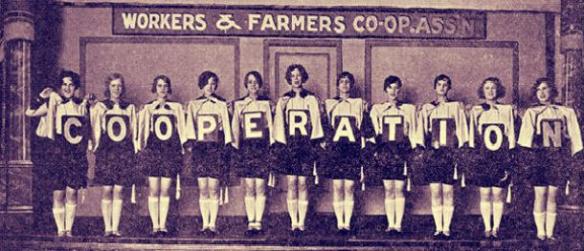
Socialism, Marxism and the Question of ‘Worker Cooperatives’ - Wilberg on Wednesday

A Brief Introduction


Peter Wilberg, June 2018


Why is the question so important?

  1. Because worker coops and cooperative federations are not a marginal or fringe phenomenon: “More than 1,2 billion cooperative members, one in every six people on the planet, are part of any of the 3 million co-operatives in the world! The Top 300 cooperatives and mutuals report a total turnover of 2,1 trillion USD, according to the World Co-operative Monitor (2017).”
  2. Because the question has, for centuries, been at the centre of many intense and still ongoing debates around what does or does not constitute ‘socialism’ and/or ‘communism’.
  3. Because the question is referred to many times in Marx’s writings, for example in his writings on the Paris Commune, in Capital and in his Critique of the Gotha Programme.
  4. Because the question is central to understanding the essence of Marx’s critique of capitalism, as well as to different historical understandings of Leninism, the “Economic Problems of Socialism in the USSR” under Stalin, the Chinese economy before and after Mao, the problems of Cuba, Venezuela etc. - and their relevance to all nations and regions of the planet.
  5. Because it also offers a key to understanding the key commonalities and key differences between Marxist socialism on the one hand and, for example, movements such as syndicalism, anarcho-syndicalism and also ‘national-syndicalism’ (the latter represented by National Socialism, Italian Fascism and Spanish Falangism).
  6. Because it allows socialists and communists to apply Marxism to critically evaluate both past and present forms of worker coops (whether on a local, municipal, regional, national or international level) as well as the historical evolution, status - and future - of both national and international cooperative federations across the globe.
  7. Because, for all these reasons, the question itself cannot - in principle - be a merely marginal one for socialist and communists. Indeed it is only through the analysis of the question of worker coops (and the considerable literature around them) that socialist and communist parties and movements can come to state clearly what ‘socialism’ and ‘communism’ actually mean in practice, how they can (or cannot) be achieved - and therefore offer working people a clearly thought out and practical ‘road’ to the realisation of socialist and communist ideals, not just in the future but in the immediate context of their economic, social, family and community lives.


Current entry points into the question

For comrades unfamiliar or not fully up to date with the history of the question, and not in a position to study all the literature on it, I recommend the following videos on present-day cooperatives as both a stimulus to inquiry and as a starting point for the historical and critical issues I will discuss. The first two videos are just a few minutes in length. The second are 50 minutes or less - but time well spent.

'Reimagine work' with Leeds Bread Co-op | The Hive

The Mondragon Cooperatives in the Basque Country

Mondragon, A Basque Cooperative

TOGETHER - How cooperatives show resilience to the crisis


Critical questions

Here I list just a few of the many questions raised in the scholarly and Marxist literature regarding worker coops, particularly in relation to the Mondragon example:


What did Marx and his contemporaries think about worker cooperatives?

What were their chief disagreements about socialism and worker coops?

Do cooperatives serve a valuable function in overcoming the alienation of labour?

What is the role, if any, of socialist political thinking in the cooperative movement?

What are the chief criticisms levelled against the Mondragon cooperative corporation?

What is the relationship between capital, management and labour in such large scale intercooperatives?

What is the main difference between worker cooperatives and nationalised or ‘state owned enterprises’?

How can coops and intercooperative groups maintain their principles within a global capitalist economy?

Can they replace the capitalist law of production for profit and exchange with simple production for use?

What sort of relationship is needed between coops and economic planning in a fully socialist economy?

What would the role of the state be in this relationship - or would it be wholly subsumed by civil society?

Would a complete dominance of cooperative enterprises over capitalist ones constitute socialism itself?


What did Marx have to say?

“The co-operative factories run by workers themselves are, within the old form, the first examples of the emergence of a new form, even though they naturally reproduce in all cases, in their present organization, all the defects of the existing system, and must reproduce them. But the opposition between capital and labour is abolished there, even if at first only in the form that the workers in association become their own capitalists, i.e., they use the means of production to valorise their labour. These factories show how, at a certain stage of development of the material forces of production, and of the social forms of production corresponding to them, a new mode of production develops and is formed naturally out of the old...”

“Capitalist production has itself brought it about that the work of supervision is readily available quite independent of the ownership of capital. It has therefore become superfluous for this work of supervision to be performed by the capitalist. A musical conductor need in no way be the owner of the instruments in his orchestra, nor does it form part of his function as a conductor that he should have any part in paying the ‘wages’ of the other musicians. Cooperative factories provide the proof that the capitalist has become just as superfluous as a functionary in production as he himself, from his superior vantage-point, finds the large landlord.”
Capital, Vol. 3

“But there was in store a still greater victory of the political economy of labour over the political economy of property. We speak of the co-operative movement, especially of the co-operative factories raised by the unassisted efforts of a few bold ‘hands’. The value of these great social experiments cannot be overrated. By deed instead of by argument, they have shown that production on a large scale, and in accord with the behests of modern science, may be carried on without the existence of a class of masters employing a class of hands; that to bear fruit, the means of labor need not be monopolized as a means of dominion over, and of extortion against, the laboring man himself; and that, like slave labor, like serf labor, hired labor is but a transitory and inferior form, destined to disappear before associated labor plying its toil with a willing hand, a ready mind, and a joyous heart. In England, the seeds of the co-operative system were sown by Robert Owen; the workingmen’s experiments tried on the Continent were, in fact, the practical upshot of the theories, not invented, but loudly proclaimed, in 1848.

At the same time the experience of the period from 1848 to 1864 has proved beyond doubt that, however, excellent in principle and however useful in practice, co-operative labor, if kept within the narrow circle of the casual efforts of private workmen, will never be able to arrest the growth in geometrical progression of monopoly … It is perhaps for this very reason that plausible noblemen, philanthropic middle-class spouters, and even keep political economists have all at once turned nauseously complementary to the very co-operative labor system they had vainly tried to nip in the bud by deriding it as the utopia of the dreamer, or stigmatizing it as the sacrilege of the socialist. To save the industrious masses, co-operative labor ought to be developed to national dimensions, and, consequently, to be fostered by national means. Yet the lords of the land and the lords of capital will always use their political privileges for the defense and perpetuation of their economic monopolies.”
Inaugural Address to the International Working Men’s Association, 1864

“Yes, gentlemen, the Commune intended to abolish that class property which makes the labor of the many the wealth of the few. It aimed at the expropriation of the expropriators. It wanted to make individual property a truth by transforming the means of production, land, and capital, now chiefly the means of enslaving and exploiting labor, into mere instruments of free and associated labor.”
“...if united co-operative societies are to regulate national production upon a common plan, thus taking it under their own control, and putting an end to the constant anarchy and periodical convulsions which are the fatality of capitalist production – what else, gentlemen, would it be but communism...?”

“In a rough sketch of national organization, which the Commune had no time to develop, it states clearly that the Commune was to be the political form of even the smallest country hamlet, and that in the rural districts the standing army was to be replaced by a national militia, with an extremely short term of service. The rural communities of every district were to administer their common affairs by an assembly of delegates in the central town, and these district assemblies were again to send deputies to the National Delegation in Paris, each delegate to be at any time revocable and bound by the mandat imperatif (formal instructions) of his constituents … The unity of the nation was not to be broken, but, on the contrary, to be organized by Communal Constitution, and to become a reality by the destruction of the state power which claimed to be the embodiment of that unity independent of, and superior to, the nation itself, from which it was but a parasitic excrescence.”
On the Paris Commune

“There can therefore be nothing more erroneous and absurd than to postulate the control by the united individuals of their total production, on the basis of exchange value, of money ... The private exchange of all products of labour, all activities and all wealth stands in antithesis ... to free exchange among individuals who are associated on the basis of common appropriation and control of the means of production.”
Grundrisse

"The German Workers' party, in order to pave the way to the solution of the social question, demands the establishment of producers' co-operative societies with state aid under the democratic control of the toiling people. The producers' co-operative societies are to be called into being for industry and agriculture on such a scale that the socialist organization of the total labor will arise from them."
Gotha Programme

Marx’s critique:

"... what does "control by the rule of the people of the toiling people" mean? And particularly in the case of a toiling people which, through these demands that it puts to the state, expresses its full consciousness that it neither rules nor is ripe for ruling!”

“That the workers desire to establish the conditions for co-operative production on a social scale, and first of all on a national scale, in their own country, only means that they are working to revolutionize the present conditions of production, and it has nothing in common with the foundation of co-operative societies with state aid. But as far as the present co-operative societies are concerned, they are of value only insofar as they are the independent creations of the workers and not proteges either of the governments or of the bourgeoisie.”

“Freedom consists in converting the state from an organ superimposed upon society into one completely subordinate to it; and today, too, the forms of state are more free or less free to the extent that they restrict the "freedom of the state". The German Workers' party — at least if it adopts the program — shows that its socialist ideas are not even skin-deep; in that, instead of treating existing society (and this holds good for any future one) as the basis of the existing state (or of the future state in the case of future society), it treats the state rather as an independent entity…”


Commentary on Marx

“On several occasions Marx declared himself strongly in favour of cooperative firms, maintaining that their generalised introduction would result in a new production mode. At different times in his life, he even seems to have been confident that cooperatives would eventually supplant capitalistic firms altogether. Lenin also endorsed the cooperative movement and, in a 1923 work (entirely devoted to this subject), he went so far as to equate cooperation with socialism at large. More precisely, besides describing cooperation as an important organisational step in the transition to socialism, he explicitly argued that ‘cooperation is socialism’ (Lenin, 1923). All the same, ever since the time of the Paris Commune the cooperative movement has received little attention from Marxists.” Bruno Jossi

To which one might add that contemporary cooperatives and their federations appear to give little or no political attention to Marxism or even to the very idea of socialism as an economic system actually based on worker coops - and not just a new ‘business model’. This was not true of Father Arizmendi, the Catholic priest who founded Mondragon, and whose ideas on cooperatives came not only from Catholic social theory but also from the works of Karl Marx and the English cooperativist Robert Owen - whom Marx clearly approved. Yet as we have already seen in his Inaugural Address, Marx himself was not also without reservations as to limits of cooperative labour operating within capitalism:

“... however, excellent in principle and however useful in practice, co-operative labor, if kept within the narrow circle of the casual efforts of private workmen, will never be able to arrest the growth in geometrical progression of monopoly … To save the industrious masses, co-operative labor ought to be developed to national dimensions, and, consequently, to be fostered by national means.”


This in turn raises two further questions:


  1. What does it mean to foster cooperative labour by “national means” and develop it to “national dimensions” in a global economy almost universally dependent on international supply chains?
  2. What is the role of the state in developing cooperative labour to national dimensions? More specifically, Is the “Dictatorship of the Proletariat” referred to in The Communist Manifesto a new form of national state apparatus or a form of national economic planning and governance, that needs to evolves directly and democratically from the economic base of civil society - for example using the political power of ever larger communal federations of cooperatives themselves to overcome bourgeois opposition, and involving also a process of progressive seizure of hitherto capitalist-owned means of production?


“In Marx’s view, the Paris Commune ‘supplied the Republic with the basis of really democratic institutions’ and could therefore be looked upon as ‘the political form, at last discovered, under which to work out the economical emancipation of Labour’” (Marx, 1871, p. 334). It brought about ‘the expropriation of expropriators’.” Jossi

Marx also seemed adamant that freely associated labour organised in the form of worker cooperatives cannot, by definition, be something forcefully imposed on labour using any form of coercive state apparatus. This is not surprising, since forced labour of any form goes directly against the essentially democratic principle of socialism - that of freely associated labour, i.e. liberated and emancipated labour. Yet in both The Communist Manifesto and its two preceding drafts - both written by Engels - reference is made to the state - to nationalised state banking and credit, nationalised state enterprises, state funded housing, education and healthcare etc. In the end however, the issue of the state is inseparable from that of the planned national organisation of production. This is also where the contradictions faced by cooperative-based corporations such as Mondragon come to the fore.


Marxism and Mondragon

No objection can be raised about cooperative workers training in the skills necessary to become experienced enterprise managers and/or simply hiring managers and technical experts - managers who can be fired at will.In the case of Mondragon the use of trained or experienced managers has also not led to or been accompanied by huge pay differentials between manager or technical experts and workers - the maximum ration being 7-1 (nothing compared to the 350-1 or more differential between top managers and workers in capitalist enterprises). There is not a situation in which a few capitalist amass money at the expense of the many. And yet there are inherent contradictions to the operation of Mondragon, the key to which lie elsewhere:

1. Class differences and surplus value extraction

This occurs through the division between ‘members’ with participative ownership and voting rights in a Mondragon coop and employees of that coop. There is large variation in the proportion of members to employees, but the question still remains as to why Mondragon’s employees are not encouraged to become members - instead of remaining a type of reserve labour with lesser rights and benefits. So long as this division remains, surplus value which goes principally to members is still extracted from the employees - not least the expanding number of outsourced foreign employees of Mondragon. In this way the coop members become collective capitalists (coopitalists’).

2. Surplus value extraction from national and international supply chains

It is an established business rule of Mondragon that all its manufacturing cooperatives seek to obtain the machines and component parts they require at the cheapest price and best quality available in the global capitalist marketplace. In this way the Mondragon cooperatives benefit also from surplus value extraction from workers in the capitalist plants manufacturing those machines and parts. This is also a key issue when it comes to envisaging any form of broader level or national planning in a cooperative socialist economy. Here the socialist principle must be the abolition of commodity production and exchange. This does not mean a return to ‘barter’, but rather the establishment of cooperatives which freely produce the raw materials, machines and parts required by other cooperatives. This means placing the principle emphasis on developing cooperative production of the means of production, rather than simply its products.

“ ... The private exchange of all products of labour, all activities and all wealth stands in antithesis ... to free exchange among individuals who are associated on the basis of common appropriation and control of the means of production.” Marx

In a planned socialist cooperative economy, each coop would be freely provided with the ‘inputs’ its requires from other coops - thus abolishing the intermediation of barter, commodity production - and money. It may take a lot of time to establish cooperative networks and federations which enable this Marxist and socialist principle to be applied in practice, but to rule it out in principle is already and de facto a surrender to capitalism - in contrast to a socialist planning which would determine how many coops require a specific raw material or ‘widget’ for the production process - and establishing sufficient coops, both industrial and agricultural, to provide it. In this way also the vagaries of capitalist competition, pricing, supply and demand would cease to affect coops in the way that they have already done to the detriment of Mondragon - leading to the bankruptcy of its flagship enterprise, along with increased dependence on employee labour paid only according to (globally) average socially necessary labour time.


3. Value and Values

Mondragon was founded not only on a set of economic principles but also on values transcending purely economic value. These spiritual values - such as working class solidarity - were part and parcel of Basque ethnic culture - but they have declined in a new generation of student-managers and cooperative entrepreneurs being trained the Mondragon university - principally through a failure to teach them not only managerial skills but also the history, principles and values of Marxism, socialism and communism. To be sure, Mondragon has its own cooperative rhetoric and instruction manuals in the principles and values of worker coops, but these lack any broader socialist political perspective or ideology. At the same time the image that Mondragon seeks to projects to the corporate capitalist world is based on a purely managerial rhetoric and jargon of exactly the same sort that every capitalist corporation employs to promote itself in the global marketplace.

4. Depoliticisation and the Alienation of Labour

The depoliticisation of Mondragon is one reason I believe, that many researcher have found no difference in the day-to-day experience of many of its members as well as their employees. For though some may mimic the rhetoric of cooperative ‘values’ and ‘principles’ based on its perceived benefits, interview-based research has shown that many experience their work as no less alienating and no more fulfilling or ‘empowering’ than in capitalist enterprises. How can it be otherwise, with the decline of working class solidarity and values and the lack of anything more than a diluted rhetoric of ‘humanity at work’ - one lacking any national, let alone international political conception or vision of socialist transformation.


Socialism and the End of Money

There is no reason in principle, why, if a communal or national socialist federations of cooperatives includes (as it must do) retail cooperatives, workers should not be paid by labour-time vouchers instead of money. These are vouchers which lose their value as soon as they are exchanged for food and other retail products. “Unlike money, vouchers cannot circulate and are not transferable between people. They are also not exchangeable for any means of production hence they are not transmutable into Capital. Once a purchase is made the labour vouchers are either destroyed or must be re-earned through labour.

Such a system is proposed by many as a replacement for traditional money while retaining a system of remuneration for work done. It is also a way of ensuring that there is no way to 'make money out of money' as in a capitalist market economy.” Wiki

Through vouchers labour time is directly exchanged for products without the intermediation of money, which thus loses its status as a commodity in itself. This would put a final end to commodity exchange even on the most basic level of M-C (Money>Commodity), not to mention C-M-C and M-C-M.

Then again, the voucher system reflects the Marxist principle that, in a socialist economy, labour and production is not only based on freely associated labour but also on free production - with products distributed solely for use or need and not for money or value exchange. Because of this the question of how the retail enterprise itself will ‘pay’ for the products it gives to other workers for their labour vouchers is not a real question at all - for the socialist retail cooperative too, would receive its products freely from all the other cooperatives that produce them.

Robert Owen and Marx both advocated the use of labour ‘Vouchers’ or ‘Certificates’.

“...the individual producer receives back from society—after the deductions have been made—exactly what he gives to it. What he has given to it is his individual quantum of labor. For example, the social working day consists of the sum of the individual hours of work; the individual labor time of the individual producer is the part of the social working day contributed by him, his share in it. He receives a certificate from society that he has furnished such-and-such an amount of labor (after deducting his labor for the common funds); and with this certificate, he draws from the social stock of means of consumption as much as the same amount of labor cost. The same amount of labor which he has given to society in one form, he receives back in another.”


On the Funding of Worker Coops

Marx was sceptical about the willingness of capitalist governments to sponsor worker coops - a scepticism no longer entirely justified in Europe. In addition, there are already a considerable number of advisory organisations, cooperative banks and loan funds and credit unions across Britain, Europe and other parts of the world set up to help and finance worker cooperatives (see here for examples in the U.S.). For more information on setting up and financing coops in the U.K. go to www.uk.coop see https://twitter.com/CooperativesUK Community and municipal shareholding can also play an important part in financing coops. Direct worker funding of coops is both alternative or complementary way of financing them. Worker coops are essentially ‘member owned’ as well as member controlled. A ‘member’ as opposed to an employee of a Mondragon coop, for example, is a worker who has contributed a fixed amount of funding - either right from the start or, if they lack the means, by accepting deduction from wages to make up his or her contribution to funding the coop. In this way the members do, as Marx pointed out, become their own ‘capitalists’, operating in competition with capitalist enterprises set up through capitalists in the essential sense, i.e. owners of capital who invest in labour-employing companies.

In this context it is important to distinguish financing organisations purely for coops from the type of bank which serves and forms part of the Mondragon Corporation. For this bank also operates nationwide across Spain - and according to the usual principles of capitalist banking. It has the ultimate power to withhold capital from the Mondragon cooperatives, thus once again giving capital the upper hand over labour. It is also important to distinguish worker coops from nationalised or State Owned Enterprises of the traditional ‘socialist’ sort, such as those created in the USSR by abolishing worker councils in 1920. But there is no reason why, in principle, a socialist government should not directly support the setting up and financing of worker coops, partly through the buyout or nationalisation of capitalist enterprises - but only if these coops are not forced to use their labour to pay the costs of any buyout to former or foreign capitalists. It could also be argued that state promotion of small or medium sized industrial cooperatives - and not only agricultural ones - could perhaps have helped the Soviet Union to make up for the emphasis of State Owned Enterprises on heavy industry at the expense of consumer goods.

In general then, it is important to distinguish ‘nationalisation’, which passes ownership from capitalist to the state, from the use of state and government to establish planned national and international federations of coops - all of which remain under the democratic control of the workers in each coop. This is not to say that nationalisation cannot or should not play a key role in terms of financing the basic social and economic infrastructure of a socialist economy - for example through the nationalisation of transport, existing water and energy supplies etc. But by far the most significant role the state can play is the nationalisation of banking and money creation itself - thus ceasing to make it dependent on borrowing from the current capitalist finance and private banking sector - which currently issues and controls the entire money supply of nations in the form of ever accumulating and ultimately unpayable debt. In the end, however, all socialist state or government measures should be seen as transitional to a fully ‘communist’ economy - in one in which income from labour time (“...to each according to his work”) ceases to play any role at all and is replaced by the principle of “from each according to his ability and to each according to his need”. In such an economy the in-built necessity, under capitalism, for the continuous expansion of production and accumulation of capital - something which goes together with the ever-increasing production of ‘use values’ for which there is actually no meaningful use or need at all - will also cease. In contrast, as Marx states in Capital, “...the methods of production employed by capital..drive towards unlimited expansion of production, towards production as an end in itself…” Finally, as regards methods of ‘planning’ of a socialist cooperative economy, one might paraphrase Lenin and say that rather than communism being “soviet power plus electrification” it is “soviet power plus computing” - for the internet now offers many ways of coordinating cooperative production which do not require a large vertical bureaucracy of the sort on which planning in the Soviet economy was reliant.


Links

www.uk.coop

https://www.uk.coop/the-hive/

https://en.wikipedia.org/wiki/British_co-operative_movement

http://www.europeansharedtreasure.eu/detail.php?id_project_base=2013-1-IT2-GRU06-51896


Further critical Marxist analysis of worker coops

https://www.jacobinmag.com/2016/03/workers-control-coops-wright-wolff-alperovitz/

https://systemicdisorder.wordpress.com/2013/11/13/capitalism-limits-cooperation/

https://louisproyect.org/2009/12/06/the-myth-of-mondragon/

Tuesday, 19 June 2018

Thoughts on Marx and the Free Press

Thoughts on Marx and the Free Press 
by Carl Barjer


Matter is the precondition of mind's possibility; and vice versa. As Marx well knew, the Bible was a balm, with a god made up by men to make life more tolerable. In the beginning was the word of men, with which they wrote god into mental existence; 'He' resides exclusively in the minds of the men who created 'Him'.

Marx was right about some stuff, wrong about others; but his work is shot through with honest endeavour. Communism was to come at the end of a process that would've dissolved corporations and withered away the state.

Marx adamantly, explicitly supported press freedom. What later came to be called 'Communism' perverted Marx's ideas.


What Marx knew, and we're seeing today, is that capitalists, when left to their devices, will create a system where power and wealth becomes concentrated in fewer and fewer hands.

'The World’s 8 Richest Men Are Now as Wealthy as Half the World’s Population'
http://fortune.com/2017/01/16/world-richest-men-income-equality/

That means a small minority enjoy considerable freedom, while a large majority are constrained, restrained, chained. One thing Marx failed to foresee, is how major a role debt would come to play in later stage 'capitalism'. Most of the masses are enslaved by new masters: mortgages, credit owners, loan sharks, etc.

Big bank takes little bank; the latter's now suborned to the former.

Marx's support for "press freedom" was principled and practical. As subsequent revolutions showed, unless you take the people with you - by educating and freeing them to achieve class consciousness - the a 'socialist' state will soon become as oppressive as the one it replaced.


EVERY society that attempted a premature and violent revolution, soon abandoned Marx's ideas, and imposed new variants on age old forms of oppression. Monarchs, aristos and priests were replaced by 'strongmen', tyrants and dictators. Instead of 'dictatorship' of the proletariat, new elites were formed to dictate to, and reimpose oppression over, the proles.

Marx opposed property. Communal living means everything is there for everyone to enjoy, as and when they need it. They are collectively and individually free; the one facilitates the other. For 'socialism' to transform into 'communism', the state (and the oppression that goes with it) must whither away


'Communism' refers to a post state, communal society, where people collectively make use of the products of their work; and control the means they collectively produce goods and services with.

'Corporatism' refers to control by certain groups, in their interests, at the expense of society in general.

Bourgeois 'capitalism' refers to control of the means of production by a minority, who own property.


All isms are impossible, in a sense; such is the nature of ideals. But those who used the term 'Communism' in reference to their regimes, abused it absolutely.

'Corporatism' was established as a reaction, and opposition, to supposed 'Communism' and 'socialism'.

'In the last half of the 19th century people of the working class in Europe were beginning to show interest in the ideas of socialism and syndicalism. Some members of the intelligentsia, particularly the Catholic intelligentsia, decided to formulate an alternative to socialism which would emphasise social justice without the radical solution of the abolition of private property. The result was called Corporatism.

'The basic idea of corporatism is that the society and economy of a country should be organised into major interest groups (sometimes called corporations) and representatives of those interest groups settle any problems through negotiation and joint agreement. In contrast to a market economy, which operates through competition, a corporate economic works through collective bargaining..

'Under corporatism the labour force and management in an industry belong to an industrial organisation. The representatives of labour and management settle wage issues through collective negotiation. While this was the theory in practice the corporatist states were largely ruled according to the dictates of the supreme leader.'

Examples: 'Fascist' Italy, Nazi Germany, Franco's Spain, Peron's Argentina, New Deal USA (under Roosevelt).


“Freedom of the press… is a kind of beauty, which one must have loved to be able to defend. It is something which I love truly, whose existence I feel to be essential, to be necessary to me so that without it I cannot live at peace, or live a full life”.

But does this follow?

“ Hence we not only opposed censorship of the workers’ and radical press, but would also have ‘made objections no less earnestly’ to bans on the reactionary, monarchist and anti-Semitic press. “

The press, for Marx, was to be of the people, for the people, by the people. Most of what masquerades as the press today would be rejected as a mockery of the term. To quote Lenin:

““Freedom of the press” … is a deception while the best printing presses and the biggest stocks of paper are appropriated by the capitalists and while capitalist rule over the press remains, a rule that is manifested throughout the world all the more strikingly, sharply, and cynically, the more democracy and the republican system are developed, as in America for example.

“The first thing to do to win real equality and genuine democracy for the working people, for the workers and peasants, is to DEPRIVE CAPITAL OF THE POSSIBILITY OF HIRING WRITERS, BUYING UP PUBLISHING HOUSES AND HIRING NEWSPAPERS. And to do that the capitalists and exploiters have to be overthrown and their resistance suppressed.

"In capitalist usage, freedom of the press means freedom of the rich to bribe the press, freedom to use their wealth to shape and fabricate so-called public opinion.

“In this respect. too, the defenders of ‘pure democracy’ prove to be defenders of an utterly foul and venal system that gives the rich control over the mass media. They prove to be deceivers of the people who, with the aid of plausible, fine-sounding, but thoroughly false phrases, divert them from the concrete historical task of liberating the press from capitalist enslavement.

“Genuine freedom and equality will be embodied in the system which the communists are building and in which there will be no opportunity for amassing wealth at the expense of others, no objective opportunities for putting the press under the direct or indirect power of money, and no impediments in the way of any working man (or groups of working men, in any numbers) for enjoying and practising equal rights in the use of public printing presses and public stocks of paper.””

In a Marx/Lenin sense, what we mostly have in the UK is a press more akin to a capitalist state-controlled one, than a free one. It needs replacing, rather than regulating. Creating a free press would require proactive, revolutionary and sustained effort.

Wednesday, 23 May 2018

Thoughts on China's Economic Agenda for 2018 - Wilberg on Wednesday


As a Marxist, I believe it is the firm duty of the CPC to represent the interests of farmers and the industrial and white-collar proletariat in private capitalist corporations - as they did before 1949. If they don't, who will? China will then just be selling out its own workers to foreign and domestic wage-slavery.

The capitalist class would very much like the CPC to serve its exclusive interests rather than  those of the people - just as 'democratic' governments in the West do. The CPC must do the opposite - use its authority to protect the proletariat and migrant farm labour from abuse by foreign and domestic capitalist corporations - and severely punish those corporations which defy regulations on minimum wages, impose unhealthy working conditions or economically enforced and excessive overtime.

I was very disappointed that the panel in this discussion used nothing but the language of capitalist economics and not one single element of Marxism in analysing the economic challenges and the future of economic development in China - particularly in the light Xi Jinping's recent and renewed emphasis on the enduring scientific truths of Marxism. The CPC has vastly and successfully accelerated the first stage of capitalist development - what Marx called the 'primitive accumulation of capital' through migration of labour from farms to factories - as well as further stages of capitalist development such as the concentration of private capital in ever larger corporations. And in his great work 'Socialism, Utopian and Scientific' Engels stressed that the final stage - state capitalism - provides the foundations upon which the transition to socialism, i.e. full state and social ownership of the means of production based on can proceed - accompanied by the Communist-led promotion of ECONOMIC democracy and working class control of the management of corporate enterprises - thus ensuring that they serve the people and not just profit. The 'visible hand' must gradually replace the 'hidden hand'. Foreign and domestic capitalist interests will necessarily work to subvert this staged Marxist and CPC led process - not least through promoting the dominance of speculative finance capital over industrial capital, the state and the people. Beware of JP Morgan and Goldman Sachs!

A debt-based state economy can only be avoided by holding to the central policy of 'The Communist Manifesto': 'the centralisation of credit in the hands of the state' - in this way maintaining China's sovereign national right to issue its own money without debt and submission to the international finance capital. The People's Bank of China has so far managed directly and indirectly to protect this basic right and maintain control of the money supply, since its 'debt' is purely notional (see  See Ellen Brown on 'Funding Infrastructure: why China is running circles around America.' )

If the privately run banking system  can create money from nothing - as the Fed and other privately owned central and commercial banks in the West freely admit to doing - so can the PBoC, but in order to invest it in the real economy and in the labour and welfare of the people (for example through state funded healthcare, unemployment security and affordable state-built housing). Its task is not like that of capitalist central banks like the Fed - which creates money to bailout the very Wall St. banks that own and control it.

The biggest threat to China is the coming collapse of this whole Western-style privately owned central and commercial banking system - from which both the state and people are forced to borrow money created from nothing. In every respect it is the duty of the CPC and its leadership to ensure that 'Socialism with Chinese characteristics' means exactly that: the evolution of 'SOCIALISM with Chinese characteristics'. Only through economic policies founded on Marxism and Scientific Socialism, which alone can recognise and overcome real economic and also CLASS contradictions facing China (let's be true Marxists and not avoid talk of class contradictions) can the great objective of Communism be fully achieved by the CPC. I was happy to hear Xi Jinping reaffirming this truth. So less reliance on capitalist economic 'experts' and more study and application of Marxist economic analyses please!!!

UNRWA are terrorists

The SMPBI has been campaigning since the 7th October Massacre in Israel for the paliarstinan terrorists to be exposed for the murdering filt...