Tuesday, 17 April 2018
BASIC INCOME AND THE WELFARE STATE– SOME IDEAS AND REMINISCENCES
by Ian RM
Overview
At various times in history, there was either no social welfare system at all, or one which depended on spontaneous or systemized charity: individual alms-giving in the Christian, Muslim, Buddhist, Hindu and other traditions; more organized supply of food, shelter or money as in the ancient Roman dole, Renaissance attempts at poor relief and the cheerless “workhouses” of 19thC England (which in fact continued in places in some form or another until the Second World War and the emergence of the postwar Welfare State).
It is a matter for historical debate whether organized “welfare” in Europe started with the mediaeval Roman Catholic church or in the 19thC with Bismarck, who set up in Prussia and then in the unified Germany a system not unlike those which emerged later in other European countries (eg in the UK under Lloyd George) and further afield: for example, Uruguay had one of the most generous “welfare” (social security) systems in the world until it collapsed in the 1970s under the weight of its expense.
However, the Roman Catholic and other religious and other non-State providers of “welfare” rarely give out money. They supply, variously, food, shelter, education and medical help.
The more modern “welfare” systems, eg in the UK, were based on the idea of social insurance: during a working lifetime, you paid in; in periods of unemployment, disability, sickness, old age, you were paid out. In the UK, this has become largely notional. Some tax is still designated as “National Insurance” payment but of course is just an extra type of income tax, fed straight into central funds and not in any way ringfenced.
Some anecdotal evidence
Like many people of my age (b. 1956) in the UK, I had to request State assistance occasionally in the past. This is or was far more common than generally supposed. The writer J.K. Rowling, now supposedly worth £100 million, has described how only the more generous –compared to today– social security of the 1990s enabled her to sit in cafes (partly to keep warm) with her baby, and to write the stories that not much later became Harry Potter. More egregiously, the vampire of Britain’s social security system, Iain Duncan Smith, has admitted that he claimed social security after having left the Army (ignominiously, having only achieved the rank of lieutenant after six years). In fact, Smith, or as he prefers to be known, Duncan Smith (the Duncan not being part of his original surname), claimed social security under false pretences, making him a hypocrite as well as what Australians apparently call a “dole blodger” and (as seen in the scandal of his fake CV and Parliamentary expenses) a fraud.
Certainly, there are those who abuse the social security system. In the past, that was far more common, because the almost Stasi level of control and surveillance that now exists for claimants in Britain had not then been put into place. The system was itself less punitive, less quick to demand impossible levels of enthusiasm for what is now and vulgarly called “jobseeking”.
I knew one woman, a citizen of the Soviet Union, who, having run away from her husband in New Zealand, came to the UK and claimed social security (including disability benefits). How could this happen? Well, her ex-husband, though resident in New Zealand, had a British passport (was British citizen) and had the right to reside in the UK. That meant that his estranged wife could do likewise, even though she had no other connection with the UK and had never even landed there! In fact, that woman never had a job (beyond odd occasional part-time jobs teaching Russian conversation at evening classes). She was supplied with monies for being slightly disabled (kidneys), monies for not having a job, monies for having two children of school age. She was also supplied with free housing. I encountered that person in 1981. She was, I heard, still collecting from the “British taxpayer” in 1996 and is almost certainly still collecting (now State Pension too!) in 2017…All monies legally-obtained, without fraud of any kind.
Another case. A young man (in the mid-1990s), from a very affluent family, who, nonetheless, was “unemployed” and so received whatever unemployment benefit was called then, as well as Housing Benefit for the large flat he occupied in Marylebone, London. In fact, the flat was owned (under cloak of a private company) by the young man’s mother (who lived in Surrey), while the young man had his own freelance work as both a designer and a male model. In this case, there certainly was some kind of dishonesty, both on the part of the young man and his mother. I doubt that they could do the same today, but I last heard of them over 20 years ago, so do not know.
The above two examples seem to show abuse of a system, but here is another case from the 1990s; less obvious, less easy to judge: a single mother of a school-age child, she about 40-y-o, with no relevant educational qualifications. This lady had a small, indeed micro, informal business, making coffee and selling home-made sandwiches to the ladies having their hair done at a large London hairdressing salon. A “Trotter’s Traders” enterprise (“no income tax, no VAT” etc…). About £200 profit on a good week, but more usually less. Not enough to live on, even then, paying Central London rent. That lady was getting State benefits as a single mother; she was getting Housing Benefit too. Now it could be said that she was “defrauding” the State, but her earned income was not enough to live on without State help. Had she given up her private work, the State would have saved nothing, the economy generally would have suffered from her not earning and spending, she and her son would have suffered considerably.
Basic Income
For me, the answer to the above lies in Basic Income, a certain amount paid to every citizen (nb. not to everyone just off the boat, or those who have walked through the Channel Tunnel). The level at which it is set will be, inevitably, contentious. Some will end up with less than under the existing system of State benefits etc. However, it has the merit of certainty. Everyone knows that x-amount will be paid weekly or monthly; those over a certain (to be decided) income can have the Basic Income payment clawed back via the tax system. It may be that everyone should also get free local transport.
The benefits of Basic Income are several. Every citizen will have the basic wherewithal of life: food, shelter, transport etc, without being forced to jump through hoops, without being bullied or snooped upon. The State will save vast amounts on administration, salaries of penpushers, maintenance of useless and expensive building such as (another vulgarity) “jobcentres”. There will be little scope for fraud and deception, because everyone under a certain income will get the same amount. If society wants to provide the disabled, sick etc with more than the basic amount, then an assessment programme (decent, honest, not cruel, unlike the existing ones) can be put into place for that.
This is obviously the way to go.
Monday, 16 April 2018
Should We Prepare for Social Collapse?
SHOULD WE PREPARE FOR SOCIAL COLLAPSE?
(by Ian RM, originally written in December 2016, and in the light of the ramping up of the endless war - the War OF Terror which was ushered in with the US Bombing of the World Trade Centre on 11.9.01 - a timely posting)
We read of those, especially in North America, who are termed “preppers”, people preparing for various forms of disaster (nuclear war, an asteroid hitting the Earth, inability of the State to maintain civil order) leading to social collapse, either with rampaging and desperate hordes of displaced people everywhere or with a mere few “survivors” from whatever calamity has struck. We in Europe tend to laugh at these American excesses (as they seem to us), but perhaps we should be less amused and more cautious.
Naturally, there is a huge difference in geographical and demographic norms. The wide open spaces of much of the USA and Canada contrast starkly with Europe, particularly the UK, with its centuries-old man-altered landscapes, densely-populated cities and towns, lack of true wilderness (except in the North-West of Scotland).
The population density of the USA, overall, is 92 persons per square mile; that of the UK nearly 700. Naturally, that is a misleadingly simplistic picture. The most densely-populated American state, New Jersey (where I myself once lived) has a population density of over 1,200 ppsm, whereas, while the UK West Midlands region has a density of over 3,000 ppsm and Manchester over 2,000, Devon has only 172, Cornwall 154 and the Scottish Highlands and Islands only 11. On the other hand, there is the point that “crowded” (in parts) New Jersey, the 4th-smallest American state, is about the same size as Wales. The more sparsely-populated areas of the USA are often a very long way from major cities or even modest towns.
It is clear that, for the UK prepper, less is more and that the congested urban and suburban areas are to be avoided as a base. However, the distinction should be made between the hardcore prepper, who intends to live by hunting, fishing and his wits, i.e. as a “survivalist” and the person who aspires to the creation of a new society after any collapse of the existing one. The latter is therefore, almost ipso facto, a conserver of civilization and culture.
I have already blogged about the idea of forming and developing a “safe zone” or base area for UK social nationalists. I have suggested that, in terms of region, the Devon/Cornwall peninsula might be the most suitable. Naturally, when social nationalists have relocated to that zone, their lives will not consist, in the absence of immediate war or social collapse, of hunter-gatherer or subsistence farmer activities. They will do normal jobs, run businesses, smallholdings, farms and estates and in general live (in most cases) as they do in those other parts of the UK where they live at present.
I suggest the following ideas. This is not supposed to be a comprehensive list, but only a basis for one:
Food Security
Keep a stock of food to last for a year or even two. The Mormons have been doing this for a long time, certainly for many decades. There is no need to re-invent the wheel when we can learn from others who know how to do things. Here is one explanation of how the food storage system works with the Mormons:
https://mormonwoman.org/2009/08/28/ask-a-mormon-woman-why-do-mormons-store-food/
The Mormon system seems to work on the idea of having a buffer for months rather than years, but with modern canning, packing and freezing techniques it should be possible to give the people in the safe zone at least a one-year supply of food from store.
Naturally, in a rural area, agricultural and horticultural produce will be available. Members of the social-national community will no doubt own estates, farms, smallholdings. In addition, those occupying smaller residences can be encouraged to cultivate part of their gardens, grow produce on a small scale under glass etc.
An important aspect of food security is the existence of a seed bank. Individuals and families can keep their own, but the community as a whole should also maintain one.
No doubt people will be able, in hard times, to forage and to find wild food and to fish.
Energy Security
It is to be expected that, in the first instance, the houses and other buildings in the safe zone will be on mains electricity. This supply is vulnerable in the event of war, natural disaster or social collapse in the wider society.
The first necessity is to build up the supply, within the zone, of solar electricity generation and solar heating. There are buy-back schemes etc whereby the householder can even sell his excess power to the National Grid, so long as it exists. At any rate, the community within the safe zone should do everything it can to utilize this renewable supply.
Geothermal heating of homes and other buildings is possible now, if the capital is there to utilize it.
It may be possible for individual residences in the countryside to have small wind turbines too, which can both supply those homes with electricity and also put any surplus back into the National Grid or a local grid.
A further option for some farms and estates would be hydropower from rivers and smaller streams of water.
As an emergency fallback, there should be a range of off-grid options for heating homes: woodburning stoves, ordinary open fires and, for electricity generation, emergency generators run from oil or other petroleum products.
It would be useful, too, if members of the community were to stockpile emergency lighting: candles (even tealights), hurricane lamps etc, battery-operated or camping gas-operated lights, wind-up lamps and torches.
Water Security
Water supply is easier, being regional and local rather than national. Indeed, many houses and farms in rural England have their own supply from springs. However, a contingency plan must be drafted and worked out.
Communications
The Internet was designed, originally, as a means by which communications might continue even after nuclear war. Presumably, that system will continue in some form even during social collapse. If so, it might be of huge importance beyond the confines of the safe zone, in the struggle to rebuild the wider society.
The community ought to maintain a radio transmitter.
Conclusion
An article such as this cannot cover all aspects of how a decent society might survive when the wider society around it is in a state of disorder and even collapse. I have not touched upon questions of social order, for example. However, these few proposals may start running a current of thought. The proposed safe zone will have to operate on the basis that an externally-triggered emergency will probably occur before very long.
Sunday, 15 April 2018
Socialist Quotes for Sunday Reflection pt 6
CIA, 1979
.....................
It cannot be too often repeated that what destroyed the Family in the modern world was Capitalism. No doubt it might have been Communism, if Communism had ever had a chance, outside that semi-Mongolian wilderness where it actually flourishes. But so far as we are concerned, what has broken up households and encouraged divorces, and treated the old domestic virtues with more and more open contempt, is the epoch and power of Capitalism. It is Capitalism that has forced a moral feud and a commercial competition between the sexes; that has destroyed the influence of the parent in favor of the influence of the employer; that has driven men from their homes to look for jobs; that has forced them to live near their factories or their firms instead of near their families; and, above all, that has encouraged for commercial reasons, a parade of publicity and garish novelty, which is in its nature the death of all that was called dignity and modesty by our mothers and fathers.
G.K. Chesterton
....................
“Almost exactly one year to the date of 2017's purported Khan Shaykhun chemical weapons attack, a near-identical incident has now taken place outside of #Damascus, with the suspicious circumstances and timing of this disputed event raising questions about who wanted it to supposedly happen and why.”
Steven Nezar Sahiounie
#Syria #SAA
مقابلتي مع اذاعة سبوتنيك الروسية "انكليزي" وأتحدث فيها عن مسرحية الكيمياوي ودور القبعات البيض في هذه المسرحيات.
..................
[The Jews] tried to kill the principles of all religions with the same mentality in which they betrayed Jesus Christ and the same way they tried to betray and kill the Prophet Muhammad.
Bashar al-Assad
....................
The captain doesn't think about death, or life, he thinks about saving his ship,
Bashar al-Assad
....................
We don't have a lot of expectations [for Donald J. Trump] because the American administration is not only about the President; it's about different powers within this administration, the different lobbies that they are going to influence any President.
Bashar al-Assad
..........................
INTRODUCTION TO NOOMAHIA. LECTURE 6. EUROPEAN CIVILIZATION
https://www.geopolitica.ru/en/studio/introduction-noomahia-lecture-6-european-civilization
1. European civilization is based on the titanomachia. Its center is problem of Dionysus.
2. When we define Dionysus as Sun and male principle we interpret him in the perspective of Indo-European civilization. It is the apollonian Dionysus – Olympian one. He is the Son of God and belong to the Heaven. So Zeus promised to him his own throne. He is the King of future, of kingdom to come.
3. In its nature Dionysus can be different as in Chinese civilization. He can be neutral. But it can be as well cybelian, black double of Dionysus.
4. European cultures solve the problem of Dionysus – every culture in its own manner.
5. Greek solution: apollonian Dionysian synthesis.
6. But in Hellenism we encounter new dimension of the culture. The Hellenism is based on Platonism and iranism. Iranism is dualistic Patriarchy.
7. Iranian Logos is based on War of Light and the culture of waiting. The concept is: the Light comes in to the Darkness. It fights with the darkness. And it is defeated by the Darkness. It dies. It is resurrected and come in the End of Time as Winner. So the is the time, salvation, Saviour, kingdom and metaphysics of Light.
8. Rome is pure apollonian in the beginning but afterwards Hellenistic.
9. Celt culture is attracted to the very powerful cybelian pole. The Dionysus obtains here the dark features. It is Orpheus figure – the descent in the Hell.
10. German is apollonian but in the warrior version. The struggle of the heroes against chtonic giants.
11. English culture is double: celt and german. It is bipolar.
Slavs are Dionysian and cybelian – by the proximity of the pole of the matriarchy in Balkans. European peasantry is balkanic by its origins
Alexander Dugin
Saturday, 14 April 2018
THE HUNGARIAN GENERAL ELECTIONS, ANOTHER BLOW FOR THE SOROS AND THE EU GLOBALISTS OF THIS WORLD!
Report by SMPBI International Liaison Officer, Pietro
AS WE ALL EXPECTED, VICTOR ORBAN TRIUMPHED LAST WEEK'S GENERAL ELECTIONS. THERE IS NO DOUBT THAT THE MERKELS, THE JUNCKERS AND THE SOROS OF THIS WORLD ARE DREADING FOUR MORE YEARS OF HIS GOVERNMENT.
HE STARTED HIS PARTY (FIDESZ) AS A NATIONAL CONSERVATIVE PARTY BUT IN RECENT YEARS EMBRACED POPULISM AND SOFT EURO-SCEPTICISM. DURING THE 2015-2016 REFUGEES CRISIS HE STUCK OUT BY REFUSING TO BEND OVER TO BRUSSELS' AND MERKEL'S LUNACY BY CLOSING THE BORDERS AND NOT ALLOWING PEOPLE INTO HUNGARY.
HIS INFLUENCE SPREAD ACROSS THE BORDERS AS POLAND AND THE CZECH REPUBLIC ALSO ADOPTED LIKE-MINDED GOVERNMENTS. THE VISEGRAD COUNTRIES CAME CLOSER IN RECENT YEARS. POPULIST PARTIES ACROSS EUROPE WHICH ARE OPPOSED TO THE EU AND IMMIGRATION SEE HIM AS AN HERO AND SEE HIS VICTORY AS A TRIUMPH OF COMMON SENSE.
GEORGE SOROS HAS WASTED NO TIME IN SUPPORTING PRO EU AND PRO OPEN BORDERS PARTIES AND NGOs IN ORDER TO UNDERMINE ANYONE WHO DOES NOT FOLLOW RELIGIOUSLY THE GLOBALIST PROJECT.
HOWEVER, THERE IS MORE TO IT. THERE IS ONE ISSUE THAT SPLIT THE VISEGRAD IN TWO, THAT IS RUSSIA. WHILE POLAND HAS INCREASED IT'S HOSTILITY TOWARDS HIS EASTERN NEIGHBOUR IN RECENT YEARS, HUNGARY UNDER VICTOR ORBAN HAS BEEN OPENING UP AND SUPPORTS A DIALOGUE WITH RUSSIA WHILE CRITICISE THE SANCTIONS. AGAIN, MORE NIGHTMARES FOR SOROS.
THERE IS NO DOUBT THAT THE REFUGEES CRISIS DOMINATED THE ELECTIONS WHILE ECLIPSING ALL OTHER ISSUES.
FOREIGN MULTINATIONALS ARE DESTROYING THE COUNTRY'S VINEYARDS - AS THROUGHOUT THE EU - THEY ARE BUYING THEM AND TAKING THE WORK OUT OF THE COUNTRY. BECAUSE THE EU FAVOURS WINE COMING FROM SPAIN, LOTS OF OTHER WINE PRODUCING NATIONS HAVE BEING SUFFERING. THAT IS ONLY ONE EXAMPLE.
FIDESZ WAS IN FAVOUR OF THE EU WHEN IN 2004 HUNGARY JOINED. EVEN NOW DESPITE ALL HE STILL DOESN'T HAVE ENOUGH COURAGE TO LEAVE NEITHER THE EU NOR NATO. THIS IS SOFT EURO-SCEPTICISM. ANYONE WHO BELIEVES THAT THE EU CAN BE REFORMED IS DELUSIONAL AND CHASING AN IMPOSSIBLE DREAM.
HOW ABOUT NATO? WELL, BEING IN THAT ORGANISATION IS LIKE GIVING AWAY THE KING AT A CHESS GAME.
THE ARMY WILL BE EQUIPPED WITH AMERICAN WEAPONS, US BASES IN YOUR COUNTRY AND BE SENT TO FIGHT FOR A ZIONIST WAR IN THE MIDDLE EAST MILES AWAY WHICH HAS NOTHING TO DO WITH YOUR INTEREST. BRUSSELS AND WASHINGTON WILL SHARE THE ACTUAL COMMAND OF THE ARMED FORCES.
ORBAN UNFORTUNATELY DOESN'T WANT TO PULL OUT OF THAT!
BUT WHO IS THE MAIN OPPOSITION PARTY? BECAUSE THIS IS THE SMASHING NEWS OF THIS ELECTIONS.
THE SOROS SPONSORED PARTIES CAME IN AT THIRD, FOURTH AND FIFTH PLACE. THE FORMER LEADING MNSZP CENTRE LEFT SOCIAL DEMOCRATS ONLY MANAGED TO PULL 12% AFTER BEING SMASHED BY JOBBIK A TRULY ANTI-GLOBALIST, ULTRA-NATIONALIST (NOT SOCIALIST UNFORTUNATELY) FORCE.
JOBBIK PULLED 18% COMING SECOND PLACE AFTER FIDESZ. THEY ARE FAMOUS FOR STANDING AGAINST GYPSY GANGS IN LOCAL NEIGHBOURHOODS BUT THERE IS MORE TO IT. THEY ARE HARD EURO-SCEPTICS AS THEY WANT TO LEAVE THIS PRISON (EU), THEY WANT TO LEAVE NATO AND GET CLOSER TO THE EURASIAN ALLIANCE. IT'S LEADER GABOR VONA SAYS THAT "HUNGARY IS ONLY TEMPORARILY ON A PASSAGE THROUGH THE EU, WHILE IT'S FUTURE IS IN THE EAST".
ANOTHER JOBBIK MEMBER TALKED ABOUT CHANGING FROM THE CET TIME TO THE EASTERN TIME.
JOBBIK IS MORE RUSSIA FRIENDLY ORIENTATED THAN FIDESZ.
IN THE MIDDLE EAST THEY ARE VERY MUCH PRO-PALESTINE, PRO-HEZBOLLAH AND PRO-IRAN. IN DEEP CONTRAST WITH THE WESTERN CIVIC NATIONALISTS WHICH TEND TO BE PRO-ISRAEL.
ALSO, THEIR NATIONALISM IS NOT CIVIC BUT ETHNO. THEY FOLLOW TURANISM, AN EXPLICIT HUNGARIAN IDEA ROOTED IN THE COUNTRY'S NATIONALIST PARTIES.
JOBBIK IS THE PARTY OF THE HUNGARIAN YOUTH AS THE MAJORITY OF IT'S MEMBERS ARE UNDER 30. THEY WORKED LOCALLY AND OFFER AN ALTERNATIVE TO THE OTHERS. IT EVEN STARTED AS A YOUTH ORGANISATION BACK IN 2003.
THERE ARE DIFFERENT FACTIONS IN THE PARTY, SOME MORE MODERATE, SOME MORE RADICAL PLUS A SIGNIFICANT THIRD POSITIONIST ONE.
CONCLUSION:
WITH SUCH A PARTY ON THE RISE AS THE MAIN OPPOSITION WE ONLY HAVE TO SEE IF IT COULD LEAD TO SOMETHING. TIME WILL TELL. FOR AS MUCH AS THE GLOBALISTS COMPLAINED ABOUT ORBAN, WELL NOT ONLY HE WON BUT THERE IS ALSO A RADICAL NATIONALIST PARTY WHICH DESTROYED TO PIECES THEIR FAVOURITE, TAKING AWAY THE ROLE OF THE MAIN OPPOSITION ONE.
Friday, 13 April 2018
Guild Socialism: An idea which must not be consigned to history
The following is from GDH Cole, written in 1922. More than a historic document, we can see this as an idea which was not implemented, but which is worthy of study. Guild Socialism sits happily alongside Syndicalism as a means of making Workers' Control a reality. Capitalism has failed. The Trotskyite mirror of Capitalism has wreaked much damage in the Socialist movement. GHD Cole, speaking to us from 1922, offers something uniquely British, and strangely something both historically sound, and revolutionary.....
GUILD SOCIALISM, the name given to a school of socialist thought which originated in England early in the 20th century, and has since spread to other parts of the world, particularly to the English-speaking countries—the United States, Australia, New Zealand and South Africa—and to Japan. As its name implies, it had, in the minds of those who originated it, a definite relation to the forms of industrial organization which existed throughout the mediaeval world, and it was an attempt to apply to the solution of modern industrial problems certain of the principles which were in active operation in the economic organization of mediaeval society. This does not mean that Guild Socialism is an attempt to restore the mediaeval guild system, or that it has any necessary relation to the restoration of a system of hand craft in place of the modern system of machine production. In harking back to the mediaeval organization of industry, Guild Socialists for the most part have in mind not the forms of production which prevailed in the Middle Ages, but the mediaeval principle of industrial self-government.
The origin of the Guild Socialist movement is to be found in The Restoration of the Gild System (1906), a book written by A. J. Penty, the well-known architect and craftsman, and in an article published at about the same time in the Contemporary Review by A. R. Orage, editor of the New Age, which was, during the following decade, very closely associated with the guild propaganda. In both these articles Guild Socialism appeared in an essentially preliminary form, and the emphasis was laid, far more than by the more recent guild writers, on an actual restoration of the mediaeval system. Mr. A. J. Penty, who has perhaps the best claim to be regarded as the originator of the modern guild movement in this form, took the craftsman's point of view and set himself in direct hostility to the modern systems of large-scale production and trading.
From 1906 to 1912 the guild idea developed gradually and almost unnoticed in the columns of the New Age; but during this period a gradual transformation of the theory was taking place, and the emphasis was coming to lie, not upon the return to craft organization or the restoration of a system closely similar to that of the Middle Ages, but upon the utilization of the modern trade-union and working-class movement as the basis for a system of industrial self-government, directly related to modern conditions and to large-scale production. During this stage the propaganda for the “restoration of the gild system” was developing into the propaganda of National Guilds, the emphasis on the word “National” indicating the necessity for a different kind of guild system corresponding to the “National Economy” of modern times.
This transition was made definite, and the first attempt to expound the new guild theory as a complete system of socialism began to be made in the New Age in 1912, when a series of articles, subsequently reprinted in the volume, National Guilds, which was written by S. G. Hobson, and edited by A. R. Orage, was published week by week. It was with the publication of these articles that the guild theory first became a definite force in the British socialist movement.
While this process of theoretical development was going on the situation in the British industrial world was rapidly changing. The earlier years of the 20th century were years of comparative industrial tranquillity, during which the main attention of the working-class movement was concentrated on political questions and on the building-up of the Labour party. From 1909 and 1910 onwards, however, a big wave of industrial unrest passed over the country. Big strikes broke out in a number of the most important industries, and a great stimulus was given to the movement for wider industrial combination. This industrial ferment also served to arouse a corresponding ferment in the realm of ideas. New socialist theories, based mainly on the working-class industrial organizations, sprang rapidly into prominence, and in particular the “Industrial Unionist” ideas, which had entered Great Britain from America a few years earlier, and the syndicalist ideas derived from contemporary developments in the French labour movement, gained for a time a large number of adherents and excited vigorous controversy. It was in the midst of this controversy and of this industrial ferment that the guild idea developed from a “Utopian” plan for the restoration of mediaeval conditions into the outline of a practical policy of industrial self-government, appealing particularly to the British organized working-class movement. The transition, however, was not fully completed with the publication of the “National Guilds” series of articles in the New Age; for the influence of the New Age, although it was during these years steadily growing, reached only a comparatively narrow circle of intellectuals in the middle and working classes. It was when a group of the younger men took up, from 1913 onwards, the wider dissemination of these ideas, particularly through the then newly founded Labour paper, the Daily Herald, that the movement began to exercise an influence over larger circles. This wide appeal, moreover, also resulted to some extent in a transformation of the Guild Socialist theory itself. The theory became steadily less Utopian and remote; and its advocates applied themselves more and more to a study of actual, pressing trade-union problems, and to the working-out of proposals for the “next steps” to be taken.
Up to this point the guild movement had remained entirely unorganized, save for the small degree of cohesion secured through the medium of the New Age. It was in 1914 that the idea of creating an organization for the propaganda and study of Guild Socialism in England first took shape at a private conference of the younger Guild Socialists. This led, at Easter 1915, to the formation of the National Guilds League, which immediately set on foot an active propaganda in the working-class and professional movement. There is no doubt that this propaganda was largely helped by the conditions of war-time industry. Workshop problems were constantly arising owing to the operation of dilution and to war-time changes in the methods and forms of production. This situation served to awaken a critical spirit in the workers, and made them more ready to listen to plans for a change in the industrial system.
It is legitimate to say that by 1921 the guild propaganda, while it had not made any direct appeal to the larger masses of the workers in Great Britain or other countries, had come to exercise a powerful influence over a steadily growing number of the younger local and national leaders of the Labour movement and in the professions. This influence could be seen in the changing policies and programmes both of trade unions and professional associations and of socialist societies. For example, the Miners' Federation, which before the war advocated a measure of nationalization of the mines which would have placed them under direct State administration, laid before the Coal Industry Commission, in 1919, a scheme which was in substance an adoption of the Guild Socialist proposals for industrial self-government. Similar influences have been at work in other industries, notably in the post-office, on the railways and in the building industry. The influence of the Guild Socialist propaganda has also been considerable in the professions, and especially in the teaching world; while in the sphere of socialist organization the policy and programme of the Independent Labour party, the Labour party and other organizations have been largely changed so as to incorporate the idea of control of industry by the workers more or less on the lines advocated by the Guild Socialists.
The National Guilds League, which is the only organization directly representing the Guild Socialist movement in Great Britain, defines its objects in the following terms: “The abolition of the Wage System, and the establishment by the workers of Self-Government in Industry through a democratic system of National Guilds, working in conjunction with other democratic functional organizations in the community.” An examination of this definition will serve to indicate clearly the main ideas upon which Guild Socialism is based.
The central idea, undoubtedly, is that of self-government in industry. The guild propaganda is above all connected with the advocacy of a change in the system of industrial administration which would result in placing the power and responsibility of administration in the hands of the workers engaged in each particular industry or service. Guild Socialists have always stressed the point that by “workers” they mean not simply the manual workers engaged in industry, but the whole necessary personnel. Indeed, the oft-used phrase “workers by hand and brain” seems to have been coined by the Guild Socialists, and was used by them from the beginning of their propaganda. They have stressed, moreover, not only the need for common action by all the workers “by hand and brain,” but also the need for the recognition, in any form of democratic industrial organization, of vital functional differences between one grade of workers and another. The democracy which they have advocated has been not the government of industry by indiscriminate mass voting, but a system in which power and responsibility would be definitely related to the particular function which each individual or group of individuals is called upon to fulfil in the service of the community.
The central idea of Guild Socialism is thus the idea of functional democracy, or, in other words, the application of democratic principles to the organization of all forms of industry and public service. This advocacy is closely combined in Guild Socialist propaganda with a critique of the current conceptions of democracy. Guildsmen are fond of pointing out that the present forms of democratic organization, which may be called, for short, “parliamentary democracy based on universal suffrage,” are not in reality democracy at all, and do not in fact provide for the direction of the affairs of the community by the positive wills of its members. They urge that it is useless to look for effective democracy in the political sphere as long as the principle on which industry, which so largely dominates men's lives in modern communities, is organized is the principle of autocracy, or, at best, of fundamental class divisions. In this aspect their teaching may be regarded as a precise application of the Marxian “materialist conception of history” to the criticism of modern parliamentary democracy. If industry is democratically organized, they hold that real democracy in the political sphere will follow almost as a matter of course; but, as long as men, in their daily work, are compelled to submit to external dictation and have no recognized voice in the ordering of their service, these class conditions, they hold, will inevitably reproduce themselves in the political sphere. Guildsmen say that “economic power precedes political power.”
The central object, then, of the Guild Socialists is to establish democracy in the sphere of industry, and thereby to secure that it shall be applied throughout the whole sphere of social organization. In advocating such a change they recognize that their hope of success rests on relating their ideal definitely to actual movements existing within the world of capitalism, but capable of being so transformed as to supplant capitalism and replace it in the organization of industries and services. They have therefore always based their propaganda directly upon the organizations which the manual and professional workers have created for the purpose of protecting their interests and improving their position under the wage system, and they have sought to persuade these organizations to accept the principle of industrial self-government, and to work for the realization of it by endeavouring, in proportion as their power increases, to extend their actual control over capitalist industrialism. Mention has been made above of the transformation which has taken place in the programmes of many trade unions and other working-class bodies, largely under the influence of Guild Socialist ideas. The members of these bodies, from regarding the purpose for which their organizations are built up as limited to the protection of their members' interests under the wage system in face of those by whom they are employed or the securing of useful legislation, are gradually broadening their conception of the function of these organizations so as to include the assumption of direct “control” and responsibility for the organization of industry. Nor is this influence manifest only in the changing programmes of the working-class organizations, but also in their positive policy and action. It was particularly plain in the “shop stewards' movement” in the British engineering and kindred industries, which, during the war, endeavoured to establish in the workshops a wider measure of direct trade-union “control of industry.” It is also manifest in the widening of the range of industrial disputes, and in the putting forward by the unions of claims which involve the recognition of their right to interfere and negotiate on behalf of their members in connexion with questions of “discipline” and “management.” It appears further in demands that foremen and supervisory workers should be members of the trade unions, and even that they should be appointed by, and responsible to, those who have to work under them.
The most remarkable outcome of the guild propaganda, and also the only important practical experiment which the Guild Socialists have so far been able to make, is to be found in England in the Building Guild movement. Towards the end of 1919 a movement arose, largely fostered by the local branch of the National Guilds League, among the building operatives in the Manchester area, for the formation of a guild which would be prepared directly to undertake work, especially on behalf of the public authorities, in the sphere of house-building. A local Building Guild organization, governed by representatives from the local management committees of the various building-trade unions, was set up in the Manchester area, and the movement spread very rapidly throughout the country, so that during the following year something like a hundred local Building Guild committees, linked up in a central organization, were brought into being. These guild organizations proceeded to make tenders to the local authorities for the carrying-out of the housing schemes which were then being brought forward in most parts of the country, and after some difficulty the Ministry of Health was induced to sanction a limited number of contracts on an experimental basis. In March 1921 work was already proceeding on about 20 such contracts.
Some of the difficulties which arose in the starting of the Building Guild movement serve to illustrate very clearly certain of the fundamental principles underlying the Guild Socialist movement. When the Building Guilds first tendered for contracts they were asked by the local authorities and by the Ministry of Health, as a private contractor would have been asked, what “financial guarantees” they were willing and able to give. They replied that they would give no financial guarantee, even if they were in a position to do so, since their intention was not to produce for profit, but to produce for the public absolutely at cost price. There is in the constitution of the Building Guilds not only no provision for capital or for interest or profits, but a definite clause which prohibits the distribution, under any circumstances, of any form of dividend or bonus or profit to the workers. This is one of the features which clearly differentiate the Building Guild movement from the movement for “Coöperative Production” with which it is sometimes confused. In their refusal to give financial guarantees the Building Guilds stressed the fact that they were in a position, as a private contractor was not, to give a “labour guarantee,” i.e. a guarantee that they could and would supply all the labour, including technical and supervising ability, necessary for the execution of the job. Stress has been laid, throughout the guild propaganda, on the idea that the power of the workers is based on their possession of a “monopoly of labour,” and the Building Guild movement itself is based on this monopoly, largely possessed by the trade unions which control the Building Guilds.
In the second place, difficulties arose because the Building Guilds firmly insisted that all workers employed by them must have security against unemployment, and must receive full-time wages irrespective of bad-weather conditions which so often cause an interruption of building work, of sickness, and of the other factors which serve to make the wages of the worker, especially in the building industry, vary so largely from week to week, and thus throw him into a position of permanent insecurity. This condition was accepted in the contracts actually signed by the Building Guilds and endorsed by the Ministry of Health; but considerable trouble subsequently arose over it in consequence of the opposition of the building-trade employers, who regarded it as “preferential treatment.”
This point is very important, and is fundamental to the whole guild theory. In the statement of objects of the National Guilds League quoted above, it will be noticed that the Guild Socialists set out first of all to secure the “Abolition of the Wage System.” A part of what they mean by this is that the conditions under which the workers at present receive wages involve permanent insecurity and are therefore degrading, and such as to place the worker at the mercy of the “governing class in industry.” Guildsmen, therefore, have always made the principle of “continuous pay,” or, as it is sometimes called, “industrial maintenance,” a fundamental part of their propaganda. They have insisted that all those who are willing to do service for the community have a right to continuous pay in return for that willingness to serve, and that the maintenance of the “reserve of labour” is a necessary and legitimate charge upon the various industries, and forms a real part of their costs of production. This principle of “industrial maintenance” has undoubtedly been one of the most favourably received and influential aspects of the Guild Socialist policy.
Guildsmen thus claim the recognition, not only of the principle that the responsibility for industrial administration should be placed in the workers' hands, but also of the principle of economic security for every worker in the widest sense. They recognize fully that this involves changes far more fundamental than any mere alteration of the machinery of industrial administration. They are not simply Guildsmen: they are also Socialists. They are in agreement with other schools of socialist thought in holding that it is necessary to transfer the means of production and distribution and exchange from private hands to some form of communal ownership. They are, however, strongly hostile to the older schools of collectivism or “State” Socialism, which contemplate the nationalization of industry in a sense which would involve its direct administration, after transference to public ownership, by the governmental organization of the political State. Guildsmen have always laid great stress in their propaganda on the evils of bureaucracy and political control in industry; and their system of direct workers' control is put forward as an alternative to State administration.
This, however, does not mean that they hold that the entire control of the various industries and services ought to pass into the hands of the workers organized as producers. They have always contemplated the exercise of direct producers' control over administration in close conjunction with a control over policy in which the representatives of the organized citizen-consumers would have an effective voice. This is what they mean when they say that self-government in industry will be exercised through guilds “working in conjunction with other democratic functional organizations in the community.”
Guildsmen differ in their conception of the precise changes which are required in order to give effect to this principle. They are united in recognizing that the working-class coöperative movement is destined to play an important part as the representative of the organized domestic consumers in the society to which they look forward. But there is much difference of opinion amongst them concerning the character and role of the State. The majority in the National Guilds League has taken a view concerning the State which is closely similar to that of the Marxians. They regard the State as a form of capitalistic organization—“an Executive Committee for administering the affairs of the whole capitalist class”—and they look forward to its supersession “by forms of organization created by and directly expressing the will of the workers themselves. . . . It (the N.G.L.) holds, however, that the exact form of organization required in any country cannot be determined in advance of the situation which calls it into being.” There is a minority, however, in the Guild Socialist movement which holds that the State is capable of adaptation to the function of acting as the political representative of the community in a state of society in which economic organization is based on the Guild Socialist principle of industrial self-government.
The Guild Socialist theory concerning the precise forms of socialist organization which would replace the present machinery of industry and the capitalist State is still in the making, or rather, to some extent, in the unmaking. Different Guild Socialist writers have put forward different views on this question; and on the whole the recent tendency of the Guild Socialist movement has been towards the abandonment of any attempt to define at all precisely the structure of the future society, and towards a concentration rather upon the principles and policies which are to guide the transition to it, preserving only in general outline a common conception of the character of the future organization. The movement has undoubtedly been influenced, as it has been sharply divided, by events in Russia from 1917 onwards. The National Guilds League in England has affirmed its “solidarity with the Russian Soviet Republic,” but has refused to commit itself as an organization to Communist principles, or to declare for the adoption, in Great Britain, of methods similar to those which the Communists have applied in Russia. It is important to point out that the Guild Socialists and their organization, the National Guilds League, must not be regarded as a party or group at all parallel to other socialist organizations such as the Independent Labour party or the Communist party. Guild Socialists in many cases belong to, and work within, one or other of the socialist parties; and they are held together not so much by a common attitude on the question of socialist political policy, as by a common belief as to the principles which must guide the making of the new society— principles which are compatible with varying views as to the policy which it may be necessary to pursue in the political field. Differences on this question of method have not prevented the guildsmen from working together in their endeavour to promote in the trade-union world, and to a less extent in the coöperative movement, a policy designed to strengthen the demand for workers' control, and to bring about substantial encroachments by the workers on the capitalist control of industry, even while the capitalist system as a whole remains in being. Mention has been made before of the development of the Building Guild organization. Side by side with this practical object-lesson, guildsmen have worked out policies for adoption in those industries in which it is not possible at present to establish guild organizations in rivalry with the existing capitalist system. They have supported, in the case of the railways, the mines and certain other industries, demands for nationalization, always, however, coupling their support with the demand that nationalization must be accompanied by a large measure of democratic control over administration. At the same time they have pressed, in industry generally, the policy known as “encroaching control.” “Encroaching control” means the attempt by the trade unions, while not at once overthrowing capitalism or dispossessing the present owners of the means of production, to transfer into the hands of the organized workers as many as possible of the functions of control which are at present exercised by employers or their representatives. The two outstanding forms of this propaganda of “encroaching control” are to be found: (a) in the demand put forward by the guildsmen for the election of foremen and supervisors by the rank-and-file workers; and (b) in the policy known as “collective contract.”
(a) Guildsmen are never weary of urging that in place of the present system, under which the foremen and industrial supervisors are appointed by the employers, usually from the ranks of the manual workers, the workers, through their trade unions, should take into their hands the right to appoint their own foremen and supervisors. This demand has not at present been conceded save in an insignificant number of instances; but the trade unions have taken certain steps towards it by securing, in numerous instances, the dismissal of foremen to whom their members have taken objection. The carrying-through of this policy of democratic election of foremen is closely bound up with the policy of “collective contract.”
(b) By “collective contract” is meant a scheme capable of assuming a number of different forms, under which the whole of the workers in a particular shop, factory or department would make with their employer a single agreement as to their terms of service, the amount and character of their output, and the payment for it. Instead of the present system, under which the employer engages and pays each worker individually, and appoints his own representatives to exercise discipline in the workshop, the trade unions themselves, under this system, would make a contract with the employer to supply the necessary labour, including workshop supervision, and to carry out the work required, and would thus control engagements and dismissals as well as workshop discipline. The employer, instead of paying each worker individually, would pay to the union, or to the works committee on its behalf, a lump sum, which the workers would then distribute amongst themselves in such a way as they might agree upon. By this arrangement, it is contended, the employer would be directly excluded from a certain sphere in which he now exercises control. The workers would thus not only get a valuable lesson and experience in the work of controlling industry, but would also greatly strengthen their position for a subsequent further assumption of power, which 'would involve the winning of industrial control over a wider area, including commercial as well as purely productive operations. This system, too, has not yet been adopted anywhere in full; but certain approximations to it have been made.
The guildsmen stress, in the whole of their propaganda, the need for an appeal to a new motive in industry if men are to be persuaded to put out their best efforts, and to do their best work in the service of the community. They claim that in the past, since the coming of large-scale industry, production has been secured mainly by the operation of two motives fear (of unemployment and starvation) and greed (for higher remuneration secured, e.g. by “payment by results”). They contend that these two motives are showing themselves more and more inadequate to secure the continuance of production, and that this is shown both by the increasing frequency and severity of industrial disputes, and by the diminished willingness on the part of the workers to do their best. They maintain that a different spirit can be made to prevail in industry only if two conditions are satisfied. The first of these conditions is that the worker must have a sense that, in putting his best into his work, he is serving, not the private interest of any individual, but the whole community, and that his work is being directed to that end which will most conduce to the common benefit; the second condition is that the responsibility for doing his best must be placed upon the worker himself, and that he must be given freedom, in the form of self-government, in the organization of his work. These two ideas are often put together in the phrase “free communal service,” which is regarded by guildsmen as the condition of the creation of reasonable industrial order. It is recognized that such an order would make higher demands upon the will and good-will of the mass of the people than the capitalist system; but guildsmen contend that, if the right appeal is made and the above conditions satisfied, the workers will rise to the occasion and will be prepared to do their best in the service of the public, because they will feel that they “count,” and that the responsibility for the good conduct of industry rests directly upon them. Guild Socialists always insist that the power which goes with responsibility must be diffused to the widest possible extent among the whole mass of the people, and that this is the necessary condition of democratic efficiency and healthy social organization.
References.— There is a large and growing literature dealing with Guild Socialism. See National Guilds, by S. G. Hobson; Guild Socialism Re-stated, by G. D. H. Cole; The Meaning of National Guilds, by M. B. Reckitt and C. E. Bechhofer; Old Worlds for New, by A. J. Penty; Self-Government in Industry, by G. D. H. Cole; other works by Hobson, Cole and Penty; and the various publications of the National Guilds League (39 Cursitor St., London, E. C. 4.). For hostile criticism see Guild Socialism, by G. C. Field; Our Social Heritage, by Graham Wallas; and The Case for Capitalism, by Hartley Withers. For the social theory of Guild Socialism see Social Theory, by G. D. H. Cole; Authority, Liberty and Function, by Ramiro de Maeztu; The Sickness of an Acquisitive Society, by R. H. Tawney; and Roads to Freedom, by Bertrand Russell. For its industrial policy see Chaos and Order in Industry, by G. D. H. Cole; The Nationalization of the Mines, by Frank Hodges, and the evidence volumes of the Coal Industry Commission, 1919 (evidence of Cole, Straker, Slesser, and others). The National Guilds League publishes a monthly journal, The Guildsman, in which questions of Guild Socialist and trade-union policy are regularly dealt with, and news given of the movement in various countries. (G. D. H. C.)
Source: https://en.wikisource.org/wiki/1922_Encyclopædia_Britannica/Guild_Socialism
Thursday, 12 April 2018
War in Syria as a distraction from the UK Regime's War on the People at home
In the UK, the government is in all but open war with the indigenous population. Our homeland has become the most controlled nation in all of Europe. The police have access to weaponry which would make Robert Peel turn in his grave. The blanket coverage of CCTV includes the sinister aspect of 24-hour camera-drones, ensuring that there is nowhere that we can go without being filmed. Our internet activity is recorded, as is every form of communication from traditional written post to electronic communication such as telephone calls and text messaging. Yet, the State broadcaster still has the audacity to repeat the lie that the UK is a free country!
The Establishment has no regard for the population, other than in terms of how much wealth can be extracted from us. We are slaves in all but name. Our Welfare and Social Security systems are ceaselessly being eroded. Our Education system leaves so many of those who pass through it with inadequate levels of numeracy and literacy, that it is an international joke. By deliberately ensuring that a substantial percentage of the population who have been educated by the State, do not have the qualifications necessary to work in anything other than the Service sector, the establishment has justified the need to bring ever more immigrants into the country. Mass unemployment and the import of immigrant labour, are tools of the Establishment to stifle demands for better working conditions and living wages. However, speaking of these facts in public, in anything but the most hushed of voices, is likely to result in one's arrest for a made up offence such as incitement to racism, xenophobia or anti-Semitism. But, don't worry, as the BBC is constantly telling us, our land is a democracy, and we have Freedom of Speech! Right?
As well as being reduced to impoverished, educationally-restricted and constantly monitored wage slaves (or wageless slaves) in the panoptican which our country has become, we have had the very soil to which we belong taken from us. With the demise of the Green Belt, which has protected what is left of our countryside, it is surely only a matter of time before the UK becomes a nightmare city state, such as depicted in the predictive programming of science fiction films, such as Blade Runner. We no longer have enough agricultural land with which to produce sufficient food to feed ourselves, but that's OK - the GMO cartel, Monsanto, will save us! The recent acquisition of Monsanto by Bayer Chemicals is a horrific assault on nature and the health of everyone, but the UK regime has no problem with, seeing it as a good exercise in capitalism. If, of course, one objects to eating genetically modified food which is injurious to one's physical and mental well-being, the option of death is always available. Our Establishment truly loves us.
Thanks to the corporate -owned lackeys who infest our government and its bureaucratic apparatus, in order to impose the will of global commerce, life in the UK has become a veritable Hell on Earth for anyone who has any sense of morality, pride and self-worth. If one is happy with living a life dedicated to no higher ideal than obtaining the latest inferior quality goods produced in the sweat shops of China, then the direction which the UK is travelling in should be to one's liking. That direction will see the death of culture, tradition, family etc, and an existence as nothing more than a completely controlled, barely human, corporate-owned producer-consumer. It is to spread this system to countries such as Syria, which for some reason do not wish to be part of the glorious One World Slave State, that the USA/UK's proxy terrorist armies, the FSA, Al Qaeda, Jaish al-Islam, Islamic State etc, have been mobilised.
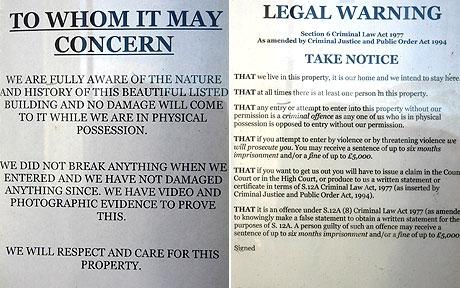
As should be expected of a regime which is more than happy to murder innocent people in their own homes; then claim that they deserved what happened to them for 'resisting freedom', the UK Ruling Class has no respect for the natural desire of people to live with a roof over their heads. In every town and city in the UK, pubs and businesses are closing at an increasing rate, forcing people out of work. This has led to an increase in the number of commercial properties lying empty, with around 1 in 4 now boarded up. Many government-owned buildings are in a similar state, and there are also increasing numbers of houses and flats which have been repossessed by the very same banks who have destroyed our economy in the first place. The reaction of the spiral in homelessness, is truly staggering. Since September 2012 it has been a criminal offence for anyone to dwell in a property to which one does not have legal permission.
The UK government justified criminalising squatting by claiming that legislation to evict squatters would help people who have had their homes broken into whilst away on holiday. Certainly, there have been rare instances of people coming home to find that people have broken in and and are refusing to leave, but the majority of the people who have to resort to squatting, are people who have been ordered from their homes by banks who have foreclosed on their mortgages, but have not left because they have nowhere to go to. The bankers themselves encouraged people to take out mortgages which they could easily default on. Of course it isn't just people with mortgages who are finding themselves homeless, robber landlords have used the cruel acceptance of the State to hike rents, which has seen many in the rented sector likewise made homeless.
The government, through its policy of allowing the construction of new housing in every conceivable location, is responsible for the destruction of the countryside, and the glut of new buildings. The new legislation will only force more people into homelessness, and will be met with the construction of new social housing, which will further scar the landscape. Those who defy the law, will be incarcerated - thus increasing the prison population by creating a new category of criminals; prisoners of debt.
The government's policy of barely restricted immigration has exacerbated the employment and housing crises which are wrecking our country, but as this increases the profits of those who own the construction companies, and the unscrupulous corporations who are able to maximise profits by reducing wages and work benefits, the human misery is of no consequence. Every policy of the government is handed down by the profiteers of the Establishment and their partners-in-crime in the multi-national corporations.
The government of the Establishment is at war with the people. In Syria, the war is more overt - with the indigenous people being killed in order to advance the economic agenda of the London regime. In the UK, the war is hidden behind mealy-mouthed political slogans, but it is no less damaging to human life for that.
SMPBI would immediately nationalise all property, reallocating the housing stock as required, for free, abolishing mortgages and rent forever, making such exploitative practises a part of history. Our long term goal would be for every family to have enough land to be self-sufficient to a high degree. In terms of what can be achieved now, we demand the return of Squatters' Rights, and we support all who ensure they have a roof over their heads in property which has been abandoned.
When you go to the polls next month, remember who created the rent sector crisis, and who gave so much power to the banks. If you can vote Socialist, do so. If not, just vote out the Tories!
Wednesday, 11 April 2018
Fishing - blame Westminster not the EU: Wilberg on Wednesday
"Boris Johnson, Nigel Farage and others like to say that the CFP has “destroyed” the British fishing industry or “halved” the number of British fishermen. In fact, in terms of profits of the big fishing companies, the British industry is one of the most successful in the EU.
If the numbers of fishermen in the UK have fallen sharply since 1973, it is partly the fault of the cod wars. It is also the result of the sale and concentration of quotas into fewer and fewer hands – something that successive British governments have permitted or encouraged.
Thus lucrative Scottish white fish quotas are now dominated by three or four multimillion-pound companies based in north-east Scotland. Worse, 50% of all English quotas and 88% of Welsh quotas are “owned” by British-flagged ships that are really Spanish or Dutch or Icelandic. One Dutch mega-trawler has the right to catch 24% of the total English quota.
Britain's fishing fleet and Brexit promises – key questions answered
Read more
By contrast, the inshore fleet – fishing within 12 miles, using boats mostly shorter than 10 metres, with much lighter ecological impact - is allowed just 4% of the total English quota. None of this has anything to do with the EU, which is why you never hear Boris Johnson or Nigel Farage complain about it. The divvying out of national quotas is purely the responsibility of national government. It is time for it to abandon its misleading rhetoric on fishing policy, and put forward reasonable proposals to Brussels.
There is a case for adjusting the 1983 EU quota pattern in Britain’s favour. There is, above all, a case for small-scale fishing communities to be given a substantial increase in their share of the British catch. That would be a genuine Brexit, and ecological, bonus – even if it has nothing to do with Brexit"
John Lichfield
Editors note:
Industrial fishing has no place in the British Isles. It destroys livelihoods and ruins the environment. The most important thing for the fishing communities and for the seas themselves is for trawlers and super trawlers to be banned from our waters. The seas ca cope with the little boats which traditionally bring home the fish - and in that instance, there is scope to share our seas. But industrial fishing is marine genocide and has to be stopped in its entirety, and until our seas recover it is the morally right thing to do, to ban all outside fishing and to stringently police our own fishing boats.
No to industrial farming, whether on land or water. All food production must be ethical and ecologically sound. SMPBI will accept nothing less than the primacy of the environment in all matters, and completely ethical farming, including the method in which the living creatures are killed to become our food.
Subscribe to:
Posts (Atom)
UNRWA are terrorists
The SMPBI has been campaigning since the 7th October Massacre in Israel for the paliarstinan terrorists to be exposed for the murdering filt...
-
by Wat Tyler The Socialist Workers Party are the product of the British education system and the media. Their obsession with the trials and ...
-
English Revolution was created in response to the need for a left-wing engagement with a rising English sense of national identity and to ...
-
There has been much speculation over the past view days as to the nature of the SWPE. As links have been posted on various sites which will...