Friday, 15 March 2019

Comic Relief - Yet more 'charity' transferring the crumbs from the poor to the rich

In 1984 in Æthiopia, one million people starved to death, with another six million at risk of starvation. The BBC began pushing images of starving children to get the public into a state of shock. Arch-europhile globalist liberal, Bob Geldof, organised the Live Aid concerts to raise money and to ensure that he gained publicity after his music career collapsed. The result was a massive £100 million raised by the general public, with more tax-payers' money given by Government. The money dispatched to Africa was syphoned off by the ruling class for funding their war against the people of Æthiopia. However, just about enough money got through to feed the starving multitude.

The masters of heart-rending propaganda at the BBC used every underhand trick to make the British people feel guilty if they didn't give money to feed the hungry. At the same time, millions were unemployed in Great Britain, and sporadic riots were breaking out. The focus of attention on Africa helped take the public gaze away from the ills afflicting the nation. Bob Geldof received a knighthood for his services to the Crown. Indeed, his help in playing on the natural empathy of the British people for the suffering of others allowed the Government to continue its globalist agenda. The people of Britain, including many of the Live Aid organisers, were manipulated for political gain.

In 2002, four million Africans were in danger of starvation.  Again the begging bowls went out, culminating in the 2005 Live8 concerts.  The result of charity globally, has been to foster a dependency culture in Africa and parts of Asia.  The constant influx of money has bolstered brutal regimes, allowing them to wage war on their own people. Food has become used as a weapon to keep the ordinary people oppressed. Another result is that many more Africans are leaving their homelands to seek a safer existence elsewhere. These people tend to be the most motivated as they are the ones who put in the effort to leave their lands. This is effectively a drain of the very people who could, if encouraged to stay, help their nations.

The BBC has been a mouthpiece of the globalist-imperialist ruling class since its inception. The propaganda they use to get people to give money to the starving millions is cynically designed to appeal to the heart, not the head. If Africans had been allowed to run their own affairs, the theft of resources by multinational capitalist corporations would have been possible and in 1984, one million people would not have been in such hunger that they died.  Many more millions who have subsequently died due to hunger or conflict would have been able to live decent lives.  Capitalism is responsible for the genocide in Africa, and indeed across the world. The people of Africa need to take control of their lands, oust the oppressive globalist-compliant corporate puppet regimes and become self-sufficient. Obviously the BBC would not want their globalist owners to lose control.

The rulers of the capitalist order want mass starvation and ignorance as it displaces indigenous populations, leading to civil disruption in the lands to which the emigrants flee. The people of Africa are being used to destroy the social cohesion of Europe, the Americas and other lands. Charities who beg for cash for food are fuelling this global catastrophe.

The BBC fund-raiser, Children In Need, is another begging mechanism which transfers money from the compassionate poor, to the parasitic rich. The modus operandi of Children In Need is to emotionally blackmail hard-pressed working class people, inculcating a feeling of guilt for not being close to starvation.  As food banks become a means for survival for many people, as homelessness becomes a massive problem, and as people are now literally starving to death in the British Isles, this emotional abuse is an absolute outrage.  Britain is one of the most highly taxed countries in the world. There is no excuse for poverty in the UK. Children In Need claims to be for the benefit of poor families in Great Britain. In reality much of the money goes abroad. Of the money which stays in the country, a substantial proportion goes to unhealthy politically motivated causes, such as funding pro-transgender sex-education (liberal brainwashing) for the very young and other trotskyite identity politic insanity.  The 'charity' Mermaids, is funded by the national lottery as well as other organisations which steal money from the most financially vulnerable - it is just one of many organisations whose actions are destructive to the youth of the nation, promoting unnecessary surgery and paedophilia.  Amnesty, Children In Need, Live Aid, Comic Relief etc - all have dark side, in fact, all have very little positive about them.

Other charities raise millions for globalist identity politics pushing causes. Oxfam is openly dedicated to transferring money to regimes in far off lands. For those who wish their money to be spent in that way, Oxfam is fine. Cafod is of a similar vein. Cancer Research funds vivisection but is at least honest about this. The problem lies with think-tanks like Common Purpose, and charities such as British Red Cross, Help the Aged etc, who purport to look after people in Britain, which to an extent they do, but not exclusively. A lot of money is diverted to politically motivated causes which ordinary people would probably not support, and to other countries. Even animal charities are not exempt from corruption and misuse of funds.

How do we deal with this misappropriation of funds? There is a saying 'Charity begins at Home'. This is where it must end too. People need to look after their neighbours, friends and relatives. By building a support network, decent people would be helped keep out of poverty. Unworthy sorts, such as heroin addicts who are given housing, benefits, food parcels etc almost as a reward for their anti-social and criminal lifestyles should be left to either sort their lives out or face the natural consequences.  As Socialists, we of course stand by fellow Socialists in every land. What we will not do, is support causes which prop up capitalist regimes and keep the working class down at home and abroad.

Ordinary people must refuse to give tax-money to prop up the banking system, fund illegal wars in the Middle East, pay for the European Union and push the degenerate liberal brainwashing of the masses. We must gird ourselves to say NO when the begging bowls come around. Even giving ten pence to these gangsters is unacceptable. Every penny given pays for our own exploitation.


If government was refused the funding and the permission to engage in political and military atrocities at home and abroad, the taxes which would otherwise go to undermining our society could be used to help our own people. The government gains its power from us. We must take that power back by refusing to give them unquestioning obedience. We must refuse to donate to charities. we can help our own people by being decent citizens. We can look after animals by giving food to the shelters, or housing those we can. We don't need faux-charities who are bleeding us white whilst helping destroy us. We are on course to living in a complete dictatorship. The choice is stark - either stand up to the petty dictators of the State and their friends with the begging bowls, or accept the absolute tyranny of the global capitalist order.


In 1984, the BBC broadcast harrowing images of Africans in Æthiopia dying of starvation. The politicians were quick to jump into the fray, stating that 'something had to be done' to alleviate the hunger, and then the phenomenon of Live Aid sprang into action, with pop music celebrities releasing the original 'Feed the World' single, followed by the massive trans-global concerts to raise money ostensibly to feed those starving to death in Africa. In 2014 we had a repeat of the 1984 Feed the World single hitting the charts (albeit one with different 'celebrities' fronting it and the emphasis on ebola rather than hunger). People in Africa were and are still dying of hunger and disease and people in the West are still being told that it is our fault. 


In 1984, the Live Aid phenomenon was used to justify external interference in Africa. Using the malleable publicity-seeking musicians to fleece the gullible general public with emotional propaganda designed to make us feel guilty for not starving whilst others were, the politicians in the 1980s used Live Aid to enact regime change across Africa in order to remove any protection the people had from globalising corporations. The largest share of the vast amount of money extracted from the working class of the European world was syphoned off by corrupt politicians and industrialists in every part of the globe, with the people in Africa receiving a meagre fraction. The causes of the Æthiopian famine were not addressed, so nothing changed to prevent future hunger and associated problems.


Just like the an Gorta Mór in Ireland, the Æthiopian Famine was not the result of natural conditions, but was caused by the theft of food from the people by those who controlled the economy; just like in Europe, the despots who condemned ordinary people in Africa to a painful death by lack of food, were people motivated by financial greed and the lust for political power. The liberals who shouted 'racism' from the rooftops and tried to make Europeans feel guilty because Africans were starving, were either indoctrinated idiots who sincerely believed that evil White people were starving Black people due to the colour of their skin, or simply liars. The starvation of the Æthiopians was motivated by a belief in money over people, and if there was an element of racism involved, it was not White versus Black (as was blatantly evident by the massive donations from ordinary White people who often themselves had very little money), rather it was the old supremacist hatred of the zionist bigots who believe they are 'chosen' by their 'god' to rule over the rest of us and profit from us even when that means killing us.


The 'race card' has been played to death in African-European relations. African-Americans in particular are taught to hate Europeans for the treatment of their ancestors in the Transatlantic Slave Trade. Europeans are taught that we must feel remorse for what our ancestors did to the Africans. The truth of the matter is that although there were some Europeans who profited by the misery of the Slave Trade, they were members of the European ruling class, and as such were people who had no concern for any members of humanity whatsoever, and rather than acting out of 'racism', their persecution of the Africans was simply a natural progression from their persecution of ordinary Europeans.  When David Lammy spouts drivel about Comic Relief being offensive because it allows white to feel they re doing something to help non-whites, his racist rubbish is just more of the same drivel which the liberal regimes have pushed for many many years.

The hated Normans who invaded England in 1066 under the leadership of William the Bastard, enslaved the Britons and others who lived in the country. The industrialists of the English, then later, British Empire, brutalised the common people, using their puppets in power to create a legal system which to this day still designates us as property of the ruling class (Subjects of the Crown). Africans were enslaved simply because they were a cheaper commodity, insofar as their enslavement didn't require a convoluted contractual and policing system . Ordinary Europeans were just as brutalised as ordinary Africans, and to suggest that we should be made to feel guilty because the people who owned us owned others with different skin tones, is incredibly offensive.

The eminent Trinidadian researcher, Professor Tony Martin, undertook painstaking research into the African Slave Trade. His conclusions vindicate the common European people from all blame, and prove that the Ruling Class in Europe, along with their Jewish, Arab and African counterparts, are wholly to blame for the evil and indefensible persecution of human beings and the treatment of ordinary people as items of property. Tony Martin was not a 'racist' or a 'white supremacist', but a sincere academic researcher. The fact that he was of African descent does silence those who seek to label all who question the official story of the Slave Trade as racists, but not because they will listen to a non-European exposing the slander against us, but because they refuse to listen! If Tony Martin had been White, he would have been defamed and attacked by the liberal bigots who form the foot soldiers of identity politics; because he was Black, he was simply ignored. To the fake anti-Racists, the work of a Black man is obviously less important than comparable work of a White man! The irony doubtless doesn't register with the globalisers whose only real contribution to the pursuit of mutual respect and equality of care, is to hate all people who oppose the destruction of sovereignty, culture, and all natural diversity, equally.

Tony Martin's lecture on the Jewish role in the Slave Trade is vital viewing as it systematically deals with the racist anti-European guilt propaganda which has been used to justify the further economic exploitation of Africa and the fleecing of ordinary Europeans by the same globalising concerns. The direct link to the video is: https://www.youtube.com/watch?v=Ut7I75Q_-zA


The exploitation of the good will of ordinary working class people worldwide in 1984, was a reprehensible display of arrogance by the people who created the famine in the first place. The Ruling Class used the racist supremacist superstitious drivel of the monotheistic religions to justify the occupation of Africa in the first place. National boundaries were torn up by imperialists who had no respect for the natural diversity of Africa. Tribes were thrown together in new States created by bureaucrats drawing lines on maps; the breakdown of these false States was an inevitable outcome if the indigenous peoples were ever to have control over their own territories again, thus the wars which have devastated Africa can be seen as a direct result of the imperialist policies of the 'European' Ruling Class. The 1984 interference in Æthiopia did not address the fundamental problems effecting that land; rather, it consolidated the rule of the corrupt African Ruling Class which is just as subservient to the capitalist money power as the enemies of the people who infest the places of power in our own countries.


Foreign Aid to Africa has increased dramatically since the 1984 Live Aid propaganda ploy of the globalist mafia. In the UK, the Government of the Bankers has ring-fenced Foreign Aid, whilst cutting back services for the general population of the country. A staggering £10.3 BILLION (0.7% of taxes extracted from the people) is given to overseas despots, with criminal and corrupt regimes taking a sizable chunk of the money stolen with menaces from people in the UK by the criminals in Westminster with the help of their uniformed thugs in the UK police. In Æthiopia, the raping, torturing and burning alive of ordinary people by the security forces of the State, has increased in direct correlation to the amount of money given by the UK Taxpayer. The brutalisation of ordinary Africans has been largely funded by Foreign Aid. But, that isn't all that Foreign Aid pays for.

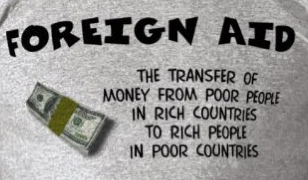
The great con of Foreign Aid is nothing but redistribution of wealth from the poor in the UK to the rich in the IMF and in the multinational corporations which are destroying the entire world. The World Bank and IMF have issued loans across Africa, on the condition that everything owned in the countries to which loans have been given, is privatised. The result has been that the economic rape of Africa has accelerated, with massive deforestation, the destruction of wildlife, obliteration of indigenous culture and the theft of natural resources and food by multinationals who don't give a damn about anything other than profit. This is pretty much what has happened in Europe as well with the EU's austerity policy.   In addition to losing everything which belongs to them, the people of Africa still have to pay back the loans issued by the IMF; the money from the loans having been squandered and stolen by the corrupt politicians - again, exactly like in Europe.  Foreign Aid is used by the corrupt politicians as a means of supplementing payments to the IMF for loans which haven't benefited anyone other than the corrupt Ruling Class and the globalist corporations. For example, in Zambia, the privatised copper mines create great wealth for the overseas speculators, whilst the people of Zambia, despite living in a land which has the third largest copper reserves in the world, live in absolute poverty, with 80% living on about £1.50 per day. Africans are taxed to the hilt to pay the IMF debt, and Foreign Aid, rather than helping the people, also goes to the same despicable enemies of humanity.

The 1984 'Feed the World' song was reissued in 2014 with new puppet performers and a few different lyrics. In 1984 the song stated 'Thank God it's them instead of You', but this line was ditched. Perhaps it was due to the fact that the UK in 2014 as now, was subject to a degree of poverty previously unimaginable, and so for many people, the misery of poverty is not something which happens to others, but something which happens to us. We have people relying upon food banks to survive; we have people dying of starvation or of hypothermia due to having to make a choice between eating or having heating; the UK is suffering 'austerity' to pay the IMF money which they have no right to anyway, whilst the Ruling Class sip champagne and laugh at us all. In spite of the hardship we are all enduring, people who have less than nothing are still scraping together money to give to the poor in Africa - and we are still being called racist!

The solution to world poverty is not pop songs, charity, or the IMF, it is jettisoning the entire apparatus of globalisation. The Banking System and Global Trade are at the root of all our woes. If the IMF debt was cancelled by means of ending that organisation in its entirety, the entire world would be better off.  In the UK, just as in Africa, the solution to poverty is the complete socialisation of the entire economy - from the largest concerns to the smallest - and the prohibition of all unearned income. This means that the Stock Exchange must be closed down, the Banks must not only be closed but those behind them punished for their crimes against humanity (in the way dictated at Nuremberg), all foreign ownership must be outlawed and the entire market ethos must be overturned in favour of a restoration of the indigenous ethos of organic British Socialism. Obviously, this isn't going to happen unless we make it happen - and there is no chance it will ever happen unless we have a complete change of outlook. We need to shed the race hatred which sees others as inferior to us and as therefore not important; we need to make a stand in favour of a real solution to the woes of Africa - absolute decolonisation and a restoration of the entire continent to its own people and of the people of the continent back to their homeland as a part of a global relocation of all peoples to their own lands.
Today is Comic Relief Day. Beginning in 1988, by 2017 over £1bn had been extorted from the working class, with poverty in Britain and abroad increasing in the same period, rather than coming down as we were led to expect.  Charity is a con.  We need to look after our own - by bring food to the homeless, by taking over squats to house people, by helping our human and animal population. none of this requires giving a penny to the BBC/State-sanctioned charity muggers. Did anyone in his or her worst nightmares ever truly imagine that the UK in 2019 would be as awful as it is? If we allow the descent into hell to go unchecked, we will look back at these days with fondness. We cannot allow that to happen.  We need a lasting solution  a revolutionary solution. We Need Socialism, for the British Isles, for the World.


Please comment at:
https://www.tapatalk.com/groups/smpbiforum/comic-relief-yet-more-charity-transferring-the-cru-t118.html

Thursday, 14 March 2019

The Brexit Betrayal - getting worse by the day

On the 23rd June 2016, the people of the UK voted overwhelmingly to leave the EU. We were told that the vote was a once-in-a-lifetime affair, and that WE would be given our say, and that say would be respected.


The lying schemers in Westminster have refused to implement the will of the people. Now, nearly three years after we voted to leave the European Empire, we are still in it, with no sign of getting any closer to freedom.

When Slovenia left Yugoslavia, it did not have to negotiate nationhood. When the Baltic States quit the USSR, they simply left.  The EU is far less democratic than the Socialist states of Europe, and has refused to accept the verdict of a people who only want to be free.  Even the hated British Empire respected the will of the people of India when that nation regained sovereignty.  Clearly the EU is a monster which is unique in history for its disgusting denial of the wishes of people it misrules over.

Last night, the Westminster regime pushed through a contrived piece of pseudo-government work, in making it impossible for the UK to leave the EU without the EU granting it a 'deal'.   This means that the traitors in parliament have made the UK a vassal of the EU, and have destroyed any semblance that the UK is a democracy.  We do not need any deal - we need to be free, and we should have been free since the 24th June 2016.


The Westminster regime - with the full support of media collaborators - has performed a pantomime over the past nearly three years. They have given the impression that there is debate as to the nature of the UK's relationship with the EU, but this is all smoke and mirrors.  Westminster is committed to keeping the Working Class down, to crushing Trades Union power, to keeping wages low and unemployment high, to ensuring the corporations who own the EU, USA etc maintain absolute power, and to keeping the UK trapped inside the globalist stepping stone of the EU Empire.

The parasites in parliament have always fought to keep the ruling class in control.  Since 1066 when the Normans came and crushed first the English, then the rest of the British, the politicians have eagerly served the imperialists who operate on both sides of the English Channel.  The Enclosures Acts denied the people access to the land, giving landowners power over the rest of us.  The ruling class will punish us for stealing food to feed our children, but they have stolen our land and our opportunity to feed ourselves.  The EU land-grab is the Enclosures Acts for the new era.

The Brexit charade has proven once-and-for-all that democracy is a sham and that the only way forward is revolution.  Labour, Tory, Lib-dem, Separatist - it makes no odds. Those who put faith in UKIP learnt with the resignation of Farage on Victory Day, that his party too was a part of the same grubby ruling class-owned puppet circus.

The Socialist Motherland Party calls for civil disobedience, for the people to refuse to play the party game any longer, for national/regional elections to be boycotted, and for closer unity across the revolutionary spectrum as a means of ending this farce.

Rise Up Britons. There is no longer even the slightest excuse for obeying their laws, for playing their game. Democracy is dead. Long Live the Dictatorship of the Proletariat.


Please comment at:
https://www.tapatalk.com/groups/smpbiforum/the-brexit-betrayal-getting-worse-by-the-day-t117.html

Wednesday, 13 March 2019

Wilberg on Wednesday - The Illness Is The Cure pt 35/46


The Practice of Life Doctoring (2)


As a practice, Life Doctoring is not simply a type of counselling or analytic ‘talking cure’. That is because its principal focus is not on the causes and ‘cures’ but on the meaning of a specific illness and specific symptoms for the individual patient. Just as importantly however, as a form of therapy its principal ‘instrument’ is not just a new body of intellectual knowledge and insights but the Life Doctor’s own lived body as a whole, their body of feeling awareness or ‘soul’. It is only in this way that the Life Doctor can come to directly sense and resonate with the underlying dis-ease that pervades the patient’s own soul and its body. Cultivating the capacity to sense the felt soul-inwardness of a patient’s body takes us to a level much deeper than intellectual insight or emotional empathy alone. For the individual’s lived body is essentially not a fleshly body of tissue and organs but a “body without organs” (Deleuze), the body of the patient’s own feeling awareness of themselves, other people and the world around them. As such it is composed of particular tones, textures and tissues of feeling awareness. Like audible vocal or musical tones these silent feeling tones or tonalities of awareness have their own distinctive qualities such as tonal pitch and tone ‘colour’, brightness or darkness, warmth or coolness, lightness or heaviness, flatness or sharpness, softness or hardness, clarity or dullness, hollowness or resonance, harmony or dissonance. They are not just echoed in vocal and musical tones but also embodied in cellular, organic tone and muscular tone. Felt tonalities of awareness or feeling tones are what not only tone and colour our moods but also determine, in a quite literal sense, the ‘sound-ness’ of our health.


Particular ‘elemental’ qualities of feeling tone however – qualities such as fiery vitality, airy spaciousness, watery fluidity or earthly solidity may be more or less dominant or lacking. Thus, in the previous case example, the Life Doctor sensed a deep quality of warmth but a far lesser degree of both fieriness and solidity in the patient’s overall feeling tone - an absence echoed also in the corresponding qualities of the patient’s tone of voice. Part of the therapy also consisted of ‘voice training’ – teaching the patient to introduce a greater solidity, strength, amplitude and quality of fiery vitality to her voice tone. This was not done though any standard methods of ‘voice coaching’ but through first attuning her to particular qualities of her own inwardly heard speech – her ‘inner voice’ and its tones – and then imparting these tones of her inner voice with particular qualities of feeling tone, volume, fullness etc. – all before vocalising them audibly.

This particular method of Life Doctoring is one of many designed to amplify the patient’s awareness of silent inner tones of feeling precisely by giving them outer expression – whether through the voice tones or silently, through their face and eyes. The basic methodological principle at the root of all these practices is the principle of ‘Morphic Resonance’, a term coined by Rupert Sheldrake but which Life Medicine understands in a very specific way - and that the Life Doctor applies through a very specific practice I term ‘Morphic Resonation’. Both the principle of morphic resonance and the practice of morphic resonation are based on the understanding that by giving expressive outer form (morphe) to particular feeling tones (in particular through the voice, face and the look in our eyes) we both amplify and bring ourselves into greater resonance with these feeling tones – and thereby with our lived body as such.

Life Medicine understands the patient’s visible ‘physical’ body as a sensory image of their soul and its body. Hence also, the patient’s body language or ‘body speech’ (silent and vocal) is not only a fundamental dimension of what Freud called ‘organ speech’ but can also be used to give form to, amplify and alter a patient’s sense of the felt mood or tone pervading their own feeling awareness and its body – their soul body or lived body:

“The outer shape of a person reflects his inner mood. Changing that shape can change his mood.” David Boadella

Here ‘shape’ has the same meaning as morphe or ‘form’ in the term ‘morphic resonation’. It can refer to anything from a particular posture, tilt of the head, or any feature, however fleeting of a person’s facial expression and the look in their eyes.

“Consciousness in another’s face. Look into someone else’s face, and see the consciousness in it, and a particular shade of consciousness.” Ludwig Wittgenstein

Perhaps the single most innovative and advanced method of Life Doctoring – and one that requires much training is practiced through extended, close-up eye contact with the patient. Here the Life Doctor uses the motility and expressiveness of his or her own face and eyes to seek for and precisely mirror particular features that he sees and senses in the patient’s face and their eyes – features that no matter how subtle or fleeting can be seen and felt to give expression to the patient’s innermost sense of ‘dis-ease’.
Through this very precise art of facial and ocular mirroring the Life Doctor can:
  1. Attune to particular tones and qualities of feeling in the patient by consciously observing and intentionally mirroring them back to the patient.
  2. Amplify both their own and the patient’s lived experience of these tones and qualities of feeling – thus bringing the patient into greater contact with them.
  3. Transform the patient’s experience of these tones and qualities of feeling, in particular by moving from a stage of mirroring the patient’s ‘emotional’ feelings to mirroring these back purely as tones of feeling – comparable to purely musical tones and their sensuous qualities.
This three-stage method of Life Doctoring I call ‘Transformative Resonance’.
In the previous case example, it was applied by the Life Doctor in roughly the following way:
  1. By the Life Doctor sensing with their lived body as a whole and then mirroring back through the look in their own eyes and face in an expressively intensified way the surface look of resignation, surrender and ‘sadness’ seen in the patient’s face and eyes.
  2. By also sensing and mirroring back in intensified way glimpses of the weakly felt ‘anger’ latent within that sadness.
  3. Sensing and mirroring this ‘anger’ back in a transformed way i.e. not merely as an ‘emotional’ feeling but as a purely sensuous feeling of power, strength and fiery vitality arising from the very core of the patient’s lived body.
  4. By imparting to the patient’s lived body as a whole the Life Doctor’s own bodily feeling awareness of this quality of fiery strength and vitality.
The recognition of the importance of the face and eyes in all forms of therapy is not new. And it must therefore play a central role in any form of therapy in which the therapist takes the client seriously as ‘some-body’ – not just a ‘talking head’. Mirroring a patient’s facial expression and the look in their eyes facilitates a process of mimesis which is central to sensing, attuning to and resonating with the patient’s lived body as a whole.

“Without … willingness to read the secret expression and to nurse it into life, any therapeutic encounter is gravely weakened.”

“Facing is concerned with recognition, with how we see people, with the qualities of lumination that develop when people really face each other and with the forms of illumination that flash out of such contact. Insight develops in step with outlook.
If a person can let his inner self be seen by another, he begins to become recognisable to himself and can then look within, not in the sense of any sterile introspection, but in the sense of learning to love and accept who he is, and so recognise himself.” David Boadella, Lifestreams

Boadella also quotes an account of Wilhelm Reich’s work with a patient who suddenly began “seeing the world with new eyes”, the fear and hate having gone out of them. As a result he also saw his therapist differently. The process began with Reich noticing a new gleam in the patient’s eyes, which…

“ …. together with the shifting of the eyes and head, had brought up a new expression out of the depths of his eyes and being. It was a flirtatious, come-hither look, a sort of wink, with a raising of the eyelids, eyebrows and forehead and a moving of the eyeballs to one side, accompanied by a suggestive tilting of the head, in the same direction. As the therapist began to imitate this expression and the patient began to make better contact with it, the whole face participated in it, at first with a blushing shame-facedness, and then to the tune of a hearty laugh.” (ibid)

Reich did not merely “face” or “confront” the patient with a verbal mirror or interpretation of what he had seen and felt in the face and eyes of the patient but used his own body to mirror it back directly – thus helping the patient to feel it more fully. As a result a “miracle” happens:

 “Suddenly the patient was startled and opened his eyes wide with astonishment. While he was looking at the therapist the latter’s face had suddenly become soft, and glowed with light…He saw the world differently, as a good and pleasurable place to be in and as a future place of ‘heaven’ and not the ‘hell’ it had been before.” (ibid)

Bodily sensing and identification is involved even in the understanding of verbal and indeed philosophical thinking itself. Wittgenstein again:
“I begin to understand a philosophy by feeling my way into its existential manner, by reproducing the tone and accent of the philosopher.”

The Life Doctor must be trained in many highly subtle and multi-faceted arts or ‘yogas’ of bodily sensing and resonance – all based on the principle of morphic resonance and allowing the practice of Transformative Resonance through ‘morphic resonation’. This training begins with cultivating the Life Doctor’s capacity to quite literally see into and experience a patient’s eyes as ‘windows of the soul’ and, through looking into them, to use their own lived body as a whole to sense, resonate with and transform the particular “shade of consciousness” pervading the patient’s own bodily feeling awareness of themselves.

It is in this way that the Life Doctor can also gain a tangible sense of those tones and qualities of feeling not fully embodied or expressed by the patient, but instead ‘somatised’ – given symbolic expression through their symptoms.

“Every feeling is an embodiment attuned in this or that way,
a mood that bodies in this or that way.”
Martin Heidegger

What distinguishes Life Medicine and its therapeutic methods from those of psychoanalysis is that psychoanalytic theory understands illness symptoms only as symbolic ‘somatisations’ of feelings that the patient is not capable of articulating verbally. ‘Somatisation’, in other words, is understood solely as a failure to give expression to unconscious feeling in words – hence the emphasis of psychoanalysis on verbalisation and verbal interpretations of the symbolism of dreams and mental images.

In contrast, Life Doctoring understands ‘somatisation’ as a failure to find ways to consciously embody feelings through the patient’s overall body language and body speech, which verbal language and speech is itself but one dimension of since it is with our bodies that we also utter words. In other words, it is not just through some lack of emotional illiteracy or ‘alexithymia’ as it is called, but also and above all through lacking a rich and expressive enough body language by which to ‘speak’ our feelings that what Freud called ‘organ speech’ is forced to take the form of illness symptoms or ‘somatisation’.

It is not just that which we cannot express in words but above all that which we cannot expressively embody that we ‘somatise’. Thus, referring back to our case example, it is not simply someone who cannot express or articulate a feeling of anger in words but principally someone who cannot simply show anger through their body speech – their posture, face and eyes - who is in greater danger of turning that anger inwards or somatising it. Indeed someone may well be capable of verbally reporting an emotion of anger (or any emotion) without or indeed instead of fully feeling it. For it is through expression in the ‘shape’ or form of their body speech that awareness of feelings (and of different tones of awareness or ‘feeling tones’) are not only given form but also amplified through resonance.

What is called ‘emotional illiteracy’ – to whatever degree it is evident and however important it is in itself – almost invariably pales in extent before the poverty of the average individual’s body language and the limitations of their most basic ‘alphabet’ of postures, gestures, vocal tones, facial expressions and ways of communicating tones of feeling through the look in their eyes. This impoverishment of body speech and body language is in itself a form of generalised pathology – since it makes almost unavoidable the expression (logos) of a felt sense of dis-ease (pathos) through illness i.e. through ‘pathological’ bodily or behavioural symptom
.

Case Example 6

Patient: a 60 year old man teaching at a college and responsible also as a community elder for care and support of young people in difficulty.
Symptoms: heart arrhythmia, fainting spells, shortness of breath.
Biomedical diagnosis : atrial fibrillation (confirmed by ECG) and fibrosis of the lungs confirmed by X-ray – possibly connected through lack of sufficient oxygen and resultant shortness of breath.
Biomedical prognosis: possibility of early death (2-3 years) through progressive worsening of fibrosis in the lungs.
Medications prescribed: propranolol, badly tolerated because of side effects and replaced by sotalol – both intended to slow and regularise heart rate and reduce shortness of breath, Warfarin to reduce risk of stroke. Statins. Drugs to treat prostate enlargement.
Possible surgical interventions suggested:
  • Heart surgery in the form of catheter ablation – used to destroy an area of the heart producing abnormal electrical circuits and resulting in disturbances of cardiac rhythm.
  • Implantation of a pacemaker to regularise heartbeat.
Principle reasons for the patient arranging to see a Life Doctor:
    • Concern about the prescribed medications and their actual or possible side effects.
    • Dissatisfaction with what he experienced as a total lack of any expression of human warmth, empathy and interest on the part of the biomedical doctor s and consultants he had seen (not one of them even asked him about his feelings regarding the possibility of death within 3 years).
    • Intrinsic interest in the approach to illness represented by Life Medicine and Life Doctoring.
Initial questions presented by the Life Doctor:
Questions regarding the patient’s life history, work and current relationship.
Questions concerning the exact life time and location, life context and situation in which the symptoms first occurred, and how the patient felt and responded to them.
Questions regarding the frequency and exact situations and locations in which the symptoms of atrial fibrillation tend to re-occur.
Initial impressions and information gained by the Life Doctor:
The patient was felt as a human being with deep and natural warmth and empathy, humour and interest in others as well as in philosophical issues surrounding both methods of counselling and therapy and medicine itself.
Elements emphasised by the patient in sharing his life history:
  • Early experiences of abandonment. His father abandoned his mother and himself when he was three years old. His mother however, who suffered from on-going withdrawal symptoms resulting from long-term dependency on psychoactive prescription drugs (benzodiazepine ‘tranquilisers’) also abandoned him in a different way. This took the form of lack of attention, empathy or sustained listening. Her resulting and constant inner restlessness, anxiety, depression and self-preoccupation expressed itself in extreme impatience if, as a child, the patient did not instantaneously reply to her questions. Not being given even a moment’s time for reflection and authentic self-expression induced a severe childhood stutter in the patient, since overcome.
  • Abandonment by the mother of his children, leaving him in the position of sole carer for three young children without any social or familial support whatsoever even from his brother or sister. This was reinforced by his sister-in-law, who refused to allow visits or even telephone calls with his brother. It was during this period that the patient’s symptoms emerged.
  • In contrast, the patient frequently emphasised how much he enjoyed the human contact with his students and how much appreciation they expressed for his warmth, humanity and overall bearing towards them – for example the way he did not ‘talk down’ to them as a teacher, but, as well as offering valuable teaching and insights, also related to them as human beings in their own right in an authentic and non-formal or role-bound way.
Initial links made by the Life Doctor between the patient’s illness and his life circumstances:
  • Life history of abandonment and the responses to it resulting from the patient’s symptoms.
  • Notably, it was only through an initial severe bout of his symptoms while living as an isolated single father that, despite his sister-in-law’s prohibitions, he took the decision to phone his brother and actively seek support.
  • The patient’s decision to write to and consult with the Life Doctor was made not just in the context of his medical diagnosis and prognosis, but also his experience (through his mother and others) of the potentially damaging effects of prescription drugs and his sense of not being treated as a human being by medical professionals. Proactively contacting the Life Doctor thus constituted a way in which the patient’s illness itself led him to enact a healthy part of himself – one that refused to surrender to many life experiences of relational isolation and abandonment.


Other felt impressions from the initial consultation:
  • The Life Doctor observed that at no point in the initial consultation did the patient say how his initial account of his illness and life, together with his current medical diagnosis and prognosis left him feeling or thinking (a question which no one, even his current partner, had at any time asked him). Instead the ‘patient’ simply took great pleasure and interest in the opportunity the consultation provided for warm, informal but also patient and therefore insight-generating communication provided by the Life Doctor himself – both as a human being and as a man of similar age with whom he shared common life values, understandings and even experiences.
  • On the other hand, the Life Doctor felt, through the patient’s downcast gaze and generally lowered lids, a bodily sense of something like an underlying mood of resignation behind the patient’s otherwise animated, open and interest-full vocal communication. The mood of resignation seemed in contrast to the proactive and healthy steps taken by the patient in response to his experiences of abandonment that his symptoms had led him to enact – leading ultimately to the pleasure and interest he took in the Life-Doctoring consultation itself and his interest in having further sessions. At the same time, the Life Doctor observed that the patient was taking more of an interest in the consultation itself than in his own feelings about his illness. Together with the sensed mood of resignation, the Life Doctor became even more curious about what the essential existential or life ‘dis-ease’ of the patient might be, particularly since the patient had also reported an acute episode of his symptoms in which he felt he might be dying – but also felt quite happy to let go and resign himself to death – therefore in effect abandoning himself.
Between life and death – the patient’s essential life dilemma:
Knowing something of the circumstances surrounding the emergence of the patient’s symptoms – and knowing also that despite the fibrosis of his lungs and occasional shortness of breath walking up steep inclines, the patient was still able to take mile-long walks without any difficulty – the Life Doctor returned in the second session to the patient’s symptoms of atrial fibrillation and asked the patient how frequently and in what particular circumstances he tended to experience them. The answer was quickly forthcoming and revealing – whenever he was at home with his current partner, towards whom he had long felt a loss of sexual attraction, who did not share any of his interests, with whom he could not discuss his work as a teacher or any deeper philosophical and life questions. Indeed it was his partner herself who – although the patient described her as very “loving and caring” – made clear that she felt abandoned by him merely by his reading a book in her presence. Lacking all forms of physical contact and sexual fulfilment from the patient led to a progressive increase in the weight gain that had first diminished his sexual desire for her since they met. However she was also limited in her willingness and capacity to openly discuss their physical relationship. This was made worse by personal and cross-cultural differences which made even attempts at mutual discussion of the future of their relationship very difficult.

Placed in the context of the patient’s radically different experience of his world of work, the picture that emerged was one of the patient inhabiting two entirely separate and contrasting life worlds. One world was the spacious, enlivening, emotionally heartening, intellectually inspiring and also libidinally restorative (if not fulfilling) world of his close, authentic and heartfelt relationships with his students and co-teachers. This was a world in which he was able to embody his deepest values and abilities as a human being, share his greatest interests and at least feel if not fulfil strong sexual desires. The other world was the narrow, enclosed and stifling world of his sexually and communicatively unsatisfying home life and relationship with his partner. For this, in contrast, was a world he experienced each day as disheartening and deadening – in contrast to the enheartening and enlivening relational world of his work and students in which he also felt ‘room to breathe’. It became clear to the Life Doctor that the bodily mood of resignation he had sensed in the patient had to do with the way the patient had resigned himself to living in these two contrasting worlds – one enlivening and enheartening, the other disheartening and deadening – leaving him with a life quite literally led ‘between life and death’. The Life Doctor shared with the patient the direct parallels he saw between this, the essential ‘dis-ease’ of the patient, and his potentially life-threatening or life-shortening heart and lung symptoms and the ‘disease’ or ‘disorders’ by which they were biomedically labelled.
The patient’s response to the life picture of his illness:
In the third session, the patient, when questioned, reported how much he had reflected on, understood and agreed with the ‘life picture’ of his illness offered by the Life Doctor at the end of the second session and how he also saw the clear relationship it revealed between his lung and heart condition and his current life situation. In this session too however, it also became clear to both doctor and patient that, in the context of his life picture of his illness, the biggest threat to the patient’s health and life lay not in any biomedically labelled condition or prognosis but rather in resigning himself to a life led ‘between life and death’, i.e. between two life worlds, the one alive and the other dead. The Life Doctor suggested that the alternative to resignation or self-abandonment in this limbo state lay in understanding the lived dis-ease and its bodily symptoms as the expression and embodiment of a fundamental life dilemma – one which demanded careful consideration and perhaps new and courageous life decisions from him, not least with regards to his relationship to and sexual life with his current life partner – with whom it became clear again that he was extremely ‘ill-at-ease’.

In this context the Life Doctor became aware, following this session, of a particular paradox of the patient’s life dilemma and the potential life decisions it demanded from him – namely that were he to leave his relationship with his partner or pursue new relationships whilst staying within it, he himself would become the abandoner rather than the abandoned. On the other hand, it was already evident that he had for a long time inwardly been afraid of or abandoned all attempts to rescue or redeem the relationship, as had his partner herself – leaving it in a state of routinized, uncommunicative and death-like limbo, one in which they inhabited separate worlds even whilst living together.

It was agreed that future sessions would concentrate on the life dilemmas and decisions faced by the patient, together with (1) on-going monitoring of when, in what situations, to what degree and how often his symptoms occurred and (2) continued discussion of whether – or which – of the several different prescription drugs he was taking were necessary. Questions of the role and potential influence on health exerted by different beliefs about death – and the existence or not of an afterlife – were also placed on the agenda for further exploration.
Observation of the patient’s mood and body language:
Last but not least, the Life Doctor felt a need to address what he felt as the patient’s underlying mood of resignation in the face of his life circumstances and dilemmas. This was expressed very strongly in the patient’s body language – in particular the tilt of his head and body, the look in his eyes and his facial expression as a whole. The Life Doctor observed that the patient tended almost invariably to tilt his head down to one side and towards his left shoulder. This was accompanied by a type of worried frown which drew his eyelids together almost completely – as if squinting in the face of a bright light – making eye contact with others impossible.

It was as if the patient had over the years got stuck in a habit of never fully ‘holding his head high’ rather than leaning it down to one side – and found it now extremely difficult to do so. His ‘downcast gaze’, in other words, had effectively become part of his body identity, as had his tendency not to open his eyes fully so that he could not ‘look people straight in the eye.

The Life Doctor responded to this by feeding back his observations of the patient’s body language, mirroring them and explaining to him the principle that: “The outer shape of a person reflects his inner mood” (Boadella) and that “Changing that shape can change his mood.”. Noting how even in close up eye contact with the patient – and despite attempts to straighten his head and neck – the patient still invariably held his head slightly tilted to one side, the Life Doctor gave the patient inter-session ‘body homework’. This took the form of suggesting that he attempt to keep his head perfectly balanced and upright for an entire day or week – and to then see and feel how ‘changing his shape’ in this way and also looking people ‘straight in the eye’ might affect his bodily sense of self and alter both his mood of resignation and resigned mode of relating. For his current posture both embodied and reinforced these – not just in his relation to his partner but also his supervising manager.
Progression and Outcomes of the Life Doctoring Sessions:
The possibility of a less resigned and more proactive mode of relating – both verbally and bodily – was heeded by the patient with good results – initially however only in the context of his relationship to his supervisor, which he approached in a new, courageous and effective way.

Though he also made attempts to move closer to his partner, these were clearly not successful, and yet they gave further insight into his heart symptoms. For on further questioning he reported that his symptoms of atrial fibrillation started or became particularly acute not just in the presence of his partner but specifically on occasions when she indicated a desire for sex. The patient described how on such occasions he experienced strong inner feelings of guilt at not being able to reciprocate in any way the love and care he felt he received from her. Rather than openly and proactively sharing these feelings of guilt with her – which would itself have at least been a token of his reciprocal care for her – he would simply say he was “not in the mood ”, hiding both his feelings and the episodes of atrial fibrillation that accompanied them. And though the patient took on board a suggestion to make time to honestly share his feelings with his partner – and his reasons for not wanting sex – he found this extremely difficult to do. He even found it impossible to offer his partner any form of affectionate non-sexual contact such as a hug. Recognising that in this way he was effectively ‘abandoning’ his partner, The Life Doctor suggested that this might be a way of acting out his own history of abandonment by others as well as being part of his general and long-term inability to experience intimate connection with women except through sexual arousal and intercourse.

With regards to the patient’s other symptom – shortness of breath – its initial diagnosis and prognosis through X-ray scans as a specific form of fibrosis of the lungs, one which might progressively worsen and even shorten his remaining life span to two years, was brought into question. For when the patient met his medical consultant again and asked why a decision had been taken not to conduct any further scans but instead to just regularly monitor the patient’s lung function capacity, the consultant effectively admitted that the initial scan was not conclusive.

As a result, the patient reported having no more worries at all about having a potentially terminal illness – since it was the seemingly premature medical diagnosis and prognosis itself that had really ‘taken his breath away’ – causing more anxiety than his shortness of breath itself. And in the course of his sessions with the Life Doctor these had become and remained so mild as to be hardly even abnormal. The patient instead reported going on long walks again – for him both a major source of pleasure in life and also his means, besides teaching, of enjoying a sense of friendship and non-sexual bonding and connection with others.

This is not to imply that the sessions of Life Doctoring constituted, in and of themselves, a ‘cure’ for the patient’s illnesses, but rather an opportunity to let them serve as a cure for the patient – firstly by showing how they expressed important aspects and dilemmas connected with past and current life and relationships, and also by urging him to find a new body identity – one in which a basic mood of resignation to life could be transformed, quite literally, by learning to ‘hold his head high’ and ‘look people firmly in the eye’.

Death by Prognosis and the ‘Nocebo Effect’
– a postscript to Case Example 6

More than two years after my work with the patient described in Case Example 6 – whose initial reason for coming to me was the fear evoked in him by having been told that given the condition of his lungs he had only two years of life left - I was most surprised to hear from him again by e-mail saying that he had once again been given a dire and dread-inducing medical prognosis – this time being told he had only one year left. The prognosis was initially given solely on the basis of a poor result from a lung function test - though, I as immediately suspected - but only much later admitted to him - this result could not in fact be regarded as evidence of anything, since it which was conducted shortly after he had a temporary chest infection. I should add here that the chest infection itself arose just after he had, once again, managed (and that in cold and damp winter weather) to take a series of 12-16 mile walks with his friends on the Pennine Way – not exactly evidence of a man whose lungs are about to give in, and that despite his lung fibrosis.

I was very shocked to hear this news – knowing that according to his first prognosis he should have already been dead by now, and that it had taken only a couple of sessions in my work with him to lift the fears it had aroused in him. Indeed it seemed to me almost as if his physicians wanted him to die just in order to once again try and prove a flawed ‘scientific’ prognosis. Knowing also how deeply depressed he was at having long since lost the teaching job that was his principal source of meaning and enjoyment in life – as well as his sole source of income – and that he had almost no chance of getting another job, I offered him free consultations – both by phone, at home in my practice and through correspondence. In the course of these I learned that his fears of dying had, this time, been even further intensified by being referred to a specialist palliative care nurse, offered counselling for terminal illness and advice on writing a Will – even to the extent of being asked whether he had a pet that he might want included in it.

My shock turned into outrage however, when I learned, furthermore, that he had attended a meeting of mutual support group for patients with the same medical condition, and that at this meeting a hospital pharmacist had addressed the group in a clear attempt to persuade them to act as guinea pigs for a new and highly expensive drug (£30,000 per patient) that might extend their lives by a few months, yet doing so even whilst admitting that this very same drug had been “poorly trialled” and had side effects such as nausea, loss of appetite and liver toxicity that could significantly affect patients’ quality of life.

I used my renewed sessions with this patient to conduct a ‘breath test’ of my own with him and also to share two important facts and research with him that he might not know of. The test I conducted was simply to feel the strength of his abdominal muscles by getting him to attempt to expand his abdomen against the pressure of my hand. The conclusion I shared with him was that a big question for me was not how well or badly he was capable of breathing (for despite his regular miles-long walking he did report occasional occasional experiences of shortness of breath) but how he breathed. That was because the result of my own test shocked me – for in all my years I had never encountered a client, student or patient with such totally flaccid abdominal muscles – or someone so wholly incapable of using these muscles – and not just his chest muscles – to breathe more fully and deeply (something I advise or train all my patients to do).

One of the important facts I shared with him was that for many years now (and although this came about principally as a result of litigation fears among United States physicians) even doctors in the U.K. National Health Service had been brainwashed to now consider it more ‘ethical’ to give their patients a worst-case figure when it came to their life expectancy. This new, supposedly more ‘ethical’ stance was confirmed by my patient’s own wife when she questioned the doctors working at the medical clinic at which she was employed.

I also shared my research into what is called the ‘nocebo effect’ in contrast to the ‘placebo effect’: a placebo being a totally inert drug that appears to work simply because the patient is led to believe and expect it will, and a ‘nocebo’ being one that has harmful effects for the same reason – its effects on the patient’s beliefs and expectations.

“The term nocebo (Latin nocēbō, "I shall harm", from noceō, "I harm") was chosen by Walter Kennedy, in 1961, to denote the counterpart of one of the more recent applications of the term placebo (Latin placēbō, "I shall please", from placeō, "I please"); namely, that of a placebo being a drug that produced a beneficial, healthy, pleasant, or desirable consequence in a subject, as a direct result of that subject's beliefs and expectations.” Wikipedia

The concept of placebo and nocebo effects however, has been extended by medical anthropologists to embrace any type of medical procedure or even any type of behaviour of communication of physicians that effects a patient’s beliefs and expectations. Thus the most effective doctors tend to be those who – in themselves and through their own way of relating to their patients, have a ‘placebo effect’ on then patients – for example by giving those patients both empathy and positive reassurance. In contrast it was all too clear that my own Life Doctoring patient was suffering from a strong and deeply troubling ‘nocebo effect’, one stemming not just from the pessimistic prognosis he had been given but the multiple bureaucratic procedures and referrals that followed it, in which a veritable army or ‘task force’ of drug companies, pharmacists, consultants, nurses and counsellors was targeted at him in a way that could only intensify his fears and negative expectations.

The concept of a nocebo effect has also been used to explain the phenomenon of ‘voodoo death’ – people dying as a result of a firm belief in the fatal powers of a witchdoctor’s spells, curses or rituals, such as ‘bone pointing’ or giving someone the ‘evil eye’. The modern definition is broader:

“Voodoo death, a term coined by Walter Cannon in 1942 also known as psychogenic death or psychosomatic death, is the phenomenon of sudden death as brought about by a strong emotional shock, such as fear. The anomaly is recognized as "psychosomatic" in that death is caused by an emotional response – often fear – to some suggested outside force. Voodoo death is particularly noted in native societies, and concentration or prisoner of war camps, but the condition is not specific to any culture or death.

Another scientist—Clifton K. Meador, MD—in 1992 discussed the case of a man diagnosed with cancer who, along with his physicians and family, believed he was dying of cancer. In the autopsy after his death, however, the doctors discovered that his cancer was not at all the cause of his death. Meador deduces that the man's belief in his imminent death was the cause of his death itself.” Wiki

A third point was made by an associate of mine, himself a practicing doctor, who reminded my patient that the medical profession comes to clinical judgements, decisions – and prognoses – on the basis of patient ‘clusters’ (i.e. statistics) rather than by assessing patients as individuals.

Together it seemed that my patient was initially much encouraged by our talks and correspondence, writing “that I cannot thank you enough for your approach, resources and commitment, it has given me a different perspective…” and “…has really helped me to view the disease differently and abate the panic attacks…” He wrote also that “My major learning lesson has been that when we are vulnerable and passive, how much power we give up…” and of his failure to meet any professional he had spoken to who had heard of the ‘nocebo effect’ – let alone to take any interest in it or even give it a moment’s thought.

Yet given the basic mood of morbid resignation towards life that had come to the fore in our first round of sessions, as well as the continued and deepening depression associated with his joblessness, general loss of meaning in life – and the fear occasioned by his ‘new’ prognosis – I was both immensely saddened and the same time not entirely surprised to learn, after just a two-month or so interval in our communication, that my patient had unexpectedly and quickly died. He did so in hospital following a recurrence of his chest infection after another round of what he still enjoyed most – walking. Yet it was his death that prompted me to write this chapter on ‘Death by Prognosis and the Nocebo Effect’, and it is to him – a most likeable, humble and gentle man, and one full of human warmth and kindness – that I dedicate it.


Please comment at:
https://www.tapatalk.com/groups/smpbiforum/wilberg-on-wednesday-the-illness-is-the-cure-pt-35-t116.html

UNRWA are terrorists

The SMPBI has been campaigning since the 7th October Massacre in Israel for the paliarstinan terrorists to be exposed for the murdering filt...